
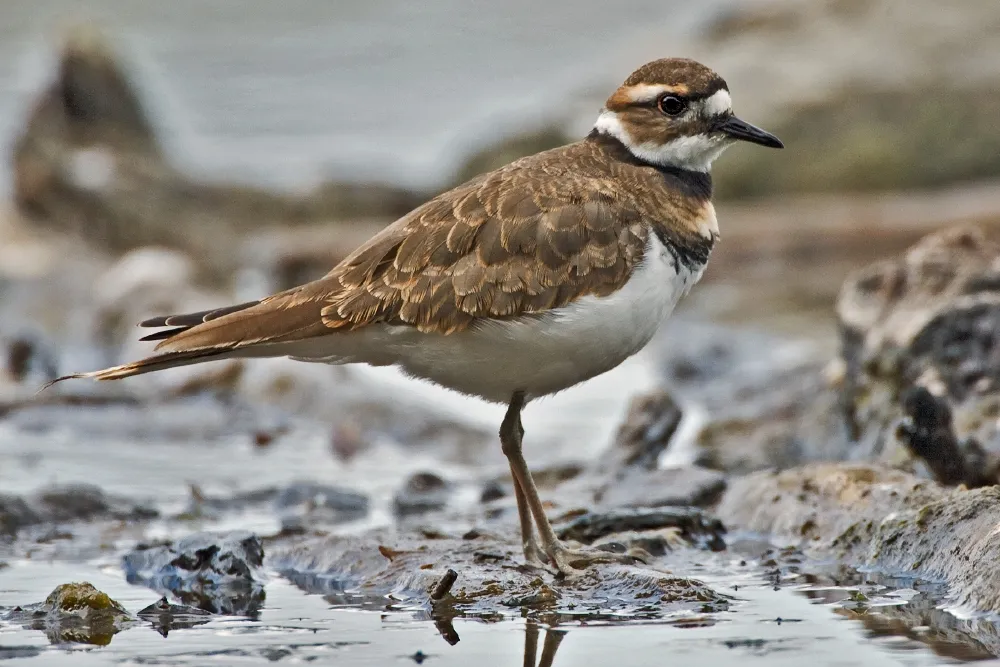
Pluvier kildir— Quebec wildlife
Charadrius vociferus
CharadriidaeNo period published by Québec.ca
Québec.ca publishes no hunting or trapping period for this species. Check the official regulations.
Wikipedia
Pluvier kildir
The killdeer (Charadrius vociferus) is a large plover found in the Americas. Its shrill, two-syllable call is often heard, sounding like "kill deer". It was described and given its current scientific name in 1758 by Carl Linnaeus in the 10th edition of his Systema Naturae. Three subspecies are described. Its upperparts are mostly brown with rufous fringes, the head has patches of white and black, and two black bands cross the breast. The belly and the rest of the breast are white. The nominate (or originally described) subspecies breeds from southeastern Alaska and southern Canada to Mexico. It is seen year-round in the southern half of its breeding range; the subspecies C. v. ternominatus is resident in the West Indies, and C. v. peruvianus inhabits Peru and surrounding South American countries throughout the year. North American breeders winter from their resident range south to Central America, the West Indies, and the northernmost portions of South America. The nonbreeding habitat of the killdeer includes coastal wetlands, beach habitats, and coastal fields. Its breeding grounds are generally open fields with short vegetation (but locations such as rooftops are sometimes used); although it is a shorebird, it does not necessarily nest close to water. The nest itself is a scrape lined with vegetation and white material, such as pebbles or seashell fragments. This bird lays a clutch of four to six buff to beige eggs with dark markings. The breeding season (starting with egg-laying) occurs from mid-March to August, with later timing of egg-laying in the northern portion of the range. Both parents incubate the eggs for 22 to 28 days typically. The young stay in the nest until the day after being hatched, when they are led by their parents to a feeding territory (generally with dense vegetation where hiding spots are abundant), where the chicks feed themselves. The young then fledge about 31 days after hatching, and breeding first occurs after one year of age. The killdeer primarily feeds on insects, although other invertebrates and seeds are eaten. It forages almost exclusively in fields, especially those with short vegetation and with cattle and standing water. It primarily forages during the day, but in the nonbreeding season, when the moon is full or close to full, it forages at night, likely because of increased insect abundance and reduced predation during the night. Predators of the killdeer include various birds and mammals. Its multiple responses to predation range from calling to the "ungulate display", which can be fatal for the performing individual. The killdeer was formerly considered a least-concern species by the IUCN due to its large range and population, but is now considered a near-threatened species due to its population decline, though the decline is not rapid enough to warrant uplisting the killdeer to a vulnerable species.
Description
The killdeer is a tall and slender plover, with a relatively long tail.Adults ranging in length from 20
Text from Wikipedia — Killdeer, revision 1361766784, CC BY-SA 4.0, retrieved 2026-09-04. Encyclopedic text reused under CC BY-SA 4.0. Sentences about hunting or regulation are removed: on this site, the rule comes from Québec.ca.
Other names
French
English
Presence in Quebec
- Origin
- Indigène
- Occurrence
- Régulier
- Population status
- Reproducteur
- Certainty
- Confirmé
Conservation
Québec.ca
Official periods
Source: Québec.ca — tables reproduced as published (retrieved 2026-08-30).
Regulations change. Always check Québec.ca before hunting or trapping.
Where this data comes from
This species is listed in an official government dataset. The identification and status shown in the data sheet are reproduced from it.
Source: List of Quebec’s vertebrate wildlife (LFVQ) — Ministère de l’Environnement, de la Lutte contre les changements climatiques, de la Faune et des Parcs. File LFVQ_25_03_2026.csv, retrieved 2026-08-30 · CC BY 4.0.
Measurements, habitat, diet and reproduction are not shown: no official source is attached to them yet.