
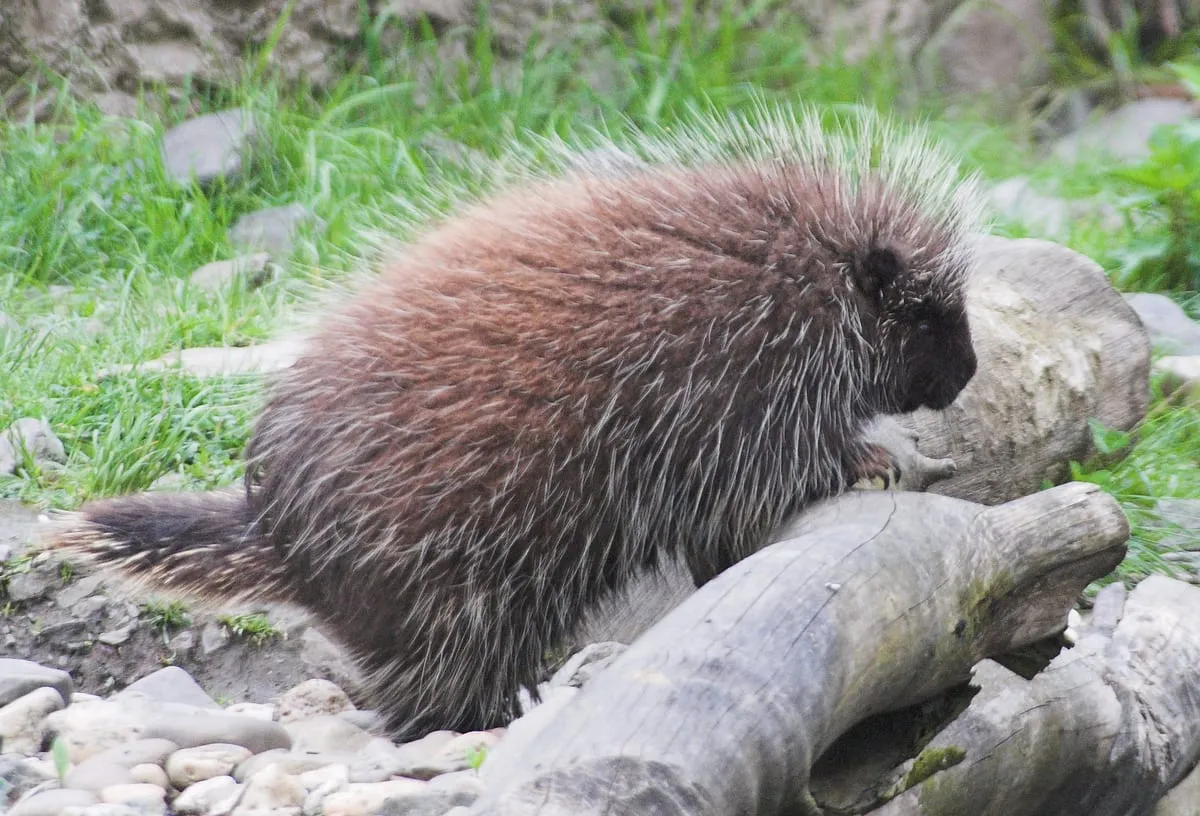
Porc-épic d'Amérique— Quebec wildlife
Erethizon dorsatum
ErethizontidaeNo period published by Québec.ca
Québec.ca publishes no hunting or trapping period for this species. Check the official regulations.
Wikipedia
Porc-épic d'Amérique
The North American porcupine (Erethizon dorsatum), also known as the Canadian porcupine, is a large quill-covered rodent in the New World porcupine family. It is the second largest rodent in North America after the North American beaver (Castor canadensis). The porcupine is a caviomorph rodent whose ancestors were believed to have crossed the Atlantic from Africa to Brazil 30 million years ago, and then migrated to North America during the Great American Interchange after the Isthmus of Panama rose 3 million years ago.
Description
Porcupines are usually dark brown or black in color, with white highlights. They have a stocky body, a small face, short legs, and a short, thick tail. This species is the largest of the New World porcupines and is the second largest rodent endemic to North America, after the American beaver (the Lesser capybara, which is larger, does range into North American Panama, but mostly occurs in South America). The head-and-body length is 60 to 90 cm (2.0 to 3.0 ft), not counting a tail of 14.5 to 30 cm (5.7 to 11.8 in). The hind foot length is 7.5 to 9.1 cm (3.0 to 3.6 in). Weight can range from 3.5 to 18 kg (7.7 to 39.7 lb). Weight in adult females can average some 7 kg (15 lb) while 5 wild-caught males averaged 10.67 kg (23.5 lb). The porcupine, the wolverine, and the skunk are North American mammals that have strongly contrasting black-and-white coloration, which benefits them by letting other animals know where and what they are in the dark of night. The coloration of E. dorsatum generally does not vary. However in the Pacific Northwest, members of the E. d. epixanthum subspecies have been found with a recognizable yellow coloration to their quills. The porcupines found with this distinct coloration did not have albinism and the eyes and nose had their typical pigmentation, they are believed to be isabelline in terms of coloration.
Text from Wikipedia — North American porcupine, revision 1363889985, CC BY-SA 4.0, retrieved 2026-09-04. Encyclopedic text reused under CC BY-SA 4.0. Sentences about hunting or regulation are removed: on this site, the rule comes from Québec.ca.
Presence in Quebec
- Origin
- Indigène
- Occurrence
- Régulier
- Population status
- Toute l'année
- Certainty
- Confirmé
Conservation
Québec.ca
Official periods
Source: Québec.ca — tables reproduced as published (retrieved 2026-08-30).
Regulations change. Always check Québec.ca before hunting or trapping.
Where this data comes from
This species is listed in an official government dataset. The identification and status shown in the data sheet are reproduced from it.
Source: List of Quebec’s vertebrate wildlife (LFVQ) — Ministère de l’Environnement, de la Lutte contre les changements climatiques, de la Faune et des Parcs. File LFVQ_25_03_2026.csv, retrieved 2026-08-30 · CC BY 4.0.
Measurements, habitat, diet and reproduction are not shown: no official source is attached to them yet.