
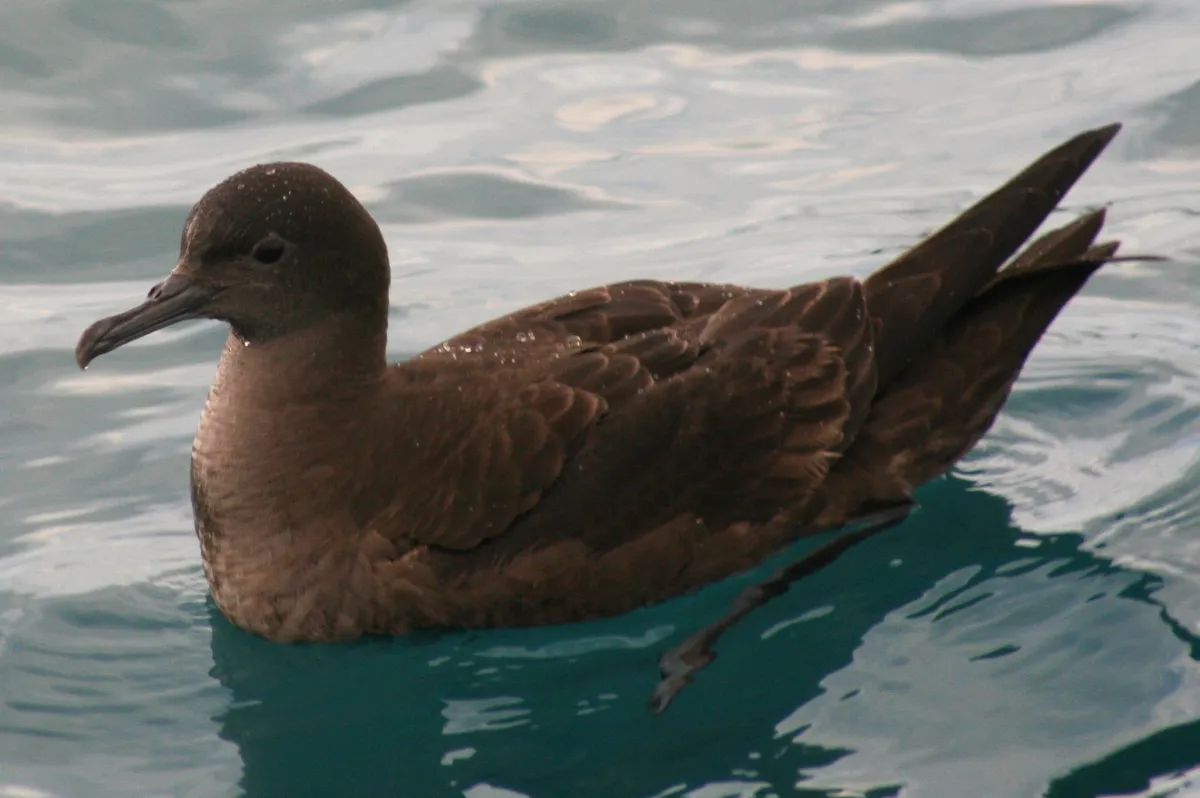
Puffin fuligineux— Quebec wildlife
Ardenna grisea
ProcellariidaeNo period published by Québec.ca
Québec.ca publishes no hunting or trapping period for this species. Check the official regulations.
Wikipedia
Puffin fuligineux
The sooty shearwater (Ardenna grisea) is a medium-large shearwater in the seabird family Procellariidae. In New Zealand, it is also known by its Māori name tītī, and is harvested by Māori people for muttonbird, like its relatives the wedge-tailed shearwater (A. pacificus) and the Australian short-tailed shearwater (A. tenuirostris).
Description
Sooty shearwaters are 40–51 cm (16–20 in) in length with a 94–110 cm (37–43 in) wingspan. It has the typical "shearing" flight of the genus, dipping from side to side on stiff wings with few wing beats, the wingtips almost touching the water. Its flight is powerful and direct, with wings held stiff and straight, giving the impression of a very small albatross. This shearwater is identifiable by its dark plumage, which is responsible for its name. In poor viewing conditions, it looks all black, but in good light, it shows as dark chocolate-brown with a silvery strip along the centre of the underwing. Sooty shearwaters are vocal at night on the breeding grounds, with usually loud coos and croaks. At sea, they are usually silent, though may call when competing for food in large groups. In the Atlantic, it is the only all-dark large shearwater, though can be confused with the smaller and usually somewhat paler Balearic shearwater at long range; the latter does not have the pale stripe on the underwing. In the Pacific part of its range, other all-dark large shearwaters are found. The short-tailed shearwater in particular is almost impossible to tell apart from the present species at a distance.
Text from Wikipedia — Sooty shearwater, revision 1362632957, CC BY-SA 4.0, retrieved 2026-09-04. Encyclopedic text reused under CC BY-SA 4.0. Sentences about hunting or regulation are removed: on this site, the rule comes from Québec.ca.
Other names
French
English
Presence in Quebec
- Origin
- Indigène
- Occurrence
- Régulier
- Population status
- Non reproducteur
- Certainty
- Confirmé
Conservation
Québec.ca
Official periods
Source: Québec.ca — tables reproduced as published (retrieved 2026-08-30).
Regulations change. Always check Québec.ca before hunting or trapping.
Where this data comes from
This species is listed in an official government dataset. The identification and status shown in the data sheet are reproduced from it.
Source: List of Quebec’s vertebrate wildlife (LFVQ) — Ministère de l’Environnement, de la Lutte contre les changements climatiques, de la Faune et des Parcs. File LFVQ_25_03_2026.csv, retrieved 2026-08-30 · CC BY 4.0.
Measurements, habitat, diet and reproduction are not shown: no official source is attached to them yet.