
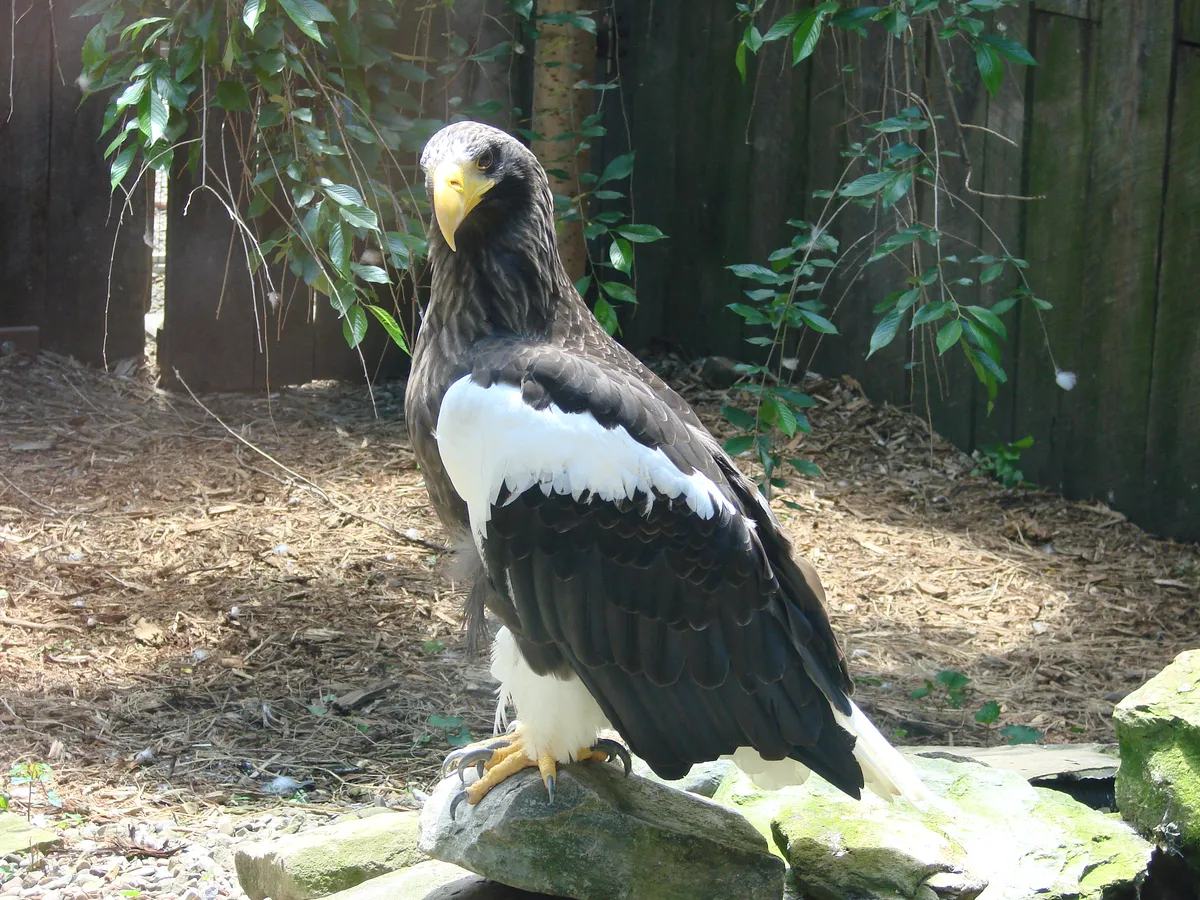
Pygargue empereur— Quebec wildlife
Haliaeetus pelagicus
AccipitridaeNo period published by Québec.ca
Québec.ca publishes no hunting or trapping period for this species. Check the official regulations.
Wikipedia
Pygargue empereur
Steller's sea eagle (Haliaeetus pelagicus), also known as the Pacific sea eagle or white-shouldered eagle, is a very large diurnal bird of prey in the family Accipitridae. It was described first by Peter Simon Pallas in 1811. No subspecies are recognized. A sturdy eagle, it has dark brown plumage with white wings and tail, a yellow beak, and yellow talons. Typically, it is the heaviest eagle in the world, at about 5 to 10 kg (11 to 22 lb), but in some other standard measurements, may be smaller than the harpy eagle (Harpia harpyja) and the Philippine eagle (Pithecophaga jefferyi). Steller's sea eagle females are bigger than males, as in other raptors. The Steller's sea eagle is endemic to coastal northeastern Asia, where it lives in Russia, Korea, Japan, and China. It mainly preys on fish and water birds. The Kamchatka Peninsula in Far Eastern Russia is known for its relatively large population of these birds; about 4,000 of these eagles live there. Steller's sea eagle is listed as vulnerable on the International Union for Conservation of Nature's Red List (IUCN Red List) of threatened species.
Diet
Steller's sea eagle mainly feed on fish and are apex predators of their environment. Their favored prey in river habitats are salmon and trout (of the Pacific salmon genus; Oncorhynchus spp.). Among these, pink salmon (O. gorbuscha) and chum salmon (O. keta) are reportedly favored, sometimes intensely supplemented by grayling (Thymallus sp.) and three-spined stickleback (Gasterosteus aculeatus). While pink and chum salmon average approximately 2.2 and 5 kg (4.9 and 11.0 lb) in mature mass, respectively, Steller's sea eagle not infrequently preys on fish up to 6 to 7 kg (13 to 15 lb). In coastal areas, nesting eagles may feed on Bering wolffish (Anarchichas orientalis), Hemitripterus villosus, smooth lumpfish (Aptocyclus ventricosus), and Myoxocephalus spp. Relatively large numbers of these normally solitary birds can be seen congregating on particularly productive spawning rivers in August through September due to an abundant food supply. On Kamchatka, aggregations of as many as 700 eagles have been reported, though much smaller groups are the norm. In summer, live fish, typically in the range of 20 to 30 cm (7.9 to 11.8 in) in length, are fed to the young at the nest. Normally, the parents catch about two or three fish for the young to eat each day. In autumn, when many salmon die after spawning, dead fish tend to be consumed more often than live ones, and these are the main food for Steller's sea eagles that overwinter in inland rivers with unfrozen waters. On Hokkaido, eagles are attracted by abundant Pacific cod (Gadus macrocephalus), which peak in the Rausu Sea and the Nemuro Straits in February. This resource supports an important commercial fishery, which, in turn, helps to support eagles.
Reproduction
This eagle builds several bulky aeries made of twigs and sticks at a height up to 1
Text from Wikipedia — Steller's sea eagle, revision 1367596896, CC BY-SA 4.0, retrieved 2026-09-04. Encyclopedic text reused under CC BY-SA 4.0. Sentences about hunting or regulation are removed: on this site, the rule comes from Québec.ca.
Presence in Quebec
- Origin
- Indigène
- Occurrence
- Accidentel/non régulier
- Population status
- Migrateur
- Certainty
- Confirmé
Conservation
Official remark
PYEM 2021-07 : 09-31/07/2021 Gaspé ; 07-08/08/2021 Matane. Mention acceptée (5-0). Documentation avec photos (2021-09-22).
Québec.ca
Official periods
Source: Québec.ca — tables reproduced as published (retrieved 2026-08-30).
Regulations change. Always check Québec.ca before hunting or trapping.
Where this data comes from
This species is listed in an official government dataset. The identification and status shown in the data sheet are reproduced from it.
Source: List of Quebec’s vertebrate wildlife (LFVQ) — Ministère de l’Environnement, de la Lutte contre les changements climatiques, de la Faune et des Parcs. File LFVQ_25_03_2026.csv, retrieved 2026-08-30 · CC BY 4.0.
Measurements, habitat, diet and reproduction are not shown: no official source is attached to them yet.