
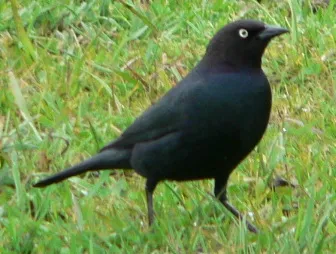
Quiscale de Brewer— Quebec wildlife
Euphagus cyanocephalus
IcteridaeNo period published by Québec.ca
Québec.ca publishes no hunting or trapping period for this species. Check the official regulations.
Wikipedia
Quiscale de Brewer
Brewer's blackbird (Euphagus cyanocephalus) is a medium-sized New World blackbird. It is named after the ornithologist Thomas Mayo Brewer.
Description
Adult males have black plumage with an iridescent purple head and neck and glossy bluish-green highlights on the rest of the body. The feet and legs are black and the eye is bright yellow. The female is brownish-grey with slight hints of the male's iridescence. The female's eyes are dark brown, while the male's is bright yellow. Overall, they resemble the eastern member of the same genus, the rusty blackbird; Brewer's blackbird, however, has a shorter bill and the male's head is iridescent purple. This bird is often mistaken for the common grackle but has a shorter tail. The call is a sharp check which is also distinguishable. This bird is in a different family from the Eurasian blackbird.
Habitat and range
Their breeding habitat is open and semi-open areas, often near water, across central and western North America. They are also very common in parking lots or around schools, and easily acclimate to the presence of people. They can live in low elevation, as low as below sea level in Southern California, and elevations as high as 8,000 feet. They are capable of surviving in diverse environments, including marshlands and forests. These birds are often permanent residents in the west. Other birds migrate to the Southeastern United States and Mexico in Spring. The range of this bird has been expanding east in the Great Lakes region. They have expanded their habitat as recently as the 20th century.
Diet
They forage in shallow water or in fields, mainly eating seeds and insects, some berries. They sometimes catch insects in flight. They feed in flocks outside of the breeding season, sometimes with other blackbirds. In marshy areas, they are known to stand on aquatic plants and wade in shallow water to catch insects. Some have even been known to eat smaller mammals, amphibians, and the nestlings of other birds.
Reproduction
These birds have mates but the mates don't stay together all year round. The same pair tends to reunite for mating season and both parents take a role in feeding. During mating, male Brewer's blackbirds will puff up their feathers while simultaneously spreading out their wings and tail to look as large as possible. They will point their beak out forward. Their clutch size can vary, usually between 3–7. Eggs are usually a tan color with darker speckles throughout to allow for camouflage. The female bird primarily incubates for 12–14 days. The chicks leave the nest only 2 weeks after hatching. Nests are not built in isolation, but in colonies of up to 30 pairs. Pairs prefer to nest in areas that are around 20–40' in treetops. However, colonies that live near water may also nest in reeds and other freshwater plants. Nests are made from nearby material such as reeds, sticks and hair. They are built by the female in a cup-like shape and are bonded with mud or other securing substances.
Text from Wikipedia — Brewer's blackbird, revision 1321171824, CC BY-SA 4.0, retrieved 2026-09-04. Encyclopedic text reused under CC BY-SA 4.0. Sentences about hunting or regulation are removed: on this site, the rule comes from Québec.ca.
Other names
French
English
Presence in Quebec
- Origin
- Indigène
- Occurrence
- Accidentel/non régulier
- Population status
- Migrateur
- Certainty
- Confirmé
Conservation
Québec.ca
Official periods
Source: Québec.ca — tables reproduced as published (retrieved 2026-08-30).
Regulations change. Always check Québec.ca before hunting or trapping.
Where this data comes from
This species is listed in an official government dataset. The identification and status shown in the data sheet are reproduced from it.
Source: List of Quebec’s vertebrate wildlife (LFVQ) — Ministère de l’Environnement, de la Lutte contre les changements climatiques, de la Faune et des Parcs. File LFVQ_25_03_2026.csv, retrieved 2026-08-30 · CC BY 4.0.
Measurements, habitat, diet and reproduction are not shown: no official source is attached to them yet.