
Quiscale rouilleux— Quebec wildlife
Euphagus carolinus
IcteridaeNo period published by Québec.ca
Québec.ca publishes no hunting or trapping period for this species. Check the official regulations.
Wikipedia
Quiscale rouilleux
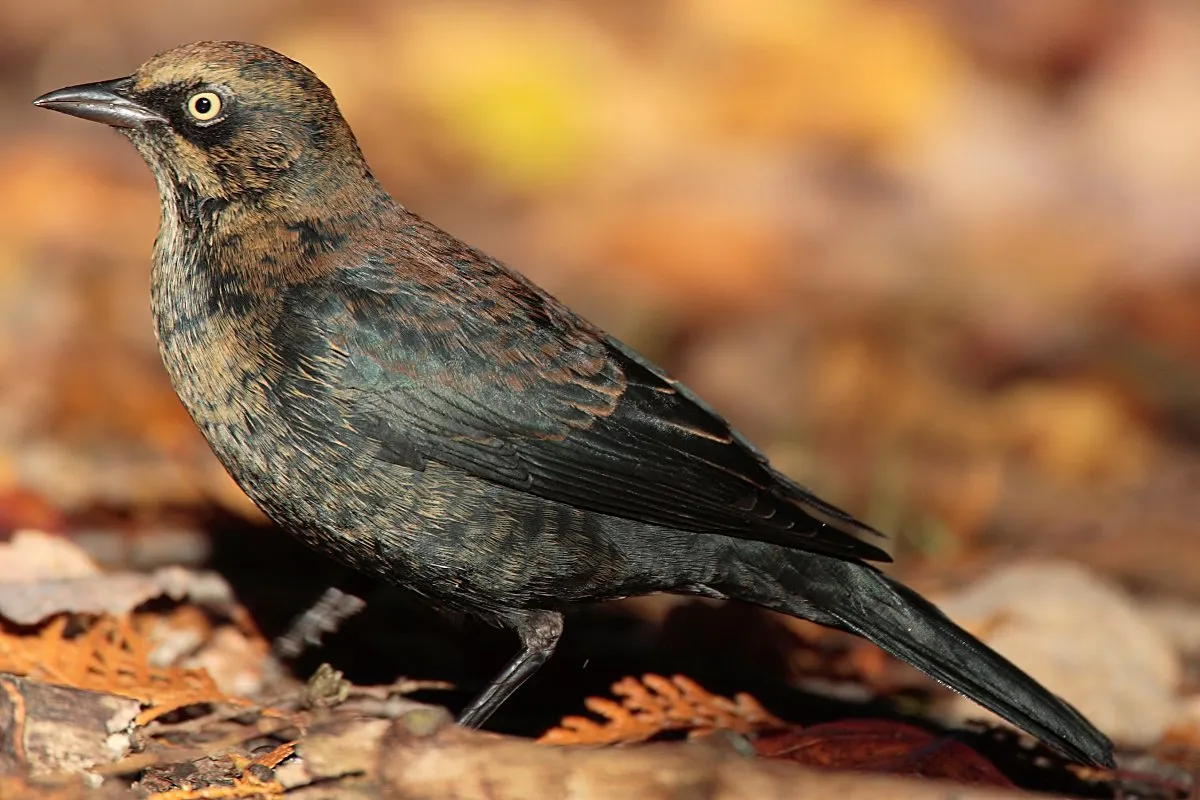
The rusty blackbird (Euphagus carolinus) is a medium-sized New World blackbird, closely related to grackles ("rusty grackle" is an older name for the species). It is a bird that prefers wet forested areas, breeding in the boreal forest and muskeg across northern Canada, and migrating southeast to the United States during winter. Formerly abundant, the rusty blackbird has undergone one of the most rapid declines of any abundant bird species in North America in recent years, for reasons that are not well understood.
Description
Adults have a pointed bill and a pale yellow eye. They have black plumage with faint green and purple gloss; the female is greyer. "Rusty" refers to the brownish winter plumage. They resemble the western member of the same genus, the Brewer's blackbird; however, Brewer's has a longer bill and the male's head is iridescent green.
Habitat and range
Their breeding habitat is wet temperate coniferous forests and muskeg across Canada, New England, the Upper Peninsula of Michigan, the Adirondack Mountains in New York and Alaska. Birds usually nest at the edge of ponds and wetlands with the cup nest located in a tree or dense shrub, often over the water. Emerging dragonflies and their larvae are important food items during the summer. These birds migrate to the eastern and southeastern United States, into parts of the Grain Belt, sometimes straying into Mexico. Additional vagrants have been reported inn Greenland and Russian Siberia.
Text from Wikipedia — Rusty blackbird, revision 1365115459, CC BY-SA 4.0, retrieved 2026-09-04. Encyclopedic text reused under CC BY-SA 4.0. Sentences about hunting or regulation are removed: on this site, the rule comes from Québec.ca.
Other names
French
English
Presence in Quebec
- Origin
- Indigène
- Occurrence
- Régulier
- Population status
- Reproducteur
- Certainty
- Confirmé
Conservation
Québec.ca
Official periods
Source: Québec.ca — tables reproduced as published (retrieved 2026-08-30).
Regulations change. Always check Québec.ca before hunting or trapping.
Where this data comes from
This species is listed in an official government dataset. The identification and status shown in the data sheet are reproduced from it.
Source: List of Quebec’s vertebrate wildlife (LFVQ) — Ministère de l’Environnement, de la Lutte contre les changements climatiques, de la Faune et des Parcs. File LFVQ_25_03_2026.csv, retrieved 2026-08-30 · CC BY 4.0.
Measurements, habitat, diet and reproduction are not shown: no official source is attached to them yet.