
Râle de Virginie— Quebec wildlife
Rallus limicola
RallidaeNo period published by Québec.ca
Québec.ca publishes no hunting or trapping period for this species. Check the official regulations.
Wikipedia
Râle de Virginie
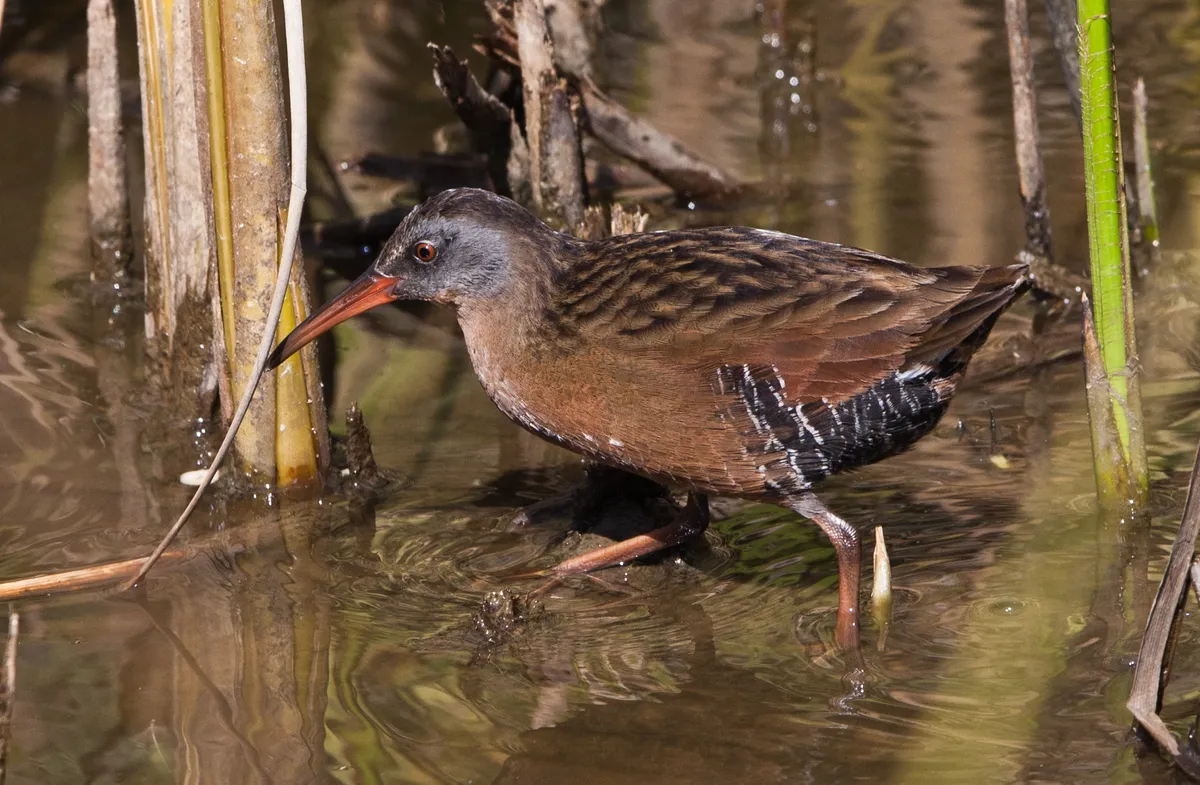
The Virginia rail (Rallus limicola) is a small waterbird, of the family Rallidae. These birds remain fairly common despite continuing loss of habitat, but are secretive by nature and more often heard than seen. The Ecuadorian rail is often considered a subspecies, but some taxonomic authorities consider it distinct.
Description
Adults are mainly brown, darker on the back and crown, with orange-brown legs. To walk through dense vegetation, they have evolved a laterally compressed body and strong forehead feathers adapted to withstand wear from pushing through vegetation. Rails have the highest ratio of leg-muscle to flight-muscle of all birds (25% - 15% of body weight respectively). They have long toes used to walk on floating vegetation. Their tail is short and they have a long slim reddish bill. Their cheeks are grey, with a light stripe over the eye and a whitish throat. Chicks are black. Juveniles are blackish brown on upperparts with rufous on the edge of feathers and brownish bill and legs. Their underparts are dark brown to black, while the face is grayish brown. Both sexes are very similar, with females being slightly smaller. Adults measure 20–27 cm (7.9–10.6 in) in total length, and weigh about 85 g (3.0 oz) on average. Its wingspan is 32–38 cm (13–15 in).
Text from Wikipedia — Virginia rail, revision 1369783233, CC BY-SA 4.0, retrieved 2026-09-04. Encyclopedic text reused under CC BY-SA 4.0. Sentences about hunting or regulation are removed: on this site, the rule comes from Québec.ca.
Other names
French
English
Presence in Quebec
- Origin
- Indigène
- Occurrence
- Régulier
- Population status
- Reproducteur
- Certainty
- Confirmé
Conservation
Québec.ca
Official periods
Source: Québec.ca — tables reproduced as published (retrieved 2026-08-30).
Regulations change. Always check Québec.ca before hunting or trapping.
Where this data comes from
This species is listed in an official government dataset. The identification and status shown in the data sheet are reproduced from it.
Source: List of Quebec’s vertebrate wildlife (LFVQ) — Ministère de l’Environnement, de la Lutte contre les changements climatiques, de la Faune et des Parcs. File LFVQ_25_03_2026.csv, retrieved 2026-08-30 · CC BY 4.0.
Measurements, habitat, diet and reproduction are not shown: no official source is attached to them yet.