
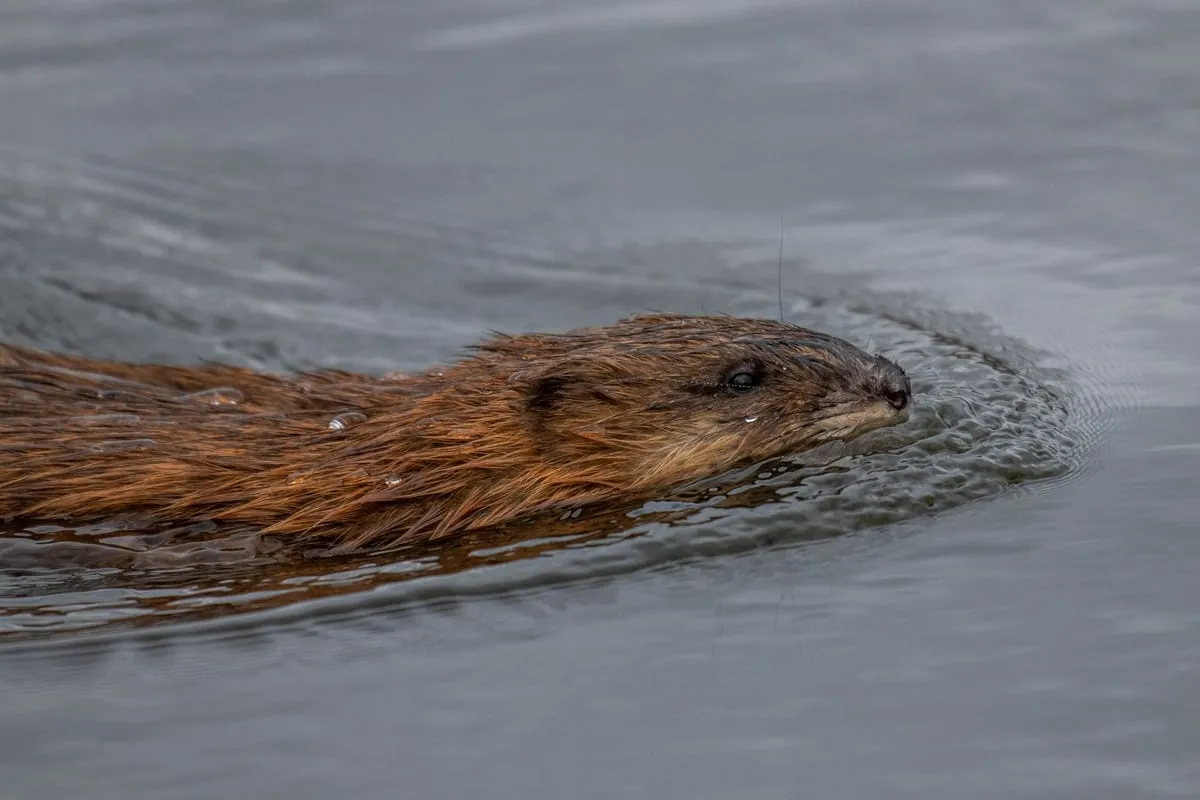
Trapping periods published by Québec.ca
Official tables below — trapping units (UGAF) and dates.
Wikipedia
Rat musqué
The muskrat or common muskrat (Ondatra zibethicus) is a medium-sized semiaquatic rodent. Adult muskrats weigh 0.6–2 kg (1+1⁄4–4+1⁄2 lb), with a body length (excluding the tail) of 20–35 cm (8–14 in). They are covered with short, thick fur of medium to dark brown color. Their long tails, covered with scales rather than hair, are laterally compressed and generate a small amount of thrust, with their webbed hind feet being the main means of propulsion and the unique tail mainly important in directional stability. Muskrats spend most of their time in the water and can swim underwater for 12 to 17 minutes. They live in families of a male and female pair and their young. They build nests to protect themselves from the cold and predators, often burrowed into the bank with an underwater entrance. Muskrats feed mostly on cattail and other aquatic vegetation but also eat small animals. Ondatra zibethicus is the only extant species in the genus Ondatra; its closest relative is the round-tailed muskrat (Neofiber alleni). It is the largest species in the subfamily Arvicolinae, which includes 142 other species of rodents, mostly voles and lemmings. The species is native to North America and an introduced species in parts of Eurasia and South America. The muskrat is found in various wetlands and has crucial effects on their ecology. It is also a resource of food and fur for humans.
Description
An adult muskrat is about 40–70 cm (16–28 in) long, half of that length being the tail, and weighs 0.6–2 kg (1+1⁄4–4+1⁄2 lb). That is about four times the weight of the brown rat (Rattus norvegicus), though an adult muskrat is only slightly longer. It is one of the most prominent and heaviest members of the family Cricetidae, which includes all voles, lemmings, and most mice native to the Americas, and hamsters in Eurasia. The muskrat is much smaller than a beaver (Castor canadensis), with which they often share a habitat. Muskrats are covered with short, thick fur, which is medium to dark brown or black, with the belly a bit lighter (countershaded); as the animal ages, it turns partly gray. The fur has two layers, which protect it from cold water. They have long tails covered with scales rather than hair. To aid in swimming, their tails are slightly flattened vertically, a shape that is unique to them. When they walk on land, their tails drag on the ground, which makes their tracks easy to recognize. Muskrats spend most of their time in water and are well suited to their semiaquatic life. They can swim underwater for 12 to 17 minutes. Their bodies, like those of seals and whales, are less sensitive to the buildup of carbon dioxide than those of most other mammals. They can close off their ears to keep water out. Their hind feet are partially webbed and are their primary means of propulsion. Their tail functions as a rudder, controlling the direction they swim. Musk glands are situated in the tail.
Text from Wikipedia — Muskrat, revision 1371437393, CC BY-SA 4.0, retrieved 2026-09-04. Encyclopedic text reused under CC BY-SA 4.0. Sentences about hunting or regulation are removed: on this site, the rule comes from Québec.ca.
Other names
French
Presence in Quebec
- Origin
- Indigène
- Occurrence
- Régulier
- Population status
- Toute l'année
- Certainty
- Confirmé
Conservation
Québec.ca
Official periods
Source: Québec.ca — tables reproduced as published (retrieved 2026-08-30).
Trapping
Muskrat and American mink
| UGAF | Periods |
|---|---|
| 1, 2, 3, 4, 5, 6, 7, 8, 9, 10, 11, 12, 13, 14, 15, 17, 18, 19, 20, 21, 22, 23, 26, 27, 28, 29, 30, 31, 32, 33, 34, 35, 36, 37, 38, 39, 40, 41, 42, 43, 44, 45, 46, 47, 48, 49, 50, 51, 52, 53 | From October 18 to April 21 |
| 16, 24, 25, 70, 71, 72, 73, 74, 75, 76, 77, 78, 79, 80, 81, 82, 83, 84, 85, 86 | From October 25 to April 21 |
| 54, 55, 56, 57, 58, 59, 60, 61, 62, 63, 64, 65, 66, 68 | From October 18 to May 15 |
Trapping
Muskrat and American mink
| UGAF | Underwater cage trapping periods |
|---|---|
| 1 à 15, 17 à 23, 26 à 68 | From October 18 to December 31 |
| 16, 24, 25, 70 à 86 | From October 25 to December 31 |
Regulations change. Always check Québec.ca before hunting or trapping.
Where this data comes from
This species is listed in an official government dataset. The identification and status shown in the data sheet are reproduced from it.
Source: List of Quebec’s vertebrate wildlife (LFVQ) — Ministère de l’Environnement, de la Lutte contre les changements climatiques, de la Faune et des Parcs. File LFVQ_25_03_2026.csv, retrieved 2026-08-30 · CC BY 4.0.
Measurements, habitat, diet and reproduction are not shown: no official source is attached to them yet.