
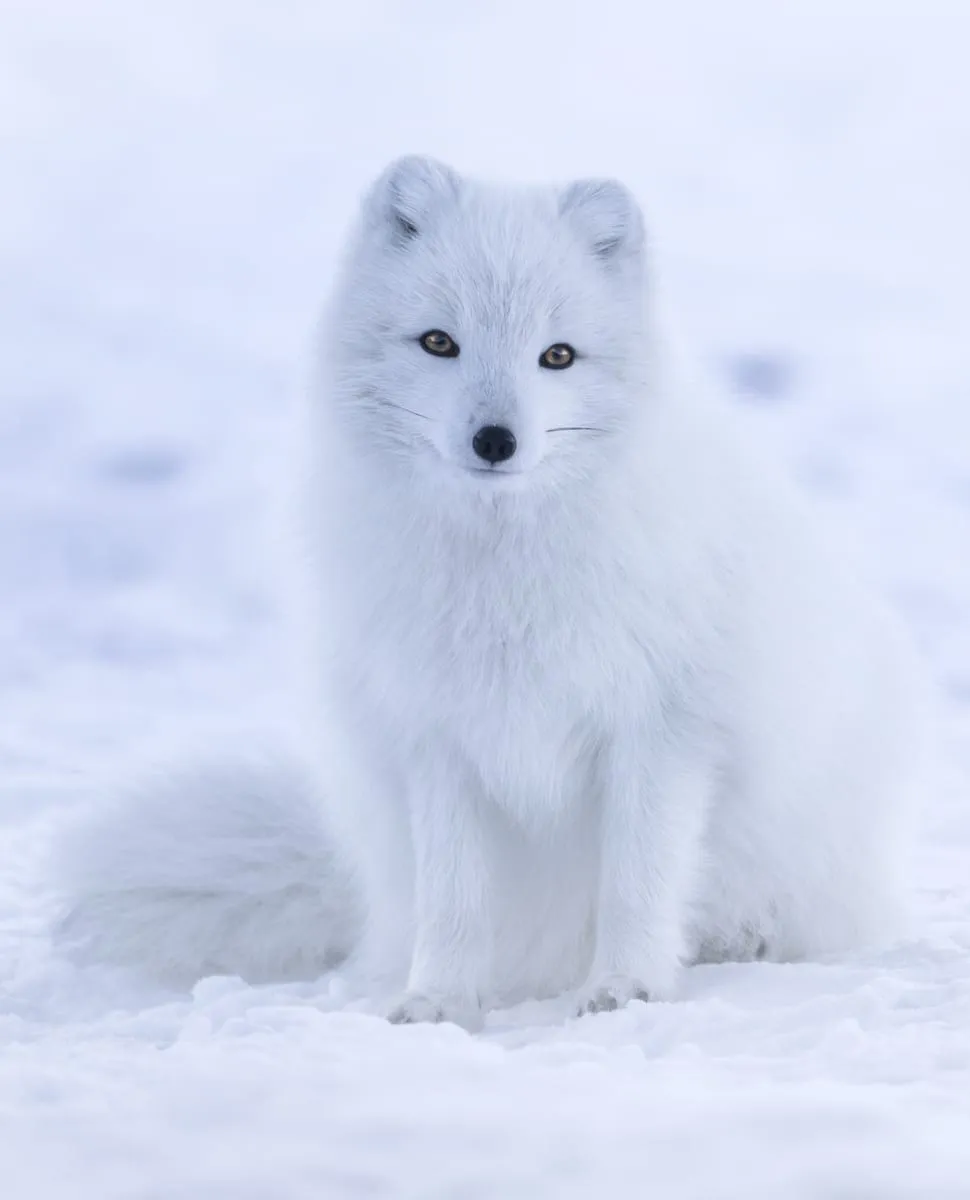
Renard arctique— species and hunting in Quebec
Vulpes lagopus
CanidaeTrapping periods published by Québec.ca
Official tables below — trapping units (UGAF) and dates.
Wikipedia
Renard arctique
The Arctic fox (Vulpes lagopus), also known as the white fox, polar fox, or snow fox, is a small species of fox native to the Arctic regions of the Northern Hemisphere and common throughout the Arctic tundra. It is well adapted to living in cold environments, and is known for its thick, warm fur that can be used as camouflage against snow in the winter. It has a large and fluffy tail. In the wild, most individuals do not live past their first year but some exceptional ones survive up to 11 years. Its body length ranges from 46 to 68 cm (18 to 27 in), with a generally rounded body shape to minimize the escape of body heat. The Arctic fox preys on many small creatures such as lemmings, voles, ringed seal pups, fish, waterfowl, and seabirds. It also eats carrion, berries, seaweed, and insects and other small invertebrates. Arctic foxes form monogamous pairs during the breeding season and they stay together to raise their young in complex underground dens. Occasionally, other family members may assist in raising their young. Natural predators of the Arctic fox include golden eagles, Arctic wolves, polar bears, wolverines, red foxes, and brown bears.
Description
The Arctic fox is smaller than the red fox, standing 25–30 cm (9.8–11.8 in) tall at the shoulder. Males weigh 3.5 kg (7.7 lb) on average, with a range of 3.2–9.4 kg (7.1–20.7 lb), while females average 2.9 kg (6.4 lb), with a range of 1.4–3.2 kg (3.1–7.1 lb). The average head-to-rear length of males is 55 cm (22 in), ranging from 46–68 cm (18–27 in), while females average 52 cm (20 in) with a range of 41–55 cm (16–22 in). Foxes that live further north are smaller than more southern foxes. The tail is about one third the length of the body.
Text from Wikipedia — Arctic fox, revision 1371618626, CC BY-SA 4.0, retrieved 2026-09-04. Encyclopedic text reused under CC BY-SA 4.0. Sentences about hunting or regulation are removed: on this site, the rule comes from Québec.ca.
Other names
Former scientific names
Presence in Quebec
- Origin
- Indigène
- Occurrence
- Régulier
- Population status
- Toute l'année
- Certainty
- Confirmé
Conservation
Québec.ca
Official periods
Source: Québec.ca — tables reproduced as published (retrieved 2026-08-30).
Trapping
Coyote, wolf, Arctic fox and red fox
| UGAF | Periods |
|---|---|
| 1, 2, 3, 4, 5, 6, 7, 11, 13, 17, 20, 21, 29, 30, 31, 32, 33, 34, 35, 38, 39, 41, 42, 43, 44, 45, 46, 47, 48, 49, 50, 51, 52, 53 | From October 18 to March 1 |
| 8, 9, 10, 12, 14, 15, 16, 18, 19, 22, 23, 24, 25, 26, 27, 28, 36, 37, 40, 70, 71, 72, 73, 74, 75, 76, 77, 78, 79, 80, 81, 82, 83, 84, 85, 86 | From October 25 to March 1 |
| 54, 55, 56, 57, 58, 59, 60, 61, 62, 63, 64, 65, 66 | From October 18 to March 15 |
| 68 | From October 18 to March 15 |
| 69 | From December 15 to December 31 |
Regulations change. Always check Québec.ca before hunting or trapping.
Where this data comes from
This species is listed in an official government dataset. The identification and status shown in the data sheet are reproduced from it.
Source: List of Quebec’s vertebrate wildlife (LFVQ) — Ministère de l’Environnement, de la Lutte contre les changements climatiques, de la Faune et des Parcs. File LFVQ_25_03_2026.csv, retrieved 2026-08-30 · CC BY 4.0.
Measurements, habitat, diet and reproduction are not shown: no official source is attached to them yet.