
No period published by Québec.ca
Québec.ca publishes no hunting or trapping period for this species. Check the official regulations.
Wikipedia
Renard gris
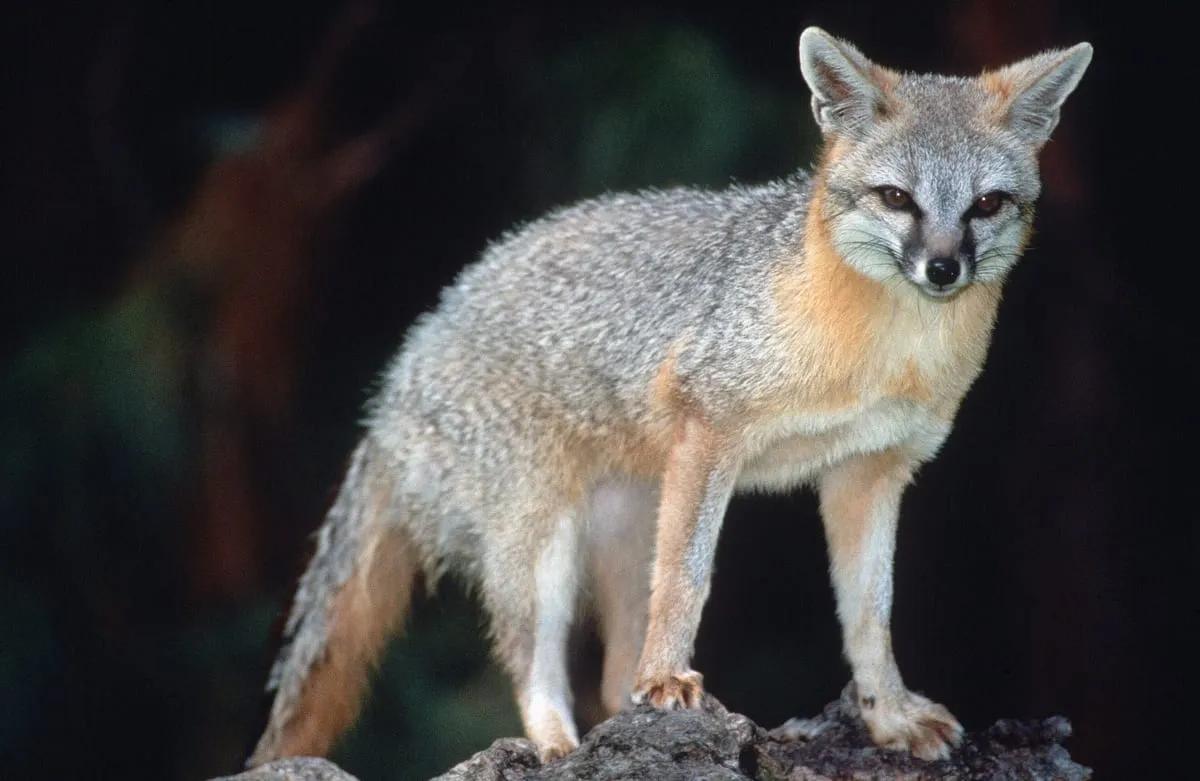
The gray fox (Urocyon cinereoargenteus), or grey fox, is an omnivorous mammal of the family Canidae, widespread throughout North America and Central America. This species and its only congener, the diminutive island fox (Urocyon littoralis) of the California Channel Islands, are the only living members of the genus Urocyon, which is considered to be genetically sister to all other living canids. Its species name cinereoargenteus means "ashen silver". It was once the most common fox in the eastern United States, and though still found there, human advancement and deforestation allowed the red fox to become the predominant fox-like canid. Despite this post-colonial competition, the gray fox has been able to thrive in urban and suburban environments, one of the best examples being southern Florida. The Pacific States and Great Lakes region still have the gray fox as their prevalent fox.
Description
The gray fox is mainly distinguished from most other canids by its grizzled upper parts, black stripe down its tail and strong neck, ending in a black-tipped tail, while the skull can be easily distinguished from all other North American canids by its widely separated temporal ridges that form a 'U'-shape. Like other canids, the fox's ears and muzzle are angular and pointed. Its claws tend to be lengthier and curved. There is little sexual dimorphism, save for the females being slightly smaller than males. The gray fox ranges from 76 to 112.5 cm (29.9 to 44.3 in) in total length. The tail measures 27.5 to 44.3 cm (10.8 to 17.4 in) of that length and its hind feet measure 100 to 150 mm (3.9 to 5.9 in). The gray fox typically weighs 3.6 to 7 kg (7.9 to 15.4 lb), though exceptionally large individuals can weigh as much as 9 kg (20 lb). The gray fox is readily distinguished from the red fox by its obvious lack of the "black stockings" that stand out on the red fox. The grey fox has a stripe of black hair that runs along the middle of its tail, and individual guard hairs that are banded with white, gray, and black. The gray fox displays white on the ears, throat, chest, belly, and hind legs. Gray foxes also have black around their eyes, on the lips, and on their noses. In contrast to the species in genus Vulpes, such as the red fox, the gray fox has oval (instead of slit-like) pupils. The gray fox also has reddish coloration on parts of its body, including the legs, sides, feet, chest, and back and sides of the head and neck. The stripe on the fox's tail ends in a black tip as well. Its weight can be similar to that of a red fox, but the gray fox appears smaller because its fur is not as long and it has shorter limbs. The dental formula of U. cinereoargenteus is 3.1.4.23.1.4.3 = 42.
Diet
It frequently preys on the eastern cottontail (Sylvilagus floridanus) in the eastern U.S., though it will readily catch voles, shrews, and birds.In California, the gray fox primarily eats rodents (such as deer mice, woodrats, and cotton rats), fol
Text from Wikipedia — Gray fox, revision 1369222563, CC BY-SA 4.0, retrieved 2026-09-04. Encyclopedic text reused under CC BY-SA 4.0. Sentences about hunting or regulation are removed: on this site, the rule comes from Québec.ca.
Presence in Quebec
- Origin
- Indigène
- Occurrence
- Accidentel/non régulier
- Population status
- Non reproducteur
- Certainty
- Confirmé
Conservation
Québec.ca
Official periods
Source: Québec.ca — tables reproduced as published (retrieved 2026-08-30).
Regulations change. Always check Québec.ca before hunting or trapping.
Where this data comes from
This species is listed in an official government dataset. The identification and status shown in the data sheet are reproduced from it.
Source: List of Quebec’s vertebrate wildlife (LFVQ) — Ministère de l’Environnement, de la Lutte contre les changements climatiques, de la Faune et des Parcs. File LFVQ_25_03_2026.csv, retrieved 2026-08-30 · CC BY 4.0.
Measurements, habitat, diet and reproduction are not shown: no official source is attached to them yet.