
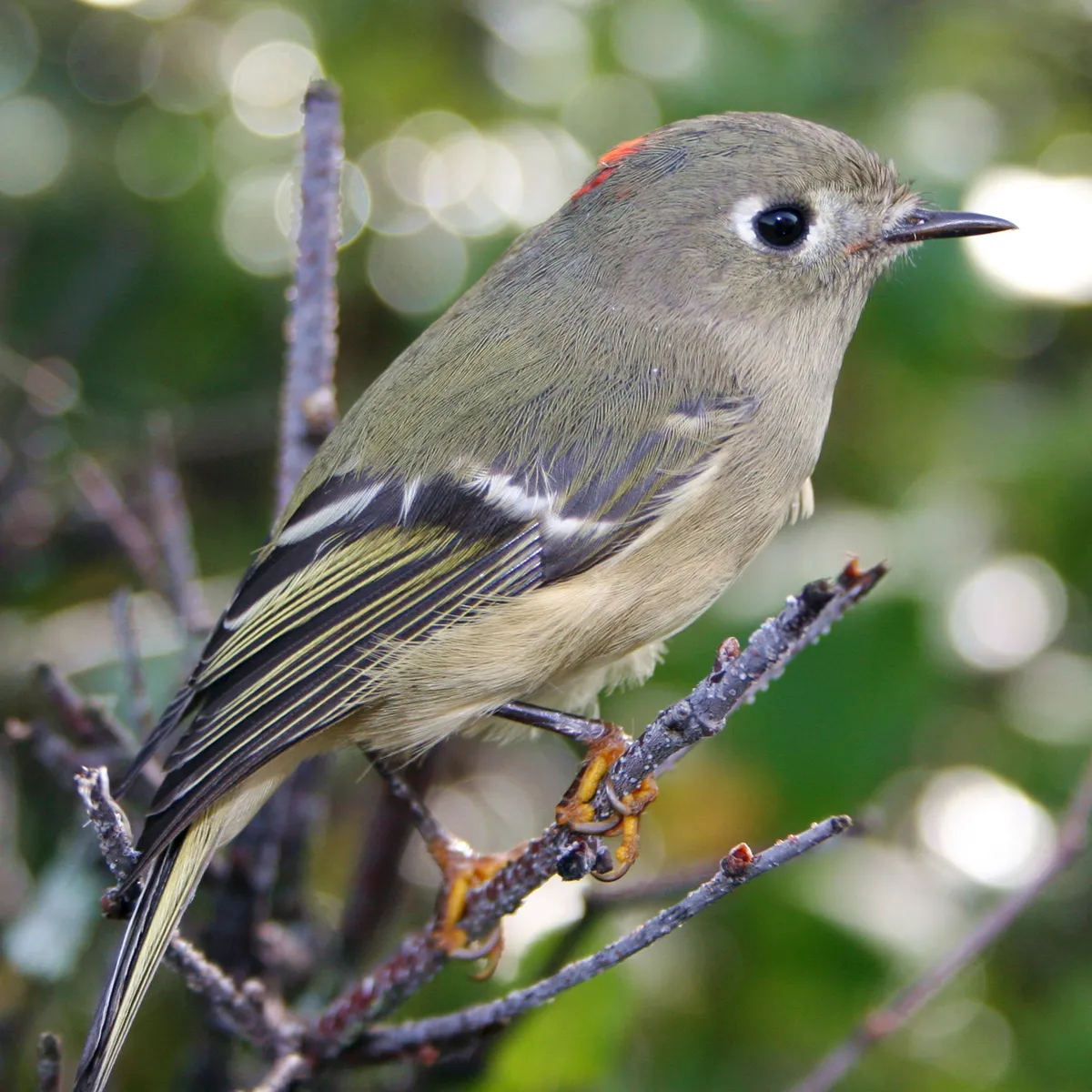
Roitelet à couronne rubis— Quebec wildlife
Regulus calendula
RegulidaeNo period published by Québec.ca
Québec.ca publishes no hunting or trapping period for this species. Check the official regulations.
Wikipedia
Roitelet à couronne rubis
The ruby-crowned kinglet (Corthylio calendula) is a very small passerine bird found throughout North America. It is a member of the kinglet family. The bird has olive-green plumage with two white wing bars and a white eye-ring. Males have a red crown patch, which is often concealed. The sexes are identical apart from the crown, and juveniles are similar in plumage to adult females. It is one of the smallest songbirds in North America. The ruby-crowned kinglet is not closely related to other kinglets and was moved from Regulus to its own genus, Corthylio, in 2021. Three subspecies are currently recognized. The kinglet is mostly migratory, and its range extends from northwest Canada and Alaska south to Mexico. Its breeding habitat is spruce-fir forests in the northern and mountainous regions of the United States and Canada. The ruby-crowned kinglet builds a cup-shaped nest, which may be pensile or placed on a tree branch and is often hidden. It lays up to 12 eggs, and has the largest clutch of any North American passerine for its size. It is mainly insectivorous, but also eats fruits and seeds.
Description
The ruby-crowned kinglet is a very small bird, being 9 to 11 cm (3.5 to 4.3 in) long, having a wingspan of 16 to 18 cm (6.3 to 7.1 in), and weighing 5 to 10 g (0.2 to 0.4 oz). It has gray-green upperparts and olive-buff underparts. It has two white wingbars and a broken white eye ring. The wingbar on the greater secondary coverts (closer to the wing-tip) is wider, and is next to a dark band. The kinglet has a relatively plain face and head, although the male has a scarlet-red crown patch, which is usually concealed by the surrounding feathers. The crown patch is rarely orange, yellow, or not present. Females are identical to males (except for the crown). Immature birds are similar to adult females, since young males lack a crown patch. The kinglet usually moves along branches or through foliage with short hops, and flies with bursts of rapid wing beats. It is constantly active, and is easily recognized by its characteristic wing-flicking. Its flight has been described as "swift, jerky, and erratic". Compared to the related golden-crowned kinglet, the ruby-crowned kinglet is slightly larger, more elongated, and has greener plumage. The bird can be mistaken for Hutton's vireo, which also displays wing-flicking, though less frequently than the kinglet. It can also be mistaken for the dwarf vireo in Mexico. However, both of the vireos are larger, have stouter bills and legs, and lack the kinglet's black bar on the wings.
Text from Wikipedia — Ruby-crowned kinglet, revision 1362409116, CC BY-SA 4.0, retrieved 2026-09-04. Encyclopedic text reused under CC BY-SA 4.0. Sentences about hunting or regulation are removed: on this site, the rule comes from Québec.ca.
Other names
French
English
Presence in Quebec
- Origin
- Indigène
- Occurrence
- Régulier
- Population status
- Reproducteur
- Certainty
- Confirmé
Conservation
Québec.ca
Official periods
Source: Québec.ca — tables reproduced as published (retrieved 2026-08-30).
Regulations change. Always check Québec.ca before hunting or trapping.
Where this data comes from
This species is listed in an official government dataset. The identification and status shown in the data sheet are reproduced from it.
Source: List of Quebec’s vertebrate wildlife (LFVQ) — Ministère de l’Environnement, de la Lutte contre les changements climatiques, de la Faune et des Parcs. File LFVQ_25_03_2026.csv, retrieved 2026-08-30 · CC BY 4.0.
Measurements, habitat, diet and reproduction are not shown: no official source is attached to them yet.