
No period published by Québec.ca
Québec.ca publishes no hunting or trapping period for this species. Check the official regulations.
Wikipedia
Roselin familier
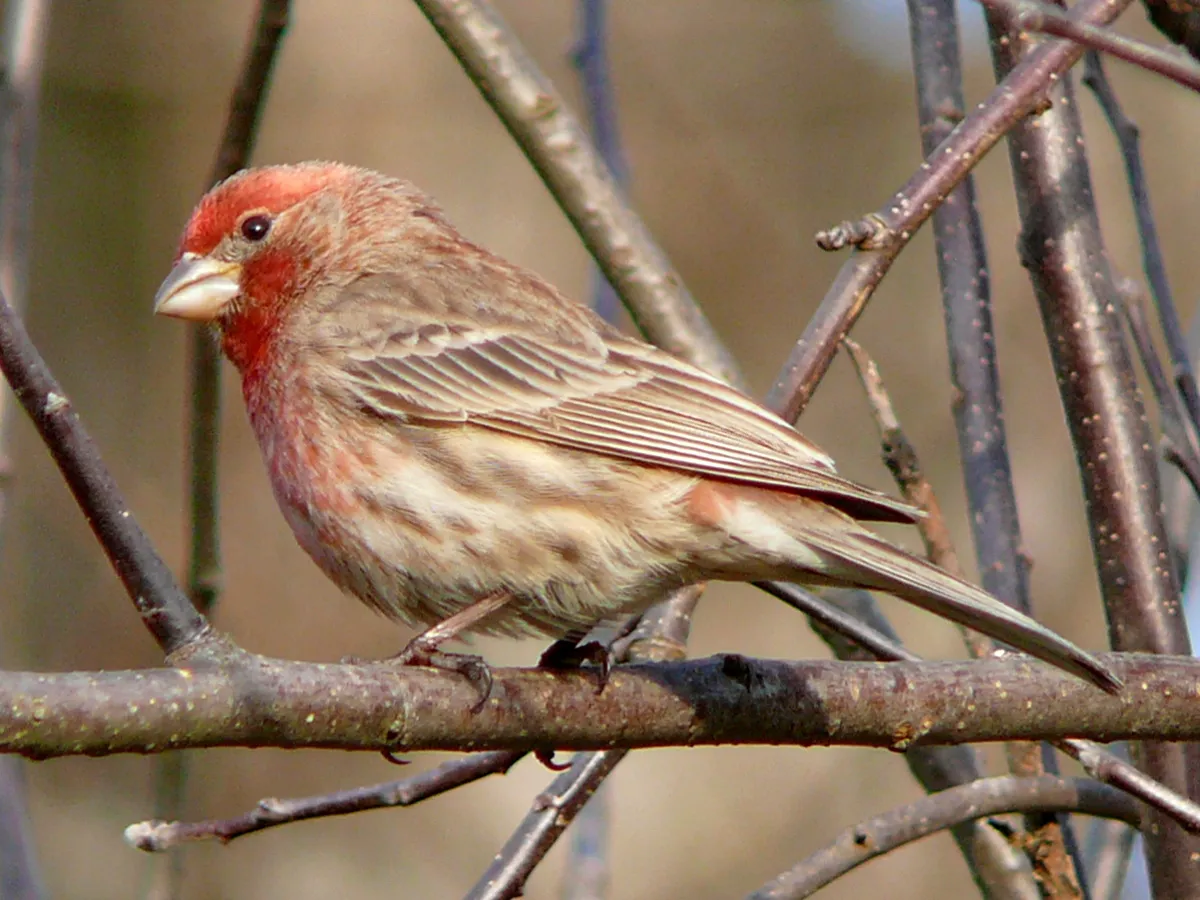
The house finch (Haemorhous mexicanus) is a North American bird in the finch family. It is native to Mexico and southwestern United States, but has since been introduced to the eastern part of North America and Hawaiʻi, and is found year-round in almost all parts of the United States and most of Mexico, with breeding grounds well into Canada as far north as northern Alberta. There are estimated to be 40 million house finches across North America, making it the second-most populous finch, just behind the American goldfinch. The house finch and the other two American rosefinches (Cassin's and purple finch) are placed in the genus Haemorhous.
Description
The house finch is a moderate-sized finch, 12.5 to 15 cm (5 to 6 in) long, with a wingspan of 20 to 25 cm (8 to 10 in). Body mass can vary from 16 to 27 g (9⁄16 to 15⁄16 oz), with an average weight of 21 g (3⁄4 oz). Among standard measurements, the wing chord is 7 to 8.4 cm (2+3⁄4 to 3+1⁄4 in), the tail is 5.7 to 6.5 cm (2+1⁄4 to 2+1⁄2 in), the culmen is 0.9 to 1.1 cm (3⁄8 to 7⁄16 in) and the tarsus is 1.6 to 1.8 cm (5⁄8 to 11⁄16 in). Adults have a long, square-tipped brown tail and are a brown or dull-brown color across the back with some shading into deep gray on the wing feathers. Breast and belly feathers may be streaked; the flanks usually are. In most cases, adult males' heads, necks and shoulders are reddish. This color sometimes extends to the belly and down the back, between the wings. Male coloration varies in intensity with the seasons and is derived from the berries and fruits in its diet. As a result, the colors range from pale straw-yellow through bright orange (both rare) to deep, intense red. Adult females have brown upperparts and streaked underparts. The house finch's songs typically consist of a series of high-pitched musical jumbles ending with a distinct high note, wheer. Calls from flight include a soft cheet or wheat, with perched birds giving a more drawn-out version.
Diet
House finches forage on the ground or in vegetation normally. They primarily eat grains, seeds and berries, being voracious consumers of weed seeds such as nettle and dandelion; included are incidental small insects such as aphids. They are frequent visitors to bird feeders throughout the year, particularly if stocked with sunflower or nyjer seed, and will congregate at hanging nyjer sock feeders. The house finch is known to damage orchard fruit and consume commercially grown grain, but is generally considered an annoyance rather than a significant pest.
Reproduction
Nests are made in cavities, including openings in buildings, hanging plants, and other cup-shaped outdoor decorations. Sometimes nests abandoned by other birds are used. Nests may be re-used for subsequent broods or in following years. The nest is built by the female, sometimes in as little as two days. It is well made of twigs and debris, forming a cup shape, usually 1.8 to 2.7 m (5 ft 11 in to 8 ft 10 in) above the ground.
Text from Wikipedia — House finch, revision 1371279388, CC BY-SA 4.0, retrieved 2026-09-04. Encyclopedic text reused under CC BY-SA 4.0. Sentences about hunting or regulation are removed: on this site, the rule comes from Québec.ca.
Other names
French
Presence in Quebec
- Origin
- Exotique
- Occurrence
- Régulier
- Population status
- Toute l'année
- Certainty
- Confirmé
Conservation
Québec.ca
Official periods
Source: Québec.ca — tables reproduced as published (retrieved 2026-08-30).
Regulations change. Always check Québec.ca before hunting or trapping.
Where this data comes from
This species is listed in an official government dataset. The identification and status shown in the data sheet are reproduced from it.
Source: List of Quebec’s vertebrate wildlife (LFVQ) — Ministère de l’Environnement, de la Lutte contre les changements climatiques, de la Faune et des Parcs. File LFVQ_25_03_2026.csv, retrieved 2026-08-30 · CC BY 4.0.
Measurements, habitat, diet and reproduction are not shown: no official source is attached to them yet.