
No period published by Québec.ca
Québec.ca publishes no hunting or trapping period for this species. Check the official regulations.
Wikipedia
Sarcelle cannelle
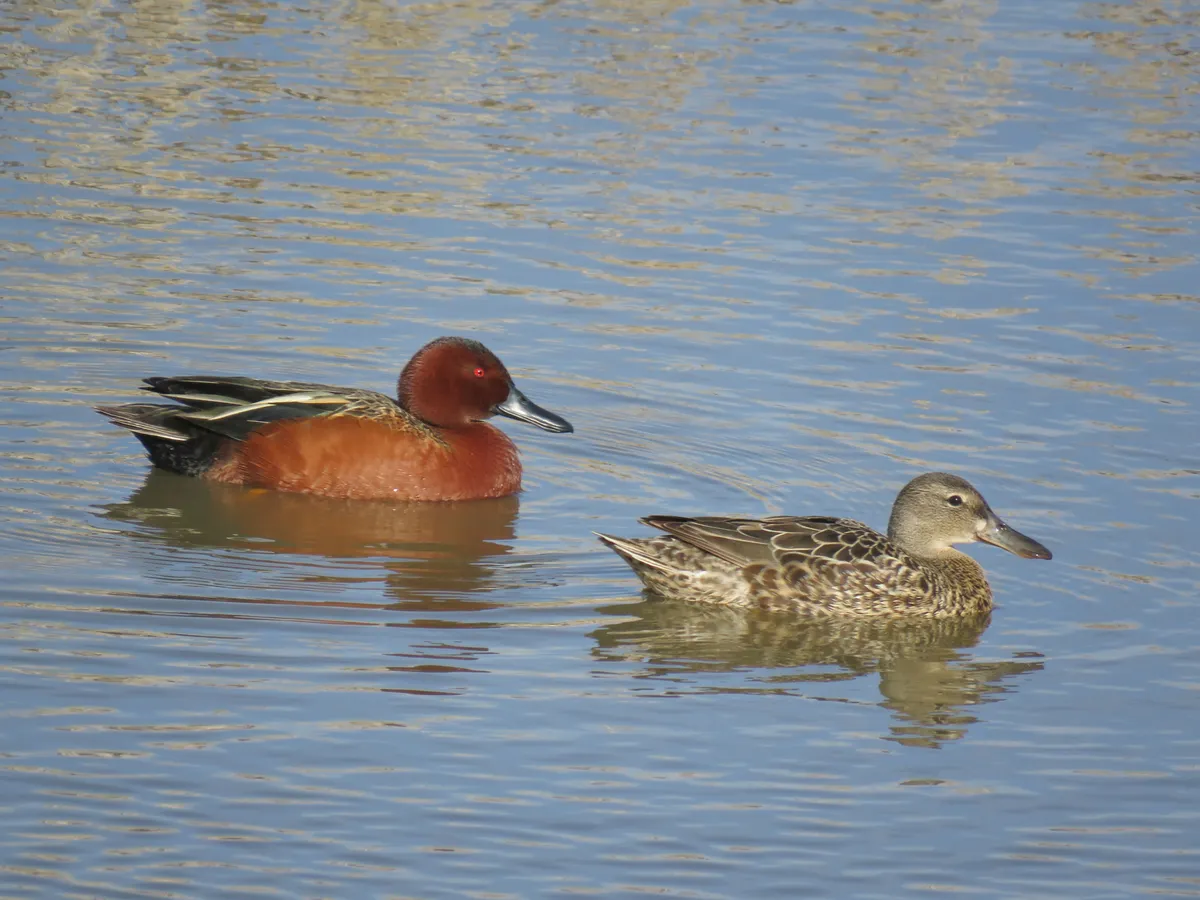
The cinnamon teal (Spatula cyanoptera) is a species of duck found in western North and South America. It is a small dabbling duck, with bright reddish plumage on the male and duller brown plumage on the female. It lives in marshes and ponds, and feeds mostly on plants.
Description
The adult male has a cinnamon-red head and body with a brown back, a red eye and a dark bill. The adult female has a mottled brown body, a pale brown head, brown eyes and a grey bill and is very similar in appearance to a female blue-winged teal; however, its overall color is richer, the lores, eye line, and eye ring are less distinct. Its bill is longer and more spatulate. Male juvenile resembles a female cinnamon or blue-winged teal but their eyes are red. They are 16 in (41 cm) long, have a 22-inch (560 mm) wingspan, and weigh 14 oz (400 g). They have 2 adult molts per year and a third molt in their first year.
Habitat and range
Their breeding habitat is marshes and ponds in western United States and extreme southwestern Canada, and are rare visitors to the eastern United States. One young male duck was spotted in Grimsby, Ontario, and became a tourist attraction due to its rarity outside of western Canada. Cinnamon teal generally select new mates each year. They are migratory and most winter in northern South America and the Caribbean, generally not migrating as far as the blue-winged teal. Some winter in California and southwestern Arizona. Two subspecies of cinnamon teal reside within the Andes of South America. The smaller S. c. cyanoptera is widespread within low elevations (<1000m) such as the coast of Peru and southern Argentina, whereas the larger subspecies S. c. orinomus occupies elevations of 3500–4600 meters in the central Andes.
Text from Wikipedia — Cinnamon teal, revision 1356797238, CC BY-SA 4.0, retrieved 2026-09-04. Encyclopedic text reused under CC BY-SA 4.0. Sentences about hunting or regulation are removed: on this site, the rule comes from Québec.ca.
Other names
French
English
Former scientific names
Presence in Quebec
- Origin
- Indigène
- Occurrence
- Accidentel/non régulier
- Population status
- Migrateur
- Certainty
- Confirmé
Conservation
Québec.ca
Official periods
Source: Québec.ca — tables reproduced as published (retrieved 2026-08-30).
Regulations change. Always check Québec.ca before hunting or trapping.
Where this data comes from
This species is listed in an official government dataset. The identification and status shown in the data sheet are reproduced from it.
Source: List of Quebec’s vertebrate wildlife (LFVQ) — Ministère de l’Environnement, de la Lutte contre les changements climatiques, de la Faune et des Parcs. File LFVQ_25_03_2026.csv, retrieved 2026-08-30 · CC BY 4.0.
Measurements, habitat, diet and reproduction are not shown: no official source is attached to them yet.