
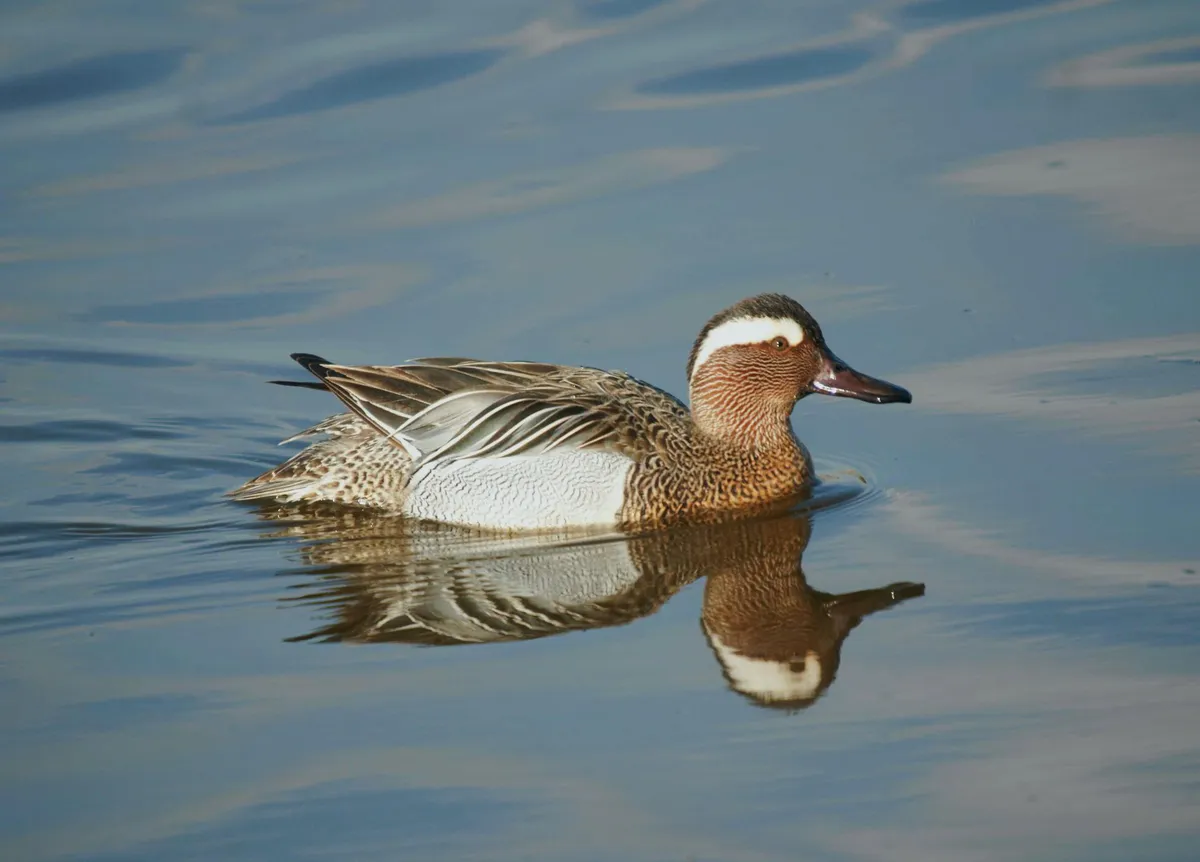
Sarcelle d'été— Quebec wildlife
Spatula querquedula
AnatidaeNo period published by Québec.ca
Québec.ca publishes no hunting or trapping period for this species. Check the official regulations.
Wikipedia
Sarcelle d'été
The garganey (Spatula querquedula) is a small dabbling duck. It breeds in much of Europe and across the Palearctic, but is strictly migratory, with the entire population moving to Africa, India (in particular Santragachi), Bangladesh (in the natural reservoirs of Sylhet district) and Australasia during the winter of the Northern hemisphere, where large flocks can occur. This species was first described by Carl Linnaeus in his landmark 1758 10th edition of Systema Naturae. Like other small ducks such as the Eurasian teal, this species rises easily from the water with a fast twisting wader-like flight. Their breeding habitat is grassland adjacent to shallow marshes and steppe lakes.
Description
The adult male is unmistakable, with its brown head and breast with a broad white crescent over the eye. The rest of the plumage is grey, with loose grey scapular feathers. It has a grey bill and legs. In flight, it shows a pale blue speculum with a white border. When swimming it will show prominent white edges on its tertials. His crown (anatomy) is dark and his face is reddish brown. Some care is needed in separating the brown female from the similar common teal, but the stronger face markings and more frequent head-shaking when dabbling are good indicators. Confusion with the female of the blue-winged teal is also possible, but the head and bill shape is different, and the latter species has yellow legs. Pale eyebrow, dark eye line, pale lore spot bordered by a second dark line. Measurements: Size: 41 cm Wingspan: 58 – 69 cm. Weight: 300–440 g These birds feed mainly by skimming rather than upending. The male has a distinctive crackling mating call; the female is rather silent for a female duck, but can manage a feeble quack. Garganey are rare breeding birds in the British Isles, with most breeding in quiet marshes in Norfolk and Suffolk. In Ireland a few pairs breed in County Wexford, and at Lough Beg in County Londonderry, with occasional breeding elsewhere. The garganey is one of the species to which the Agreement on the Conservation of African-Eurasian Migratory Waterbirds (AEWA) applies. The status of the garganey on the IUCN Red List is least concern.
Text from Wikipedia — Garganey, revision 1371443487, CC BY-SA 4.0, retrieved 2026-09-04. Encyclopedic text reused under CC BY-SA 4.0. Sentences about hunting or regulation are removed: on this site, the rule comes from Québec.ca.
Other names
French
English
Former scientific names
Presence in Quebec
- Origin
- Indigène
- Occurrence
- Accidentel/non régulier
- Population status
- Migrateur
- Certainty
- Confirmé
Conservation
Québec.ca
Official periods
Source: Québec.ca — tables reproduced as published (retrieved 2026-08-30).
Regulations change. Always check Québec.ca before hunting or trapping.
SIT Québec register
Outfitters hunting this species
90 outfitters list this species among the game they hunt.
Where this data comes from
This species is listed in an official government dataset. The identification and status shown in the data sheet are reproduced from it.
Source: List of Quebec’s vertebrate wildlife (LFVQ) — Ministère de l’Environnement, de la Lutte contre les changements climatiques, de la Faune et des Parcs. File LFVQ_25_03_2026.csv, retrieved 2026-08-30 · CC BY 4.0.
Measurements, habitat, diet and reproduction are not shown: no official source is attached to them yet.