
No period published by Québec.ca
Québec.ca publishes no hunting or trapping period for this species. Check the official regulations.
Wikipedia
Sarcelle d'hiver
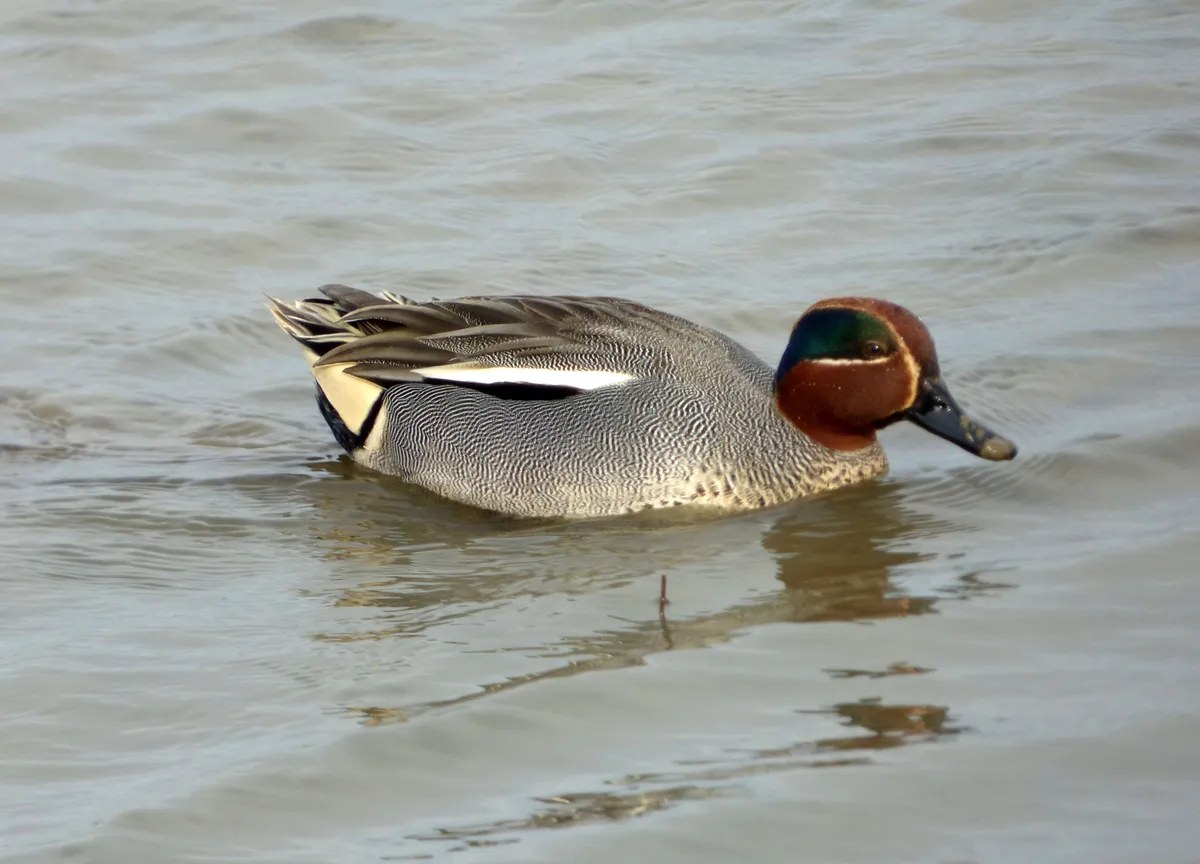
The Eurasian teal (Anas crecca), common teal, or Eurasian green-winged teal is a common and widespread duck that breeds in temperate Eurosiberia and migrates south in winter. The Eurasian teal is often called simply the teal due to being the only one of these small dabbling ducks in much of its range. The bird gives its name to the blue-green colour teal. It is a highly gregarious duck outside the breeding season and can form large flocks. It is commonly found in sheltered wetlands and feeds on seeds and aquatic invertebrates. The North American green-winged teal (A. carolinensis) was formerly (and sometimes is still) considered a subspecies of A. crecca.
Description
The Eurasian teal is one of the smallest extant dabbling ducks at 34–43 cm (13–17 in) length and with an average weight of 360 g (13 oz) in drake (males) and 340 g (12 oz) in hens (females). The wings are 17.5–20.4 cm (6.9–8.0 in) long, yielding a wingspan of 53–59 cm (21–23 in). The bill measures 3.2–4 cm (1.3–1.6 in) in length, and the tarsus 2.8–3.4 cm (1.1–1.3 in). From a distance, the drakes in breeding plumage appear grey, with a dark head, a yellowish behind, and a white stripe running along the flanks. Their head and upper neck is chestnut, with a wide and iridescent dark green patch of half-moon or teardrop-shape that starts immediately before the eye and arcs to the upper hindneck. The patch is bordered with thin yellowish-white lines, and a single line of that colour extends from the patch's forward end, curving along the base of the bill. The breast is buff with small round brown spots. The centre of the belly is white, and the rest of the body plumage is mostly white with thin and dense blackish vermiculations, appearing medium grey even at a short distance. The outer scapular feathers are white, with a black border to the outer vanes, and form the white side-stripe when the bird is in resting position. The primary remiges are dark greyish brown; the speculum feathers are iridescent blackish-green with white tips, and form the speculum together with the yellowish-white tips of the larger upperwing coverts (which are otherwise grey). The underwing is whitish, with grey remiges, dense dark spotting on the inner coverts and a dark leading edge. The tail and tail coverts are black, with a bright yellowish-buff triangular patch in the centre of the coverts at each side. In non-breeding (eclipse) plumage, the drake looks more like the duck (female); it is more uniform in colour, with a dark head and vestigial facial markings. The duck itself is yellowish-brown, somewhat darker on wings and back. It has a dark greyish-brown upper head, hindneck, eyestripe and feather pattern. The pattern is dense short streaks on the head and neck, and scaly spots on the rest of the body; overall they look much like a tiny mallard (A. platyrhynchos) duck when at rest.
Text from Wikipedia — Eurasian teal, revision 1371348690, CC BY-SA 4.0, retrieved 2026-09-04. Encyclopedic text reused under CC BY-SA 4.0. Sentences about hunting or regulation are removed: on this site, the rule comes from Québec.ca.
Other names
French
English
Presence in Quebec
- Origin
- Indigène
- Occurrence
- Régulier
- Population status
- Reproducteur
- Certainty
- Confirmé
Conservation
Québec.ca
Official periods
Source: Québec.ca — tables reproduced as published (retrieved 2026-08-30).
Regulations change. Always check Québec.ca before hunting or trapping.
Where this data comes from
This species is listed in an official government dataset. The identification and status shown in the data sheet are reproduced from it.
Source: List of Quebec’s vertebrate wildlife (LFVQ) — Ministère de l’Environnement, de la Lutte contre les changements climatiques, de la Faune et des Parcs. File LFVQ_25_03_2026.csv, retrieved 2026-08-30 · CC BY 4.0.
Measurements, habitat, diet and reproduction are not shown: no official source is attached to them yet.