
No period published by Québec.ca
Québec.ca publishes no hunting or trapping period for this species. Check the official regulations.
Wikipedia
Sittelle à poitrine blanche
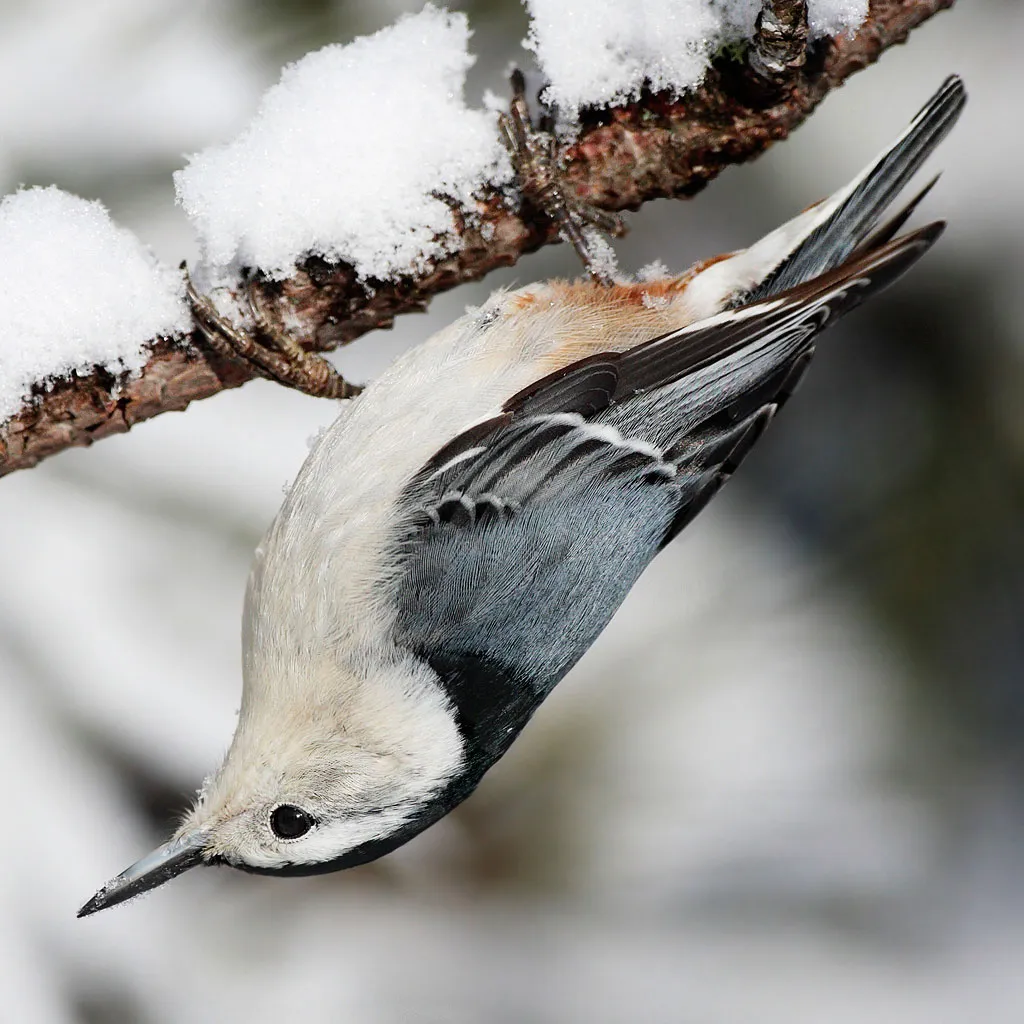
The white-breasted nuthatch (Sitta carolinensis) is a species of bird in the nuthatch family Sittidae. It is a medium-sized nuthatch, measuring approximately 15.5 cm (6.1 in) in length. Coloration varies somewhat along the species' range, but the upperparts are light blue-gray, with a black crown and nape in males, while females have a dark gray crown. The underparts are whitish, with a reddish tinge on the lower abdomen. Despite not being closely related, the white-breasted nuthatch and the white wagtail are very similar in plumage. The white-breasted nuthatch is a chatty bird. It has a nasal voice and often utters little cries or vocalizations, often composed of repetitions of small invariant whistles. In summer, it is an exclusively insectivorous bird, consuming a wide range of arthropods, but in winter its diet consists mainly of seeds. The nest is located in the cavity of a tree. The clutch consists of five to nine eggs, incubated for two weeks by the female, who is fed by the male. The two adults then feed the young until they fledge, and for a few weeks after that. The white-breasted nuthatch breeds throughout much of North America, except in the cooler and drier areas. It is mainly found at low elevations, in deciduous forests or in mixed woodlands. Seven to nine subspecies are generally distinguished by their slightly distinct distributions, vocalizations, and coloration. The species was once thought to be related to the white-cheeked nuthatch (S leucopsis) and Przewalski's nuthatch (S. przewalskii), two species from southern Asia, but is actually more closely related to the giant nuthatch (S. magna), also from Southeast Asia.
Description
The white-breasted nuthatch is a medium-sized nuthatch, measuring about 15.5 cm (6.1 in) in length. Like other members of its genus, it has a large head, short tail, short wings, a powerful bill and strong feet; it is 13–14 cm (5.1–5.5 in) long, with a wingspan of 20–27 cm (7.9–10.6 in) and a weight of 18–30 g (0.63–1.06 oz). The adult male of the nominate subspecies, S. c. carolinensis, has pale blue-gray upperparts, a glossy black cap (crown of the head), and a black band on the upper back. The wing coverts and flight feathers are very dark gray with paler fringes, and the closed wing is pale gray and black, with a thin white wing bar. The face and the underparts are white. The outer tail feathers are black with broad diagonal white bands across the outer three feathers, a feature readily visible in flight. The female has, on average, a narrower black back band, slightly duller upperparts and buffer underparts than the male. Her cap may be gray, but many females have black caps and cannot be reliably distinguished from the male in the field. In the northeastern United States, at least 10% of females have black caps, but the proportion rises to 40–80% in the Rocky Mountains, Mexico and the southeastern U.S. Juveniles are similar to the adult, but duller plumaged.
Text from Wikipedia — White-breasted nuthatch, revision 1368488760, CC BY-SA 4.0, retrieved 2026-09-04. Encyclopedic text reused under CC BY-SA 4.0. Sentences about hunting or regulation are removed: on this site, the rule comes from Québec.ca.
Other names
French
English
Presence in Quebec
- Origin
- Indigène
- Occurrence
- Régulier
- Population status
- Toute l'année
- Certainty
- Confirmé
Conservation
Québec.ca
Official periods
Source: Québec.ca — tables reproduced as published (retrieved 2026-08-30).
Regulations change. Always check Québec.ca before hunting or trapping.
Where this data comes from
This species is listed in an official government dataset. The identification and status shown in the data sheet are reproduced from it.
Source: List of Quebec’s vertebrate wildlife (LFVQ) — Ministère de l’Environnement, de la Lutte contre les changements climatiques, de la Faune et des Parcs. File LFVQ_25_03_2026.csv, retrieved 2026-08-30 · CC BY 4.0.
Measurements, habitat, diet and reproduction are not shown: no official source is attached to them yet.