
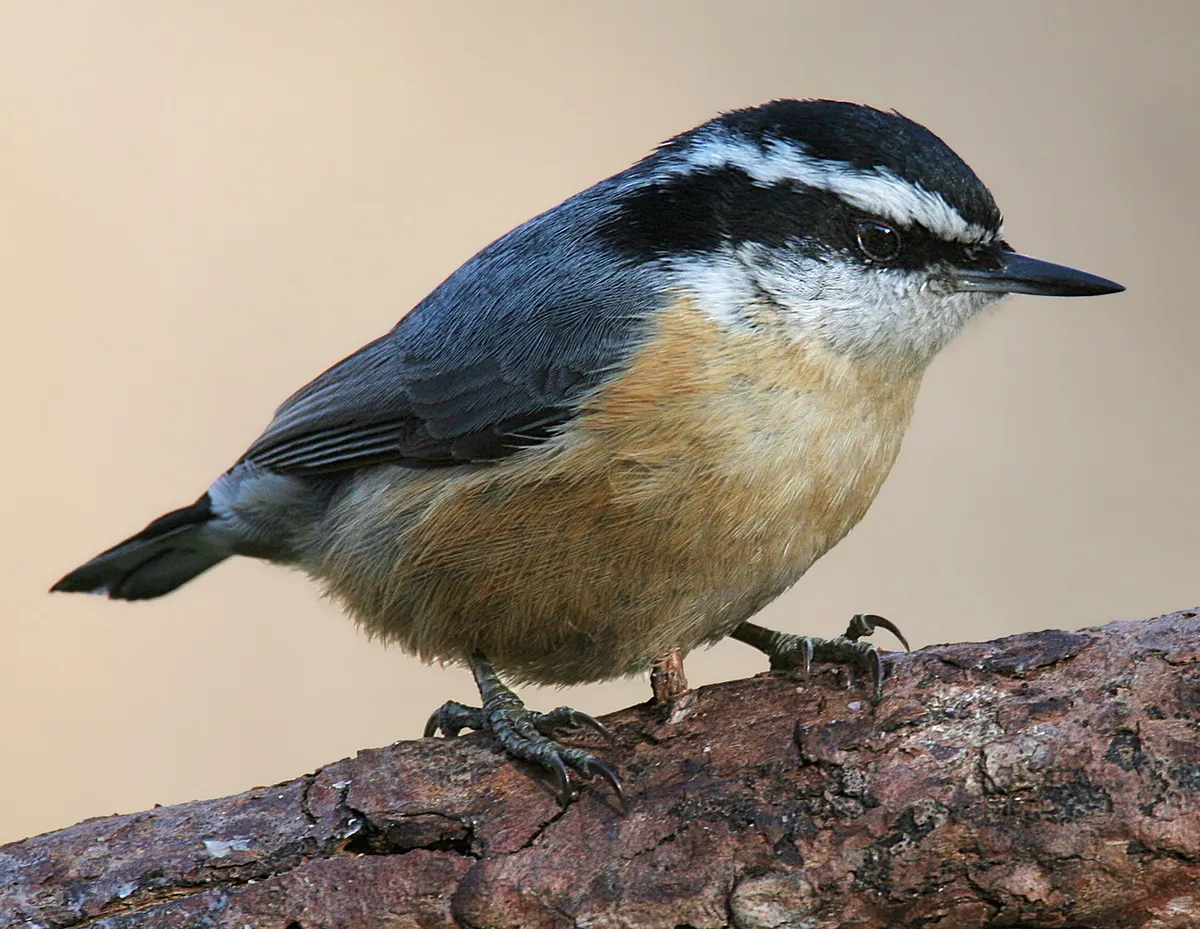
Sittelle à poitrine rousse— Quebec wildlife
Sitta canadensis
SittidaeNo period published by Québec.ca
Québec.ca publishes no hunting or trapping period for this species. Check the official regulations.
Wikipedia
Sittelle à poitrine rousse
The red-breasted nuthatch (Sitta canadensis) is a small songbird. The adult has blue-grey upperparts with cinnamon underparts, a white throat and face with a black stripe through the eyes, a straight grey bill and a black crown. Its call, which has been likened to a tin trumpet, is high-pitched and nasal. It breeds in coniferous forests across Canada, Alaska and the northeastern and western United States. Though often a permanent resident, it regularly irrupts further south if its food supply fails. There are records of vagrants occurring as far south as the Gulf Coast and northern Mexico. It forages on the trunks and large branches of trees, often descending head first, sometimes catching insects in flight. It eats mainly insects and seeds, especially from conifers. It excavates its nest in dead wood, often close to the ground, smearing the entrance with pitch.
Description
The red-breasted nuthatch is a small passerine, measuring 4.5 in (11 cm) in length, with a wingspan of 8.5 in (22 cm) and a weight of 9.9 g (0.35 oz). Its back and uppertail are bluish, and its underparts are rust-coloured. It has a black cap and eye line and a white supercilium (eyebrow). Sexes are similarly plumaged, though adult males are brigher orange below, and conversely females and youngsters have duller heads and paler underparts.
Reproduction
The red-breasted nuthatch, like all nuthatches, is monogamous. The male courts the female with a peculiar display, lifting his head and tail while turning his back to her, drooping his wings, and swaying from side to side. This bird excavates its own cavity nest, 1.53–37 m (5.0–121.4 ft) above ground (usually around 4.6 m (15 ft). Excavation is done by both sexes and takes one to eight weeks. The pair smears sap around the entrance hole, presumably to help deter predators. The nest is lined with grass, moss, shredded bark and rootlets. Nest building is done by both sexes, but mostly by females. The female lays 2–8 eggs (usually 5–6), which are white, creamy or pinkish, and covered with reddish-brown speckles. The eggs measure 0.6–0.7 in (1.5–1.8 cm) long by 0.4–0.5 in (1.0–1.3 cm) wide. Incubation is done by the female and lasts 12–13 days. The young are altricial and stay in the nest for 2–3 weeks, brooded by the female but fed by both sexes. Normally, there is only one brood per year. Lifespan is around 6 years.
Text from Wikipedia — Red-breasted nuthatch, revision 1357464341, CC BY-SA 4.0, retrieved 2026-09-04. Encyclopedic text reused under CC BY-SA 4.0. Sentences about hunting or regulation are removed: on this site, the rule comes from Québec.ca.
Other names
French
English
Presence in Quebec
- Origin
- Indigène
- Occurrence
- Régulier
- Population status
- Toute l'année
- Certainty
- Confirmé
Conservation
Québec.ca
Official periods
Source: Québec.ca — tables reproduced as published (retrieved 2026-08-30).
Regulations change. Always check Québec.ca before hunting or trapping.
Where this data comes from
This species is listed in an official government dataset. The identification and status shown in the data sheet are reproduced from it.
Source: List of Quebec’s vertebrate wildlife (LFVQ) — Ministère de l’Environnement, de la Lutte contre les changements climatiques, de la Faune et des Parcs. File LFVQ_25_03_2026.csv, retrieved 2026-08-30 · CC BY 4.0.
Measurements, habitat, diet and reproduction are not shown: no official source is attached to them yet.