
No period published by Québec.ca
Québec.ca publishes no hunting or trapping period for this species. Check the official regulations.
Wikipedia
Souris sauteuse des champs
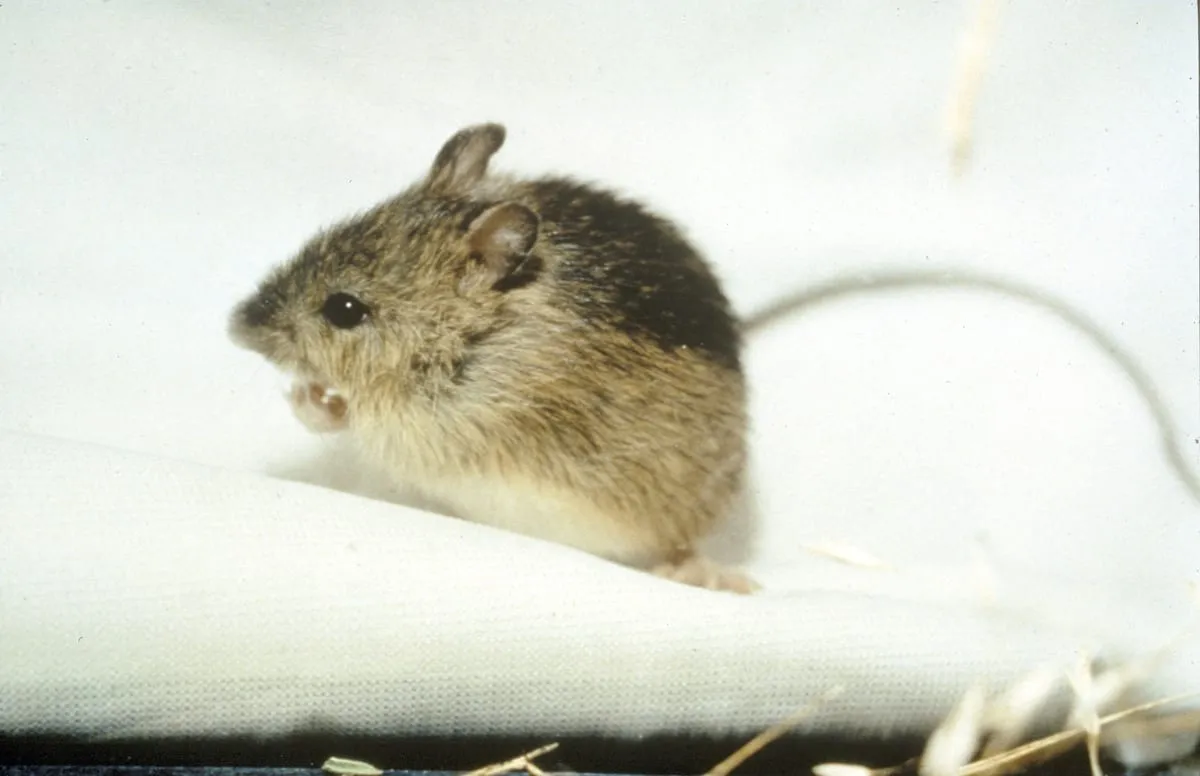
The meadow jumping mouse (Zapus hudsonius) is the most widely distributed mouse in the family Zapodidae. Its range extends from the Atlantic coast in the east to the Great Plains west, and from the arctic tree lines in Canada and Alaska to the north, and Georgia, Alabama, Arizona, and New Mexico to the south. In mid-2014, the New Mexico subspecies of the meadow jumping mouse, Zapus hudsonius luteus, was listed as an endangered species under the federal Endangered Species Act.
Description
The meadow jumping mouse can range in length, from 180 mm to 240 mm, with its tail taking credit for most of its length, usually about 108 mm to 165 mm. A distinct characteristic about this species is its enlarged hind feet, which can be 28 to 35 mm long, and relatively short forelimbs. This gives it a kangaroo rat-like look, although its tail shows that it is not a kangaroo rat because it is not bushy at the tip. The pelage of this creature is short, and with somewhat dense, coarse hair. The color of the pelage has a few variations, but a broad dorsal stripe is always present. This broad dorsal stripe is of a darker brown color, with black tips, giving it a somewhat a grayish appearance. The sides are usually a lighter color, usually bright yellow to orange, and the under body is usually white, matching the color of its feet. These mice have eight mammary glands, four inguinal, two pectoral, and two abdominal. The male genitalia are inconspicuous except during mating season when the scrotal sac becomes enlarged and more visible. The tail (which again makes up most of this creature's body length) is bicolored, showing a darker color from above and a lighter color below. It is lightly covered with hair, which gets longer as it approaches the tip, but does not get bushy like the kangaroo rat. Its ears are very noticeable, and its whiskers are prominent. The head is small, and narrow, and it is considered to be relatively high crowned. The nose is short, yet it is pointy, and the eyes are relatively big. These mice also have a large infraorbital foramen. With the exception of the Aye-Aye, the meadow jumping mouse is the only mammal to have eighteen teeth with a dental formula of: 1/1, 0/0, 1/0, and 3/3. The upper jaw is short, and narrow. The incisors are longitudinally grooved, and its cheek teeth are small. Preceding the molars is a small peg-like premolar. As a whole the female jumping mouse is slightly larger, and heavier than the male, but their weight varies quite a bit depending on the season. Their weight during summer seasons can range from 11.15 grams to 24. 8 grams, with an average at about 16 to 19 grams. Just prior to hibernation, jumping mice can obtain a weight of 35 grams or larger.
Habitat and range
Meadow jumping mice prefer a habitat which is high in humidity. Although they may live in many different areas usually with high herbaceous cover, they prefer moist grasslands, and avoid heavily wooded areas.
Text from Wikipedia — Meadow jumping mouse, revision 1367559177, CC BY-SA 4.0, retrieved 2026-09-04. Encyclopedic text reused under CC BY-SA 4.0. Sentences about hunting or regulation are removed: on this site, the rule comes from Québec.ca.
Other names
French
Presence in Quebec
- Origin
- Indigène
- Occurrence
- Régulier
- Population status
- Toute l'année
- Certainty
- Confirmé
Conservation
Québec.ca
Official periods
Source: Québec.ca — tables reproduced as published (retrieved 2026-08-30).
Regulations change. Always check Québec.ca before hunting or trapping.
Where this data comes from
This species is listed in an official government dataset. The identification and status shown in the data sheet are reproduced from it.
Source: List of Quebec’s vertebrate wildlife (LFVQ) — Ministère de l’Environnement, de la Lutte contre les changements climatiques, de la Faune et des Parcs. File LFVQ_25_03_2026.csv, retrieved 2026-08-30 · CC BY 4.0.
Measurements, habitat, diet and reproduction are not shown: no official source is attached to them yet.