
No period published by Québec.ca
Québec.ca publishes no hunting or trapping period for this species. Check the official regulations.
Wikipedia
Souris sylvestre
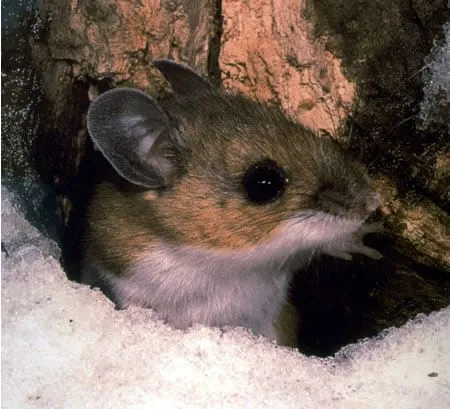
The eastern deer mouse (Peromyscus maniculatus) is a rodent native to eastern North America. It is a species of the genus Peromyscus, a closely related group of New World mice often called "deermice". When formerly grouped with the western deermouse (P. sonoriensis), it was once referred to as the North American deermouse, a species that is no longer recognized. It is fairly widespread across most of North America east of the Mississippi River, with the major exception being the lowland Southeastern United States. Like certain other Peromyscus species, it can be a vector and carrier of emerging infectious diseases such as hantaviruses and Lyme disease. It is closely related to Peromyscus leucopus, the white-footed mouse.
Habitat and range
P. maniculatus is found in all throughout eastern North America. The deer mouse nests alone for the most part, but during the winter, nests in groups of 10 or more. Deer mice, specifically the prairie form, are also abundant in the farmland of the Midwestern United States. Deer mice can be found active on top of snow or beneath logs during the winter seasons. In northern New England, deer mice are present in both coniferous and deciduous forests. Deer mice are often the only Peromyscus species in northern boreal forest. Subspecies differ in their use of plant communities and vegetation structures. The two main groups of deer mouse are the prairie deer mouse and the woodland or forest deer mouse group.
Diet
Deer mice are omnivorous; their main dietary items usually include seeds, fruit, arthropods, leaves, and fungi; fungi have the least amount of intake. Throughout the year, the deer mouse changes its eating habits to reflect what is available. During winters, arthropods compose of one-fifth of its food. These include spiders, caterpillars, and heteropterans. During the spring, seeds become available to eat, along with insects, which are consumed in large quantities. Leaves are also found in the stomachs of deer mice in the spring. During summers, the mouse consumes seeds and fruit. During the fall, the deer mouse slowly changes its eating habits to resemble the winter's diet.
Text from Wikipedia — Eastern deer mouse, revision 1358312118, CC BY-SA 4.0, retrieved 2026-09-04. Encyclopedic text reused under CC BY-SA 4.0. Sentences about hunting or regulation are removed: on this site, the rule comes from Québec.ca.
Presence in Quebec
- Origin
- Indigène
- Occurrence
- Régulier
- Population status
- Toute l'année
- Certainty
- Confirmé
Conservation
Québec.ca
Official periods
Source: Québec.ca — tables reproduced as published (retrieved 2026-08-30).
Regulations change. Always check Québec.ca before hunting or trapping.
Where this data comes from
This species is listed in an official government dataset. The identification and status shown in the data sheet are reproduced from it.
Source: List of Quebec’s vertebrate wildlife (LFVQ) — Ministère de l’Environnement, de la Lutte contre les changements climatiques, de la Faune et des Parcs. File LFVQ_25_03_2026.csv, retrieved 2026-08-30 · CC BY 4.0.
Measurements, habitat, diet and reproduction are not shown: no official source is attached to them yet.