
No period published by Québec.ca
Québec.ca publishes no hunting or trapping period for this species. Check the official regulations.
Wikipedia
Spatule rosée
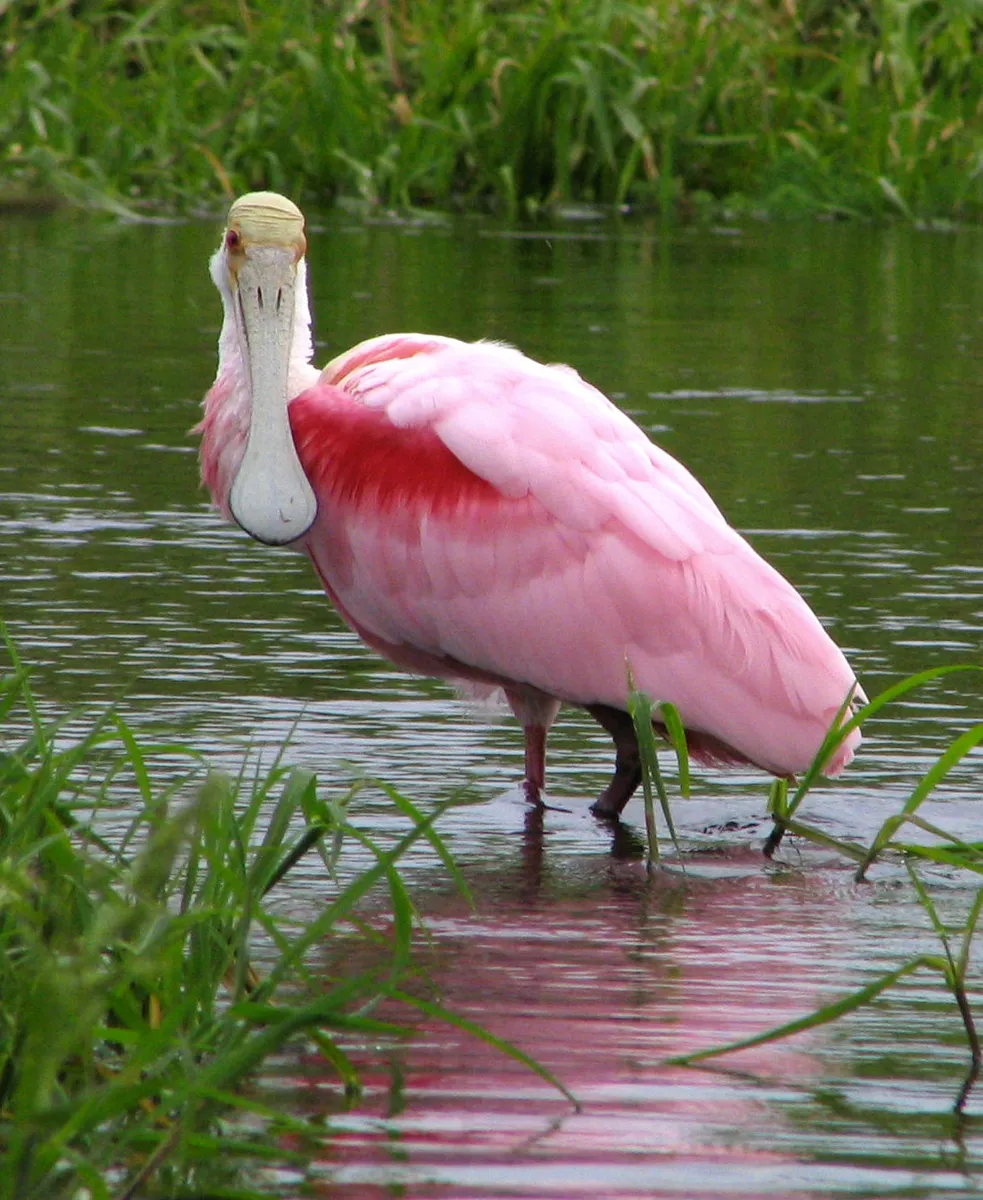
The roseate spoonbill (Platalea ajaja) is a social wading bird of the ibis and spoonbill family, Threskiornithidae. It is a resident breeder in both South and North America. The roseate spoonbill's pink color is diet-derived, consisting of the carotenoid pigment canthaxanthin, like the American flamingo.
Description
The roseate spoonbill is 71–86 cm (28–34 in) long, with a 120–133 cm (47–52 in) wingspan and a body mass of 1.2–1.8 kg (2.6–4.0 lb). The tarsus measures 9.7–12.4 cm (3.8–4.9 in), the culmen measures 14.5–18 cm (5.7–7.1 in) and the wing measures 32.3–37.5 cm (12.7–14.8 in) and thus the legs, bill, neck and spatulate bill all appear elongated. Adults have a bare greenish head ("golden buff" when breeding) and a white neck, back and breast (with a tuft of pink feathers in the center when breeding), and are otherwise a deep pink. The bill is grey. There is no significant sexual dimorphism. Like the American flamingo, their pink color is diet-derived, consisting of the carotenoid pigment canthaxanthin. Another carotenoid, astaxanthin, can also be found deposited in flight and body feathers. The colors can range from pale pink to bright magenta, depending on age, whether breeding or not, and location. Unlike herons, spoonbills fly with their necks outstretched. They alternate groups of stiff, shallow wingbeats with glides.
Habitat and range
In the United States, the species is locally common in Texas, Florida, and southwest Louisiana. Generally, the species occurs in South America mostly east of the Andes, and in coastal regions of the Caribbean, Central America, Mexico, and the Gulf Coast of the United States, and from central Florida's Atlantic coast at Merritt Island National Wildlife Refuge, adjoined with NASA Kennedy Space Center at least as far north as South Carolina's Myrtle Beach. However, following decades of conservation efforts, and the effects of climate change, the range of the roseate spoonbill has expanded considerably in the 21st century. For instance, the species was recorded breeding in the state of Georgia for the first time in 2011. Moreover, its presence in South Carolina has expanded significantly since the 1970s, as well as a single sighting of the bird in both Michigan and Wisconsin. The last known recorded log of the bird in the state of Wisconsin was of a deceased specimen in 1845 in Rock County, until it reappeared 178 years later when a specimen was sighted by a crew that was doing birding surveys on the restricted-access Cat Island causeway on 27 July 2023. In the summer of 2021, sightings of the bird were reported well outside its typical range, including in Washington, D.C., upstate New York, and even New Hampshire. The bird has also been spotted in New Jersey with increasing frequency. In Florida Bay, roseate spoonbills are an ecological and scientific indicator species.
Text from Wikipedia — Roseate spoonbill, revision 1367390641, CC BY-SA 4.0, retrieved 2026-09-04. Encyclopedic text reused under CC BY-SA 4.0. Sentences about hunting or regulation are removed: on this site, the rule comes from Québec.ca.
Presence in Quebec
- Origin
- Indigène
- Occurrence
- Accidentel/non régulier
- Population status
- Migrateur
- Certainty
- Confirmé
Conservation
Québec.ca
Official periods
Source: Québec.ca — tables reproduced as published (retrieved 2026-08-30).
Regulations change. Always check Québec.ca before hunting or trapping.
Where this data comes from
This species is listed in an official government dataset. The identification and status shown in the data sheet are reproduced from it.
Source: List of Quebec’s vertebrate wildlife (LFVQ) — Ministère de l’Environnement, de la Lutte contre les changements climatiques, de la Faune et des Parcs. File LFVQ_25_03_2026.csv, retrieved 2026-08-30 · CC BY 4.0.
Measurements, habitat, diet and reproduction are not shown: no official source is attached to them yet.