
No period published by Québec.ca
Québec.ca publishes no hunting or trapping period for this species. Check the official regulations.
Wikipedia
Sterne de Forster
Forster's tern (Sterna forsteri) is a tern in the family Laridae. The genus name Sterna is derived from Old English "stearn", "tern", and forsteri commemorates the naturalist Johann Reinhold Forster. It breeds inland in North America in the northern United States and southern Canada, and migrates south to winter in the southern United States, Mexico, the Caribbean, and northern Central America. It is also a rare but annual vagrant in western Europe, and has wintered in Ireland and Great Britain on a number of occasions. This species breeds in colonies in marshes. It nests in a ground scrape and lays two or more eggs. Like all white terns, it is fiercely defensive of its nest and young. The Forster's tern feeds by plunge-diving for fish, but will also hawk for insects in its breeding marshes. It usually feeds from saline environments in winter, like most Sterna terns. It usually dives directly, and not from the "stepped-hover" favored by the Arctic tern. The offering of fish by the male to the female is part of the courtship display. This is a medium-small tern, 33–36 cm (13–14 in) long with a 78–80 cm (31–31 in) wingspan and a weight ranging from 130 to 190 g (4.6 to 6.7 oz). It is most similar to the common tern, with pale gray upperparts and white underparts. Its legs are red and its bill is red, tipped with black. In winter, the forehead becomes white and a characteristic black eye mask remains. Juvenile Forster's terns are similar to the winter adult, but with a scaly gingery-brown pattern on the back and wing coverts. The call is similar to that of common terns, but also some harsher sounds suggestive of a small gull like Bonaparte's gull. This species is unlikely to be confused with the common tern in winter because of the black eye mask, but is much more similar in breeding plumage. Forster's has a gray center to its white tail, and the upperwings are whiter, without the darker primary wedge of the common tern.
Description
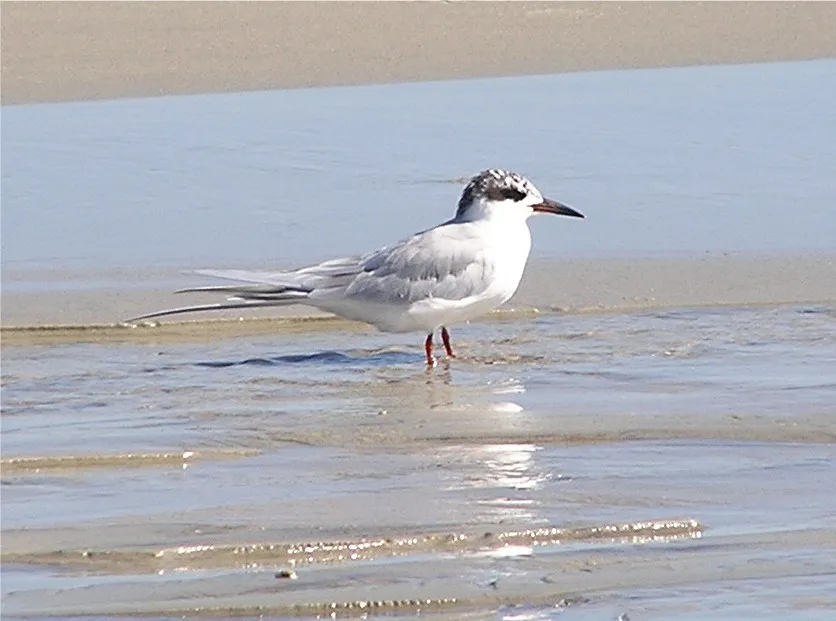
Forster's tern is a medium-sized tern with a slender body, deeply forked long tail and relatively long legs. In its non-breeding plumage, the crown is white and a black comma-shaped patch covers the eye and the ear-covert. The wings are gray with the primaries being dark silvery gray, while the underside is white. The bill is black and the legs are a dull brownish red. When breeding, an intense black cap extending down the neck appears. The wings and the back are pale gray while the underside is bright white. It has a black-tipped orange bill and bright orange legs. The juveniles have coloring similar to a non-breeding adult but often have darker primaries, and a scaly gingery-brown pattern on the back and wing coverts.
Text from Wikipedia — Forster's tern, revision 1369380255, CC BY-SA 4.0, retrieved 2026-09-04. Encyclopedic text reused under CC BY-SA 4.0. Sentences about hunting or regulation are removed: on this site, the rule comes from Québec.ca.
Other names
French
English
Presence in Quebec
- Origin
- Indigène
- Occurrence
- Accidentel/non régulier
- Population status
- Migrateur
- Certainty
- Confirmé
Conservation
Québec.ca
Official periods
Source: Québec.ca — tables reproduced as published (retrieved 2026-08-30).
Regulations change. Always check Québec.ca before hunting or trapping.
Where this data comes from
This species is listed in an official government dataset. The identification and status shown in the data sheet are reproduced from it.
Source: List of Quebec’s vertebrate wildlife (LFVQ) — Ministère de l’Environnement, de la Lutte contre les changements climatiques, de la Faune et des Parcs. File LFVQ_25_03_2026.csv, retrieved 2026-08-30 · CC BY 4.0.
Measurements, habitat, diet and reproduction are not shown: no official source is attached to them yet.