
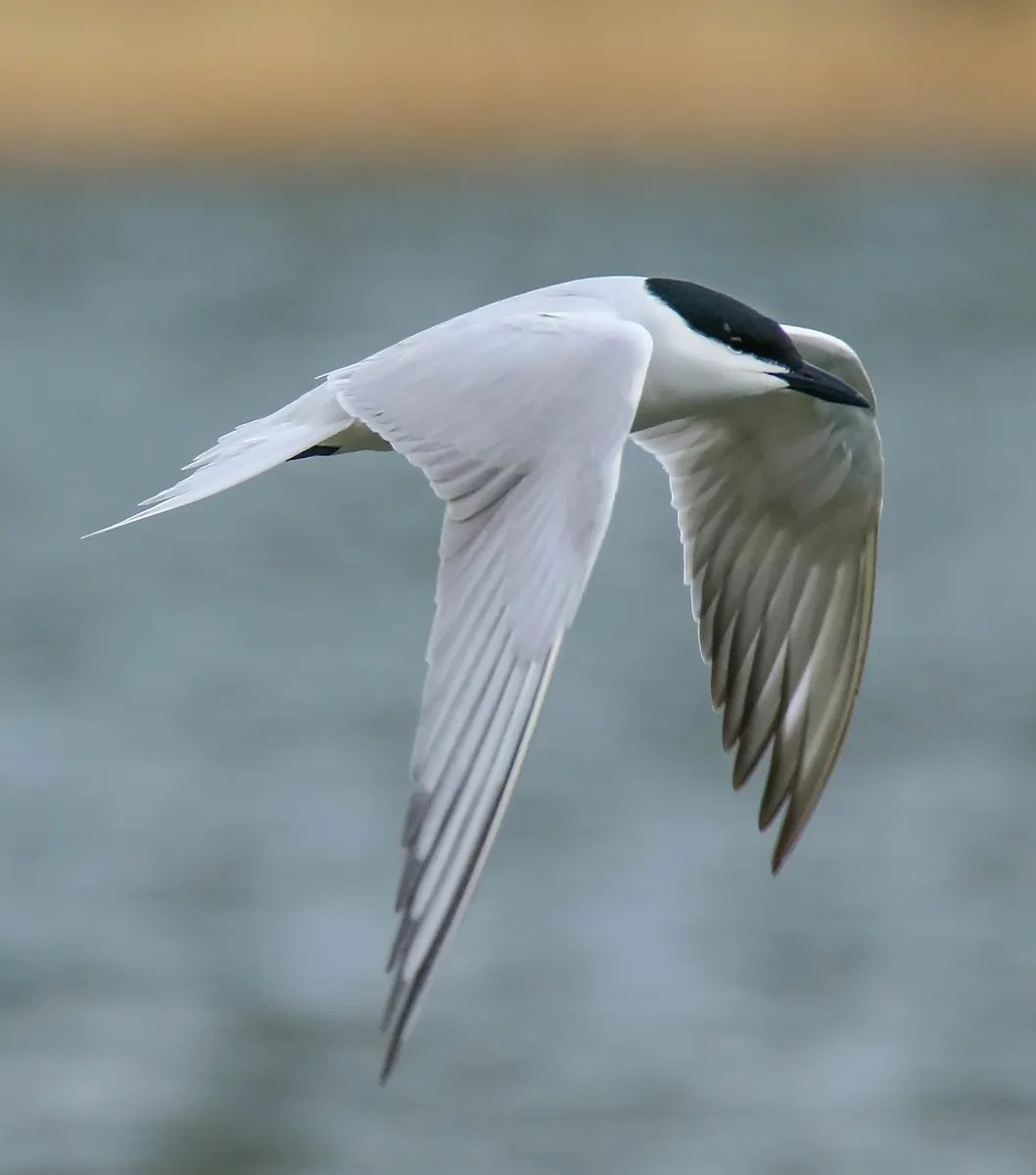
Sterne hansel— Quebec wildlife
Gelochelidon nilotica
LaridaeNo period published by Québec.ca
Québec.ca publishes no hunting or trapping period for this species. Check the official regulations.
Wikipedia
Sterne hansel
The gull-billed tern (Gelochelidon nilotica) is a tern in the family Laridae. It is widely distributed and breeds in scattered localities in Europe, Asia, northwest Africa, and the Americas. The Australian gull-billed tern was previously considered a subspecies.
Description
This is a fairly large and powerful tern, similar in size and general appearance to a Sandwich tern, but the short thick gull-like bill, broad wings, long legs and robust body are distinctive. The summer adult has grey upperparts, white underparts, a black cap, strong black bill and black legs. The call is a characteristic ker-wik. It is 33–42 cm (13–17 in) in length and 76–91 cm (30–36 in) in wingspan. Body mass ranges from 150–292 g (5.3–10.3 oz). In winter, the cap is lost, and there is a dark patch through the eye like a Forster's tern or a Mediterranean gull. Juvenile gull-billed terns have a fainter mask, but otherwise look much like winter adults. Juvenile Sandwich terns have a short bill, and are frequently mistaken for gull-billed tern where the latter species is uncommon, such as North Sea coasts.
Text from Wikipedia — Gull-billed tern, revision 1357126300, CC BY-SA 4.0, retrieved 2026-09-04. Encyclopedic text reused under CC BY-SA 4.0. Sentences about hunting or regulation are removed: on this site, the rule comes from Québec.ca.
Presence in Quebec
- Origin
- Indigène
- Occurrence
- Accidentel/non régulier
- Population status
- Migrateur
- Certainty
- Confirmé
Conservation
Québec.ca
Official periods
Source: Québec.ca — tables reproduced as published (retrieved 2026-08-30).
Regulations change. Always check Québec.ca before hunting or trapping.
Where this data comes from
This species is listed in an official government dataset. The identification and status shown in the data sheet are reproduced from it.
Source: List of Quebec’s vertebrate wildlife (LFVQ) — Ministère de l’Environnement, de la Lutte contre les changements climatiques, de la Faune et des Parcs. File LFVQ_25_03_2026.csv, retrieved 2026-08-30 · CC BY 4.0.
Measurements, habitat, diet and reproduction are not shown: no official source is attached to them yet.