
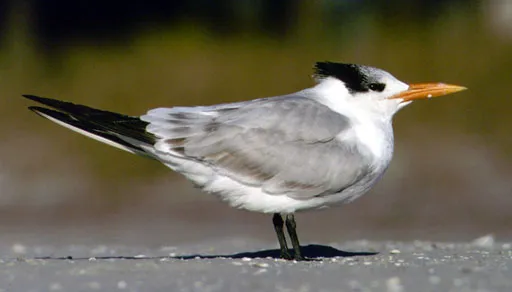
Sterne royale— Quebec wildlife
Thalasseus maximus
LaridaeNo period published by Québec.ca
Québec.ca publishes no hunting or trapping period for this species. Check the official regulations.
Wikipedia
Sterne royale
The royal tern (Thalasseus maximus) is a tern in the family Laridae. The species is endemic to the Americas, though vagrants have been identified in Europe.
Description
This is a large tern, second only to the Caspian tern among terns in the Americas, but is unlikely to be confused with this "carrot-billed" giant, which has extensive dark underwing patches. Adults have an average wingspan of 130 cm (51 in) for both sexes, with a range from 125–135 cm (49–53 in). Its bill-to-tail length ranges from 45–50 cm (18–20 in) and the weight is anywhere from 350–500 g (12–18 oz). The Old World West African crested tern T. albididorsalis and greater crested tern T. bergii are the same size; vagrant royal terns in Europe need careful documentation to distinguish them from the West African crested tern, which has also been recorded in Europe. The royal tern can also be confused with the smaller elegant tern T. elegans; that has a longer but slenderer, slightly downcurved, bill, and a longer crest. The royal tern has a stout orange-red bill, pale silvery-gray upperparts, and white underparts. Its legs are black. The entire crown is black with a shaggy, erectable crest on the nape in the spring during courtship and the start of the breeding season. From early summer into late winter, the black becomes first patchy and then fully white on the forehead and upper crown, retaining black only on the nape. Compared to elegant tern, its molt out of breeding plumage is about two months earlier (June, versus August, for northern populations), and more extensively white. Juvenile royal terns are similar to non-breeding adults, differing in the juveniles having darker gray to blackish marks on the wings, and a yellower bill. The calls of the royal tern are usually short, clear shrills. Some of the shrills sound like kree or tsirr; it also has a more plover-like whistle that is longer, rolling, and more melodious.
Text from Wikipedia — Royal tern, revision 1362867660, CC BY-SA 4.0, retrieved 2026-09-04. Encyclopedic text reused under CC BY-SA 4.0. Sentences about hunting or regulation are removed: on this site, the rule comes from Québec.ca.
Presence in Quebec
- Origin
- Indigène
- Occurrence
- Accidentel/non régulier
- Population status
- Migrateur
- Certainty
- Confirmé
Conservation
Québec.ca
Official periods
Source: Québec.ca — tables reproduced as published (retrieved 2026-08-30).
Regulations change. Always check Québec.ca before hunting or trapping.
Where this data comes from
This species is listed in an official government dataset. The identification and status shown in the data sheet are reproduced from it.
Source: List of Quebec’s vertebrate wildlife (LFVQ) — Ministère de l’Environnement, de la Lutte contre les changements climatiques, de la Faune et des Parcs. File LFVQ_25_03_2026.csv, retrieved 2026-08-30 · CC BY 4.0.
Measurements, habitat, diet and reproduction are not shown: no official source is attached to them yet.