
No period published by Québec.ca
Québec.ca publishes no hunting or trapping period for this species. Check the official regulations.
Wikipedia
Sturnelle des prés
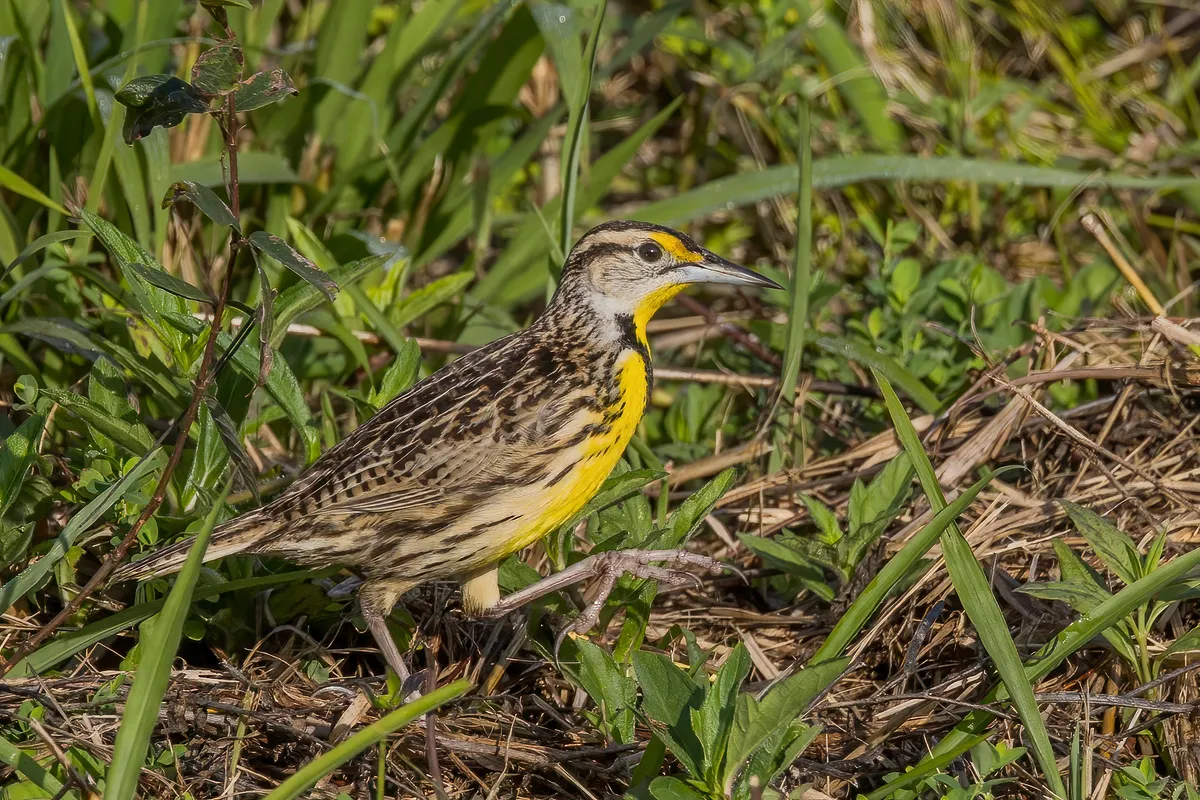
The eastern meadowlark (Sturnella magna) is a medium-sized icterid bird, very similar in appearance to its sister species, the western meadowlark. It occurs from eastern North America to northern South America, where it is also most widespread in the east. The Chihuahuan meadowlark was formerly considered to be conspecific with the eastern meadowlark.
Description
The adult eastern meadowlark measures from 19 to 28 cm (7.5 to 11.0 in) in length and spans 35–40 cm (14–16 in) across the wings. Body mass ranges from 76 to 150 g (2.7 to 5.3 oz). The extended wing bone measures 8.9–12.9 cm (3.5–5.1 in), the tail measures 5.3–8.6 cm (2.1–3.4 in), the culmen measures 2.8–3.7 cm (1.1–1.5 in) and the tarsus measures 3.6–4.7 cm (1.4–1.9 in). Females are smaller in all physical dimensions. Adults have yellow underparts with a black "V" on the breast and white flanks with black streaks. The upperparts are mainly brown with black streaks. They have a long pointed bill; the head is striped with light brown and black. The song of this bird is of pure, melancholy whistles, and thus simpler than the jumbled and flutey song of the western meadowlark; their ranges overlap across central North America. In the field, the song is often the easiest way to tell the two species apart, though plumage differences do exist, like tail pattern and malar coloration. In nonbreeding plumage, eastern meadowlarks tend to have more yellow-brown coloration in their flanks and more distinct striping on their heads. The pale Chihuahuan meadowlark of northern Mexico and the southwestern US was recognized as a separate species by the American Ornithological Society in 2022.
Text from Wikipedia — Eastern meadowlark, revision 1363983332, CC BY-SA 4.0, retrieved 2026-09-04. Encyclopedic text reused under CC BY-SA 4.0. Sentences about hunting or regulation are removed: on this site, the rule comes from Québec.ca.
Other names
French
English
Presence in Quebec
- Origin
- Indigène
- Occurrence
- Régulier
- Population status
- Reproducteur
- Certainty
- Confirmé
Conservation
Québec.ca
Official periods
Source: Québec.ca — tables reproduced as published (retrieved 2026-08-30).
Regulations change. Always check Québec.ca before hunting or trapping.
Where this data comes from
This species is listed in an official government dataset. The identification and status shown in the data sheet are reproduced from it.
Source: List of Quebec’s vertebrate wildlife (LFVQ) — Ministère de l’Environnement, de la Lutte contre les changements climatiques, de la Faune et des Parcs. File LFVQ_25_03_2026.csv, retrieved 2026-08-30 · CC BY 4.0.
Measurements, habitat, diet and reproduction are not shown: no official source is attached to them yet.