
No period published by Québec.ca
Québec.ca publishes no hunting or trapping period for this species. Check the official regulations.
Wikipedia
Talève violacée
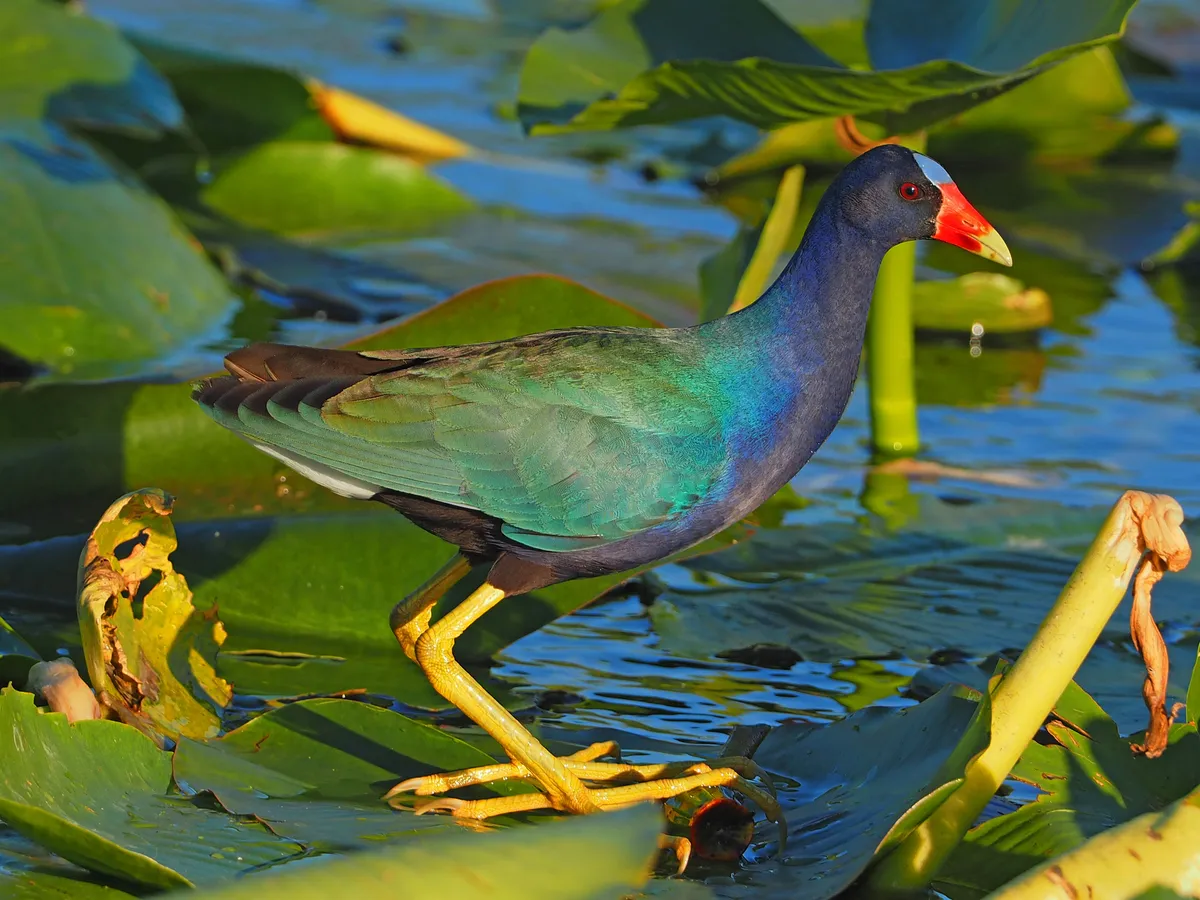
The purple gallinule (Porphyrio martinica) is a species of swamphen found in the Americas. It is in the order Gruiformes, meaning "crane-like", an order which also contains cranes, rails, and crakes. The purple gallinule is a rail species, placing it into the family Rallidae. It is also known locally as the yellow-legged gallinule. The specific name martinica denotes "of Martinique".
Description
The purple gallinule is a medium-sized rail, measuring 26–37 cm (10–15 in) in length, spanning 50–61 cm (20–24 in) across the wings and weighing 141–305 g (5.0–10.8 oz). Males, averaging 257 g (9.1 oz) in mass, are slightly larger than females, at 215 g (7.6 oz) on average. An adult purple gallinule has purple-blue plumage that will shine green and turquoise when in good lighting. Adults also have a pale blue shield on their forehead, which connects with the red and yellow bill. Darkness or low light can dim the bright purple-blue plumage of the adult to make them look dusky or brownish, although the forehead shield color differentiates them from similar species such as common gallinules. Immature purple gallinules are a brown-bronze color, with purple feathers on chest, and the bill and forehead shield is pale in color. Juvenile birds are light brown with hints of green-bronze on the wings and back, and white under-tail coverts. Purple gallinules have long toes that help them walk onto floating vegetation, by distributing their weight across a large surface area. They have an anisodactyl toe arrangement that also helps them to cling to plant stems. Adults have bright yellow legs and feet, immatures have brown-yellowish legs and feet, and juveniles have brown legs and feet. When they fly, their legs hang down. They usually fly short distances.
Text from Wikipedia — American purple gallinule, revision 1336149216, CC BY-SA 4.0, retrieved 2026-09-04. Encyclopedic text reused under CC BY-SA 4.0. Sentences about hunting or regulation are removed: on this site, the rule comes from Québec.ca.
Other names
French
Presence in Quebec
- Origin
- Indigène
- Occurrence
- Accidentel/non régulier
- Population status
- Migrateur
- Certainty
- Confirmé
Conservation
Québec.ca
Official periods
Source: Québec.ca — tables reproduced as published (retrieved 2026-08-30).
Regulations change. Always check Québec.ca before hunting or trapping.
Where this data comes from
This species is listed in an official government dataset. The identification and status shown in the data sheet are reproduced from it.
Source: List of Quebec’s vertebrate wildlife (LFVQ) — Ministère de l’Environnement, de la Lutte contre les changements climatiques, de la Faune et des Parcs. File LFVQ_25_03_2026.csv, retrieved 2026-08-30 · CC BY 4.0.
Measurements, habitat, diet and reproduction are not shown: no official source is attached to them yet.