
No period published by Québec.ca
Québec.ca publishes no hunting or trapping period for this species. Check the official regulations.
Wikipedia
Tamia mineur
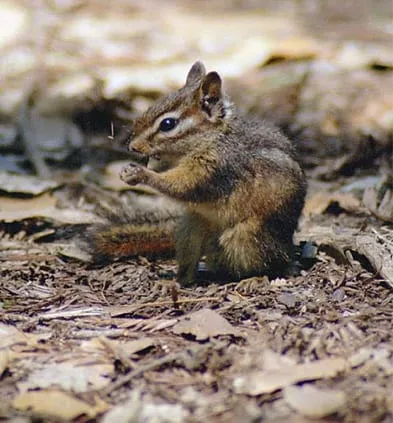
The least chipmunk (Neotamias minimus) is the smallest species of chipmunk and the most widespread in North America.
Description
It is the smallest species of chipmunk, measuring about 15.7–25 cm (6.2–9.8 in) in total length with a weight of 25–66 g (0.88–2.33 oz). The body is gray to reddish-brown on the sides, and grayish white on the underparts. The back is marked with five dark brown to black stripes separated by four white or cream-colored stripes, all of which run from the nape of the neck to the base of the tail. Two light and two dark stripes mark the face, running from the tip of the nose to the ears. The bushy tail is orange-brown in color, and measures 10–11 cm (3.9–4.3 in) long. In some areas, where range overlap with the yellow-pine chipmunk occurs, it may be difficult or impossible to distinguish the two species in the field; laboratory examination of skeletal structures may be required. As in other chipmunks, there are four toes on each of the forefeet and five on the hindfeet. Females have eight teats. The brain to body mass ratio for least chipmunks is lower than that for other species of chipmunk living in the same area, suggesting that they prefer less complex environments.
Reproduction
Females enter estrus within a week of emerging from their burrow in the spring, and mating typically takes place between March and May. Gestation lasts 28 to 30 days, with a single litter of three to seven young being born each year; females who lose their first litter soon after birth may, however, sometimes be able to breed again in the same year. The young are born hairless and blind, measuring about 5 cm (2.0 in) in length, and weighing 6 g (0.21 oz). They are able to stand and open their eyes at 27 days, and are weaned at 36 days. They are sexually mature at one year, but do not always breed until their second year. They can live for up to six years in captivity.
Text from Wikipedia — Least chipmunk, revision 1341503005, CC BY-SA 4.0, retrieved 2026-09-04. Encyclopedic text reused under CC BY-SA 4.0. Sentences about hunting or regulation are removed: on this site, the rule comes from Québec.ca.
Other names
French
Former scientific names
Presence in Quebec
- Origin
- Indigène
- Occurrence
- Régulier
- Population status
- Toute l'année
- Certainty
- Confirmé
Conservation
Québec.ca
Official periods
Source: Québec.ca — tables reproduced as published (retrieved 2026-08-30).
Regulations change. Always check Québec.ca before hunting or trapping.
Where this data comes from
This species is listed in an official government dataset. The identification and status shown in the data sheet are reproduced from it.
Source: List of Quebec’s vertebrate wildlife (LFVQ) — Ministère de l’Environnement, de la Lutte contre les changements climatiques, de la Faune et des Parcs. File LFVQ_25_03_2026.csv, retrieved 2026-08-30 · CC BY 4.0.
Measurements, habitat, diet and reproduction are not shown: no official source is attached to them yet.