
No period published by Québec.ca
Québec.ca publishes no hunting or trapping period for this species. Check the official regulations.
Wikipedia
Tamia rayé
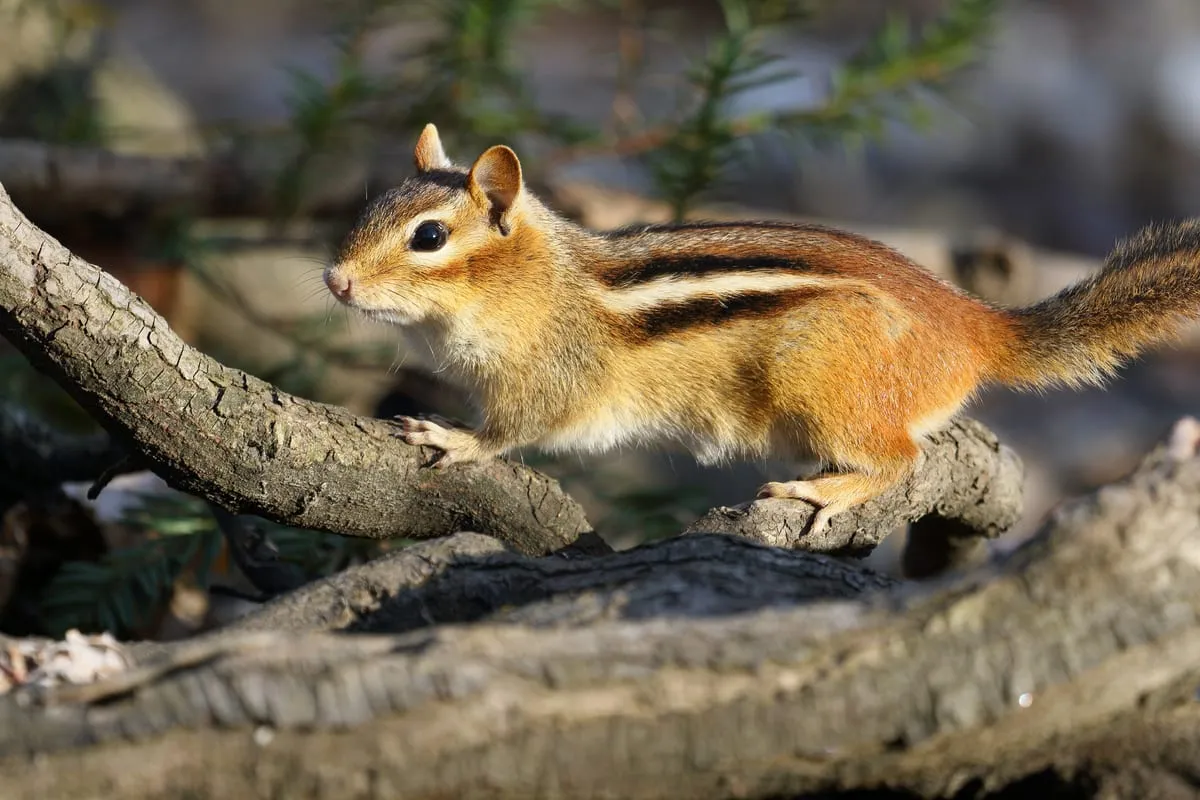
The eastern chipmunk (Tamias striatus) is a chipmunk species found in eastern North America. It is the only living member of the genus Tamias.
Description
A small species, it reaches about 30 cm (12 in) in length including the tail, and a weight of 66–150 g (2.3–5.3 oz). It has reddish-brown fur on its upper body and five dark brown stripes contrasting with light brown stripes along its back, ending in a dark tail. It has lighter fur on the lower part of its body. It has a tawny stripe that runs from its whiskers to below its ears, and light stripes over its eyes. It has two fewer teeth than other chipmunks and four toes each on the front legs, but five toes on the hind legs. The chipmunk's appearance remains consistent throughout life. There is no external difference in appearance between the sexes except the obvious anatomical characteristics of the genitalia during periods of fertility. Molt occurs once or twice annually, during May or June and sometimes again in October. Both albino and melanistic specimens have been observed, but without geographical regularity."
Habitat and range
The eastern chipmunk lives in deciduous wooded areas and urban parks throughout the eastern United States and southern Canada. It prefers locations with rocky areas, brush or log piles, and shrubs to provide cover.
Text from Wikipedia — Eastern chipmunk, revision 1367517012, CC BY-SA 4.0, retrieved 2026-09-04. Encyclopedic text reused under CC BY-SA 4.0. Sentences about hunting or regulation are removed: on this site, the rule comes from Québec.ca.
Other names
French
Presence in Quebec
- Origin
- Indigène
- Occurrence
- Régulier
- Population status
- Toute l'année
- Certainty
- Confirmé
Conservation
Québec.ca
Official periods
Source: Québec.ca — tables reproduced as published (retrieved 2026-08-30).
Regulations change. Always check Québec.ca before hunting or trapping.
Where this data comes from
This species is listed in an official government dataset. The identification and status shown in the data sheet are reproduced from it.
Source: List of Quebec’s vertebrate wildlife (LFVQ) — Ministère de l’Environnement, de la Lutte contre les changements climatiques, de la Faune et des Parcs. File LFVQ_25_03_2026.csv, retrieved 2026-08-30 · CC BY 4.0.
Measurements, habitat, diet and reproduction are not shown: no official source is attached to them yet.