
No period published by Québec.ca
Québec.ca publishes no hunting or trapping period for this species. Check the official regulations.
Wikipedia
Tantale d'Amérique
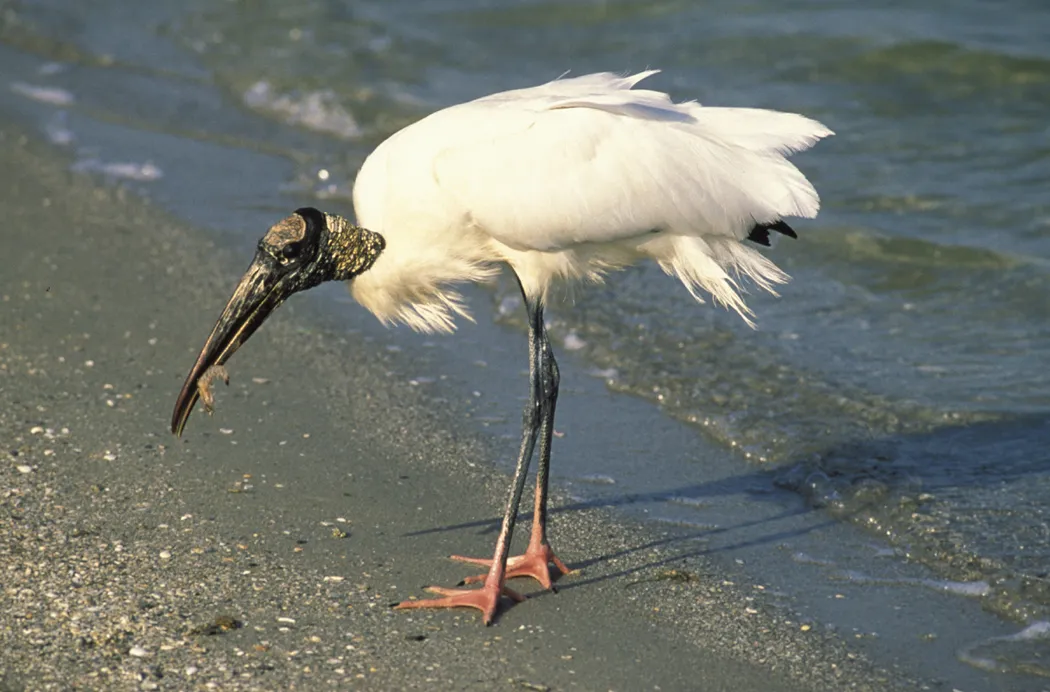
The wood stork (Mycteria americana) is a large wading bird in the family Ciconiidae (storks). Originally described in 1758 by Carl Linnaeus, this stork is native to the subtropics and tropics of the Americas, where it persists in habitats with fluctuating water levels. It is the only stork species that breeds in North America. The head and neck are bare of feathers, and dark grey in colour. The plumage is mostly white, with the exception of the tail and some of the wing feathers, which are black with a greenish-purplish sheen. Globally, the wood stork is considered to be of least concern by the International Union for Conservation of Nature. In the United States, the wood stork was previously classified as endangered due to loss of suitable feeding habitat in the Florida Everglades, its historical population stronghold in the country. The species has been subsequently downlisted to threatened after northward range expansion and increased population size.
Description
The adult wood stork is a large bird which stands 83–115 cm (33–45 in) tall with a wingspan of 140–180 cm (55–71 in). The male typically weighs 2.5–3.3 kg (5.5–7.3 lb), with a mean weight of 2.7 kg (6.0 lb); the female weighs 2.0–2.8 kg (4.4–6.2 lb), with a mean weight of 2.42 kg (5.3 lb). Another estimate puts the mean weight at 2.64 kg (5.8 lb). The head and neck of the adult are bare, and the scaly skin is a dark grey. The black downward-curved bill is long and very wide at the base. The plumage is mostly white, with the primaries, secondaries, and tail being black and having a greenish and purplish iridescence. The legs and feet are dark, and the pink/beige-coloured toes are pink during the breeding season. The sexes are similar. Newly hatched chicks have a sparse coat of grey down (protoptiles) that is replaced by a dense, wooly, and white down (mesoptiles) in about 10 days. Chicks grow fast, being about half the height of adults in 3-4 weeks. By 6-7 weeks, the plumage on the head and neck turns smokey grey. When fledged, they resemble the adult, differing only in that they have a feathered head and a yellow bill.
Text from Wikipedia — Wood stork, revision 1369307651, CC BY-SA 4.0, retrieved 2026-09-04. Encyclopedic text reused under CC BY-SA 4.0. Sentences about hunting or regulation are removed: on this site, the rule comes from Québec.ca.
Presence in Quebec
- Origin
- Indigène
- Occurrence
- Accidentel/non régulier
- Population status
- Migrateur
- Certainty
- Confirmé
Conservation
Québec.ca
Official periods
Source: Québec.ca — tables reproduced as published (retrieved 2026-08-30).
Regulations change. Always check Québec.ca before hunting or trapping.
Where this data comes from
This species is listed in an official government dataset. The identification and status shown in the data sheet are reproduced from it.
Source: List of Quebec’s vertebrate wildlife (LFVQ) — Ministère de l’Environnement, de la Lutte contre les changements climatiques, de la Faune et des Parcs. File LFVQ_25_03_2026.csv, retrieved 2026-08-30 · CC BY 4.0.
Measurements, habitat, diet and reproduction are not shown: no official source is attached to them yet.