
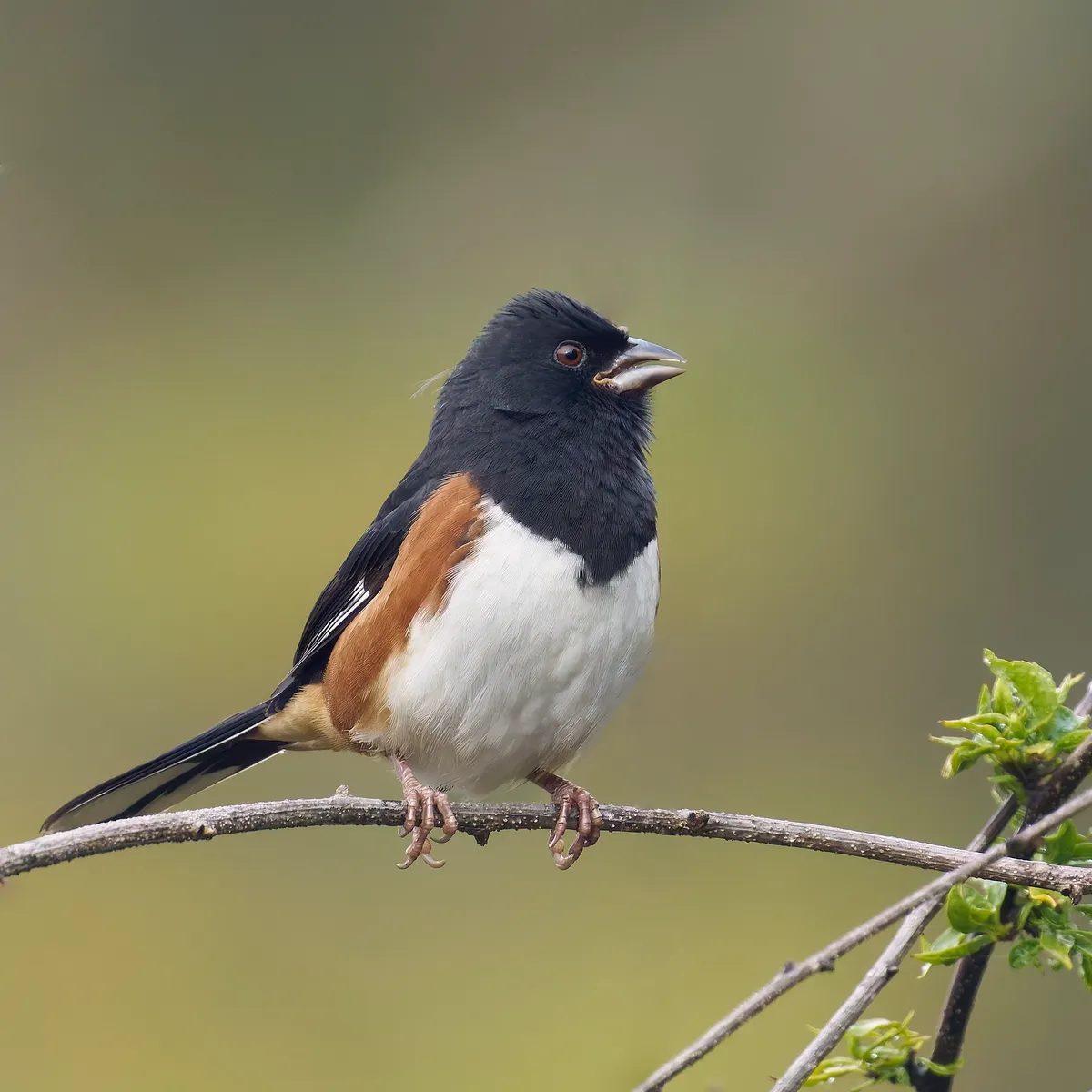
Tohi à flancs roux— Quebec wildlife
Pipilo erythrophthalmus
PasserellidaeNo period published by Québec.ca
Québec.ca publishes no hunting or trapping period for this species. Check the official regulations.
Wikipedia
Tohi à flancs roux
The eastern towhee (Pipilo erythrophthalmus), also known as chewink, joree, or joree bird, is a large New World sparrow. The taxonomy of the towhees has been under debate in recent decades, and formerly this bird and the spotted towhee were considered a single species, the rufous-sided towhee. Their breeding habitat is brushy areas across eastern North America. They nest either low in bushes or on the ground under shrubs. Northern birds migrate to the southern United States. One of this species was recorded as a vagrant to western Europe, a single bird in Great Britain in 1966. The song is a short drink your teeeeea lasting around one second, starting with a sharp call ("drink!") and ending with a short trill "teeeeea". The name "towhee" is onomatopoeic description of one of the towhee's most common calls, a short, two-part call rising in pitch and sometimes also called a "chewink" call.
Description
The eastern towhee is a large and striking species of sparrow. Their total lengths range from 17.3 to 23 cm (6.8 to 9.1 in) and their wingspans are 20–30 cm (7.9–11.8 in). The body of mass of this species ranges from 32 to 53 g (1.1 to 1.9 oz), with an average of 40 g (1.4 oz). Adults have rufous sides, a white belly, and a long, dark tail with white edges. The eyes are red for most populations, though populations in the southeastern U.S. have yellow eyes – often referred to as the "white-eye morph". Males have a black head, upper body, and tail; these parts are brown in the female. Juveniles are brown overall. Eastern towhees of all ages and both sexes generally are unmistakable. In the Great Plains, eastern towhees occasionally overlap in range with their sister species, the spotted towhee, which has resulted in rare hybrids between the two species.
Habitat and range
The eastern towhee occurs throughout the Eastern United States and southeast Canada. Occurrences from southern Saskatchewan, southwest Ontario, and Quebec south to Florida, and west to eastern Texas are noted in a literature review. Populations north of southern New England through northern Indiana and Illinois to southern Iowa primarily are summer residents. P. e. erythrophthalmus occurs in the most northerly part of the eastern towhee's distribution in the summer, and in winter migrates to the southern and eastern portion of the range of the species. The other subspecies are largely residents. P. e. canaster occurs from south-central Louisiana, north to northeastern Louisiana east through Mississippi, extreme southwestern Tennessee, northern Alabama and Georgia, central South Carolina to western North Carolina, and south to northwestern Florida and east along the Gulf Coast. The range of P. e. rileyi extends from northern Florida through southern Georgia and coastal South Carolina to east-central North Carolina. P. e. alleni occurs in peninsular Florida. The eastern towhee occurs in vegetation of disturbed areas, such as old-field successional vegetation and shrubby areas of power line rights-of-way.
Text from Wikipedia — Eastern towhee, revision 1367848725, CC BY-SA 4.0, retrieved 2026-09-04. Encyclopedic text reused under CC BY-SA 4.0. Sentences about hunting or regulation are removed: on this site, the rule comes from Québec.ca.
Other names
French
English
Presence in Quebec
- Origin
- Indigène
- Occurrence
- Régulier
- Population status
- Reproducteur
- Certainty
- Confirmé
Conservation
Québec.ca
Official periods
Source: Québec.ca — tables reproduced as published (retrieved 2026-08-30).
Regulations change. Always check Québec.ca before hunting or trapping.
Where this data comes from
This species is listed in an official government dataset. The identification and status shown in the data sheet are reproduced from it.
Source: List of Quebec’s vertebrate wildlife (LFVQ) — Ministère de l’Environnement, de la Lutte contre les changements climatiques, de la Faune et des Parcs. File LFVQ_25_03_2026.csv, retrieved 2026-08-30 · CC BY 4.0.
Measurements, habitat, diet and reproduction are not shown: no official source is attached to them yet.