
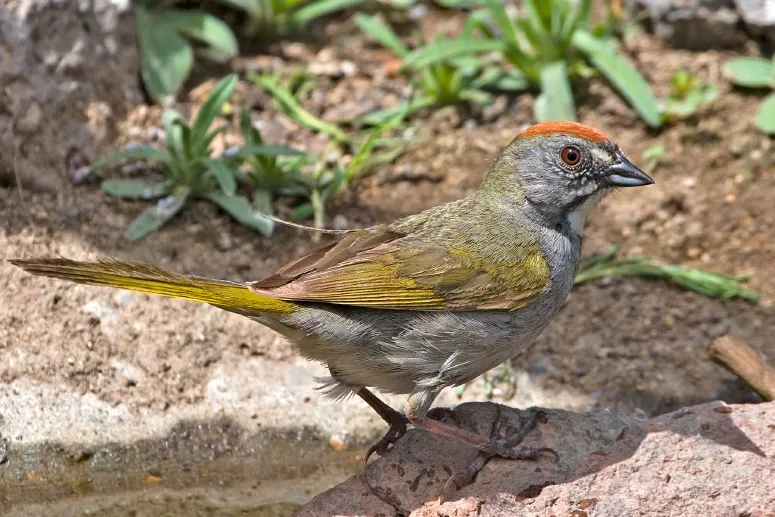
Tohi à queue verte— Quebec wildlife
Pipilo chlorurus
PasserellidaeNo period published by Québec.ca
Québec.ca publishes no hunting or trapping period for this species. Check the official regulations.
Wikipedia
Tohi à queue verte
The green-tailed towhee (Pipilo chlorurus) is a species of bird in the family Passerellidae, the New World sparrows. It is found in the western United States and much of Mexico.
Description
The green-tailed towhee is about 18 cm (7.1 in) long and weighs on average about 29 g (1.0 oz). Though the sexes have essentially the same plumage, females tend to be slightly duller than males. Adults have a reddish brown crown, a white spot above the lores, and a white "moustache" and throat on an otherwise gray head. Their hindneck, back, and scapulars are yellowish olive with grayish olive edges on the feathers. Their rump and uppertail coverts are grayish olive. Their tail is mostly greenish to yellow-green with olive brown edges on most feathers. Their wings are light fuscous with yellow-green edges on most flight feathers. Their breast and belly are grayish white, their sides and flanks pale gray with a creamy buff tinge, and their crissum creamy buff. Juveniles are comparatively drab with brownish gray upperparts and white underparts, both of which are heavily streaked with black.
Text from Wikipedia — Green-tailed towhee, revision 1356630468, CC BY-SA 4.0, retrieved 2026-09-04. Encyclopedic text reused under CC BY-SA 4.0. Sentences about hunting or regulation are removed: on this site, the rule comes from Québec.ca.
Presence in Quebec
- Origin
- Indigène
- Occurrence
- Accidentel/non régulier
- Population status
- Migrateur
- Certainty
- Confirmé
Conservation
Québec.ca
Official periods
Source: Québec.ca — tables reproduced as published (retrieved 2026-08-30).
Regulations change. Always check Québec.ca before hunting or trapping.
Where this data comes from
This species is listed in an official government dataset. The identification and status shown in the data sheet are reproduced from it.
Source: List of Quebec’s vertebrate wildlife (LFVQ) — Ministère de l’Environnement, de la Lutte contre les changements climatiques, de la Faune et des Parcs. File LFVQ_25_03_2026.csv, retrieved 2026-08-30 · CC BY 4.0.
Measurements, habitat, diet and reproduction are not shown: no official source is attached to them yet.