
No period published by Québec.ca
Québec.ca publishes no hunting or trapping period for this species. Check the official regulations.
Wikipedia
Tournepierre à collier
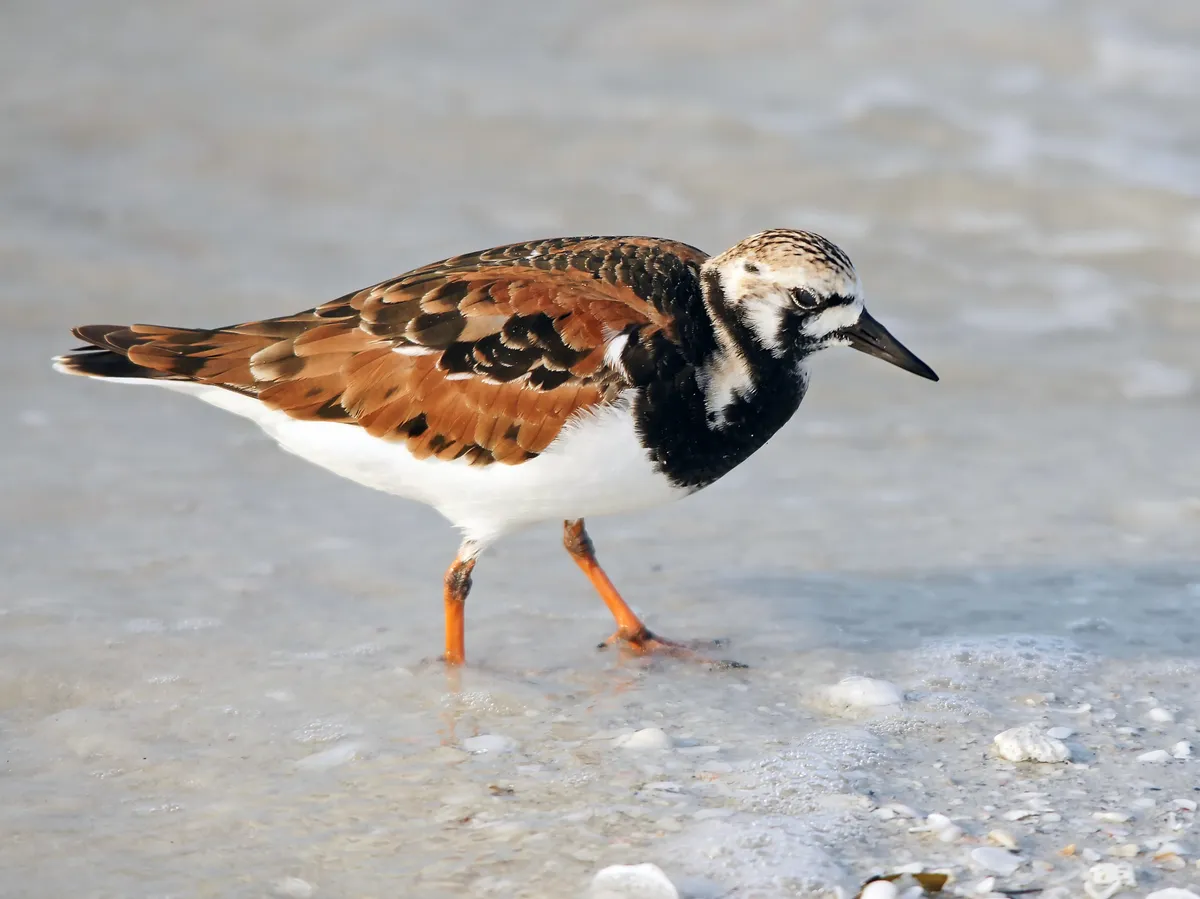
The ruddy turnstone (Arenaria interpres) is a small cosmopolitan wading bird, one of two species of turnstone in the genus Arenaria. It is now classified in the sandpiper family Scolopacidae but was formerly sometimes placed in the plover family Charadriidae. It is a highly migratory bird, breeding in northern parts of Eurasia and North America, and flying south to winter on coastlines almost worldwide. It is the only species of turnstone in much of its range and is often known simply as turnstone.
Description
It is a fairly small and stocky bird, 22–24 cm (8.7–9.4 in) long with a wingspan of 50–57 cm (20–22 in) and a weight of 85–150 g (3.0–5.3 oz). The dark, wedge-shaped bill is 2–2.5 cm (0.79–0.98 in) long and slightly upturned. The legs are fairly short at 3.5 cm (1.4 in) and are bright orange. In all seasons, the plumage is dominated by a harlequin-like pattern of brown, black and white. Breeding birds have reddish-brown upper parts with black markings. The head is mainly white with black streaks on the crown and a black pattern on the face. The breast is mainly black apart from a white patch on the sides. The rest of the underparts are white. In flight it reveals a white wingbar, white patch near the base of the wing and white lower back, rump and tail with dark bands on the uppertail-coverts and near the tip of the tail. The female is slightly duller than the male and has a browner head with more streaking. Non-breeding adults are duller than breeding birds and have dark grey-brown upperparts with black mottling and a dark head with little white. Juvenile birds have a pale brown head and pale fringes to the upperpart feathers creating a scaly impression. Birds of the subspecies A. i. morinella are marginally smaller, with darker upperparts and less streaking on the crown. The ruddy turnstone has a staccato, rattling call and also a chattering alarm-call which is mainly given during the breeding season.
Habitat and range
The ruddy turnstone breeds in northern latitudes, usually no more than a few kilometres from the sea. The subspecies A. i. morinella occurs in northern Alaska and in Arctic Canada as far east as Baffin Island. A. i. interpres breeds in western Alaska, Ellesmere Island, Greenland, Norway, Denmark, Sweden, Finland, Estonia and northern Russia. It formerly bred on the Baltic coast of Germany and has possibly bred in Scotland and the Faroe Islands. In the Americas, the species winters on coastlines from Washington and Massachusetts southwards to the southern tip of South America although it is scarce in southern parts of Chile and Argentina and is only an unconfirmed vagrant in the Falkland Islands. In Europe, it winters in western regions from Iceland, Norway and Denmark southwards. Only small numbers are found on Mediterranean coasts. In Africa, it is common all the way down to South Africa with good numbers on many offshore islands.
Text from Wikipedia — Ruddy turnstone, revision 1370395614, CC BY-SA 4.0, retrieved 2026-09-04. Encyclopedic text reused under CC BY-SA 4.0. Sentences about hunting or regulation are removed: on this site, the rule comes from Québec.ca.
Other names
French
English
Presence in Quebec
- Origin
- Indigène
- Occurrence
- Régulier
- Population status
- Migrateur
- Certainty
- Confirmé
Conservation
Québec.ca
Official periods
Source: Québec.ca — tables reproduced as published (retrieved 2026-08-30).
Regulations change. Always check Québec.ca before hunting or trapping.
Where this data comes from
This species is listed in an official government dataset. The identification and status shown in the data sheet are reproduced from it.
Source: List of Quebec’s vertebrate wildlife (LFVQ) — Ministère de l’Environnement, de la Lutte contre les changements climatiques, de la Faune et des Parcs. File LFVQ_25_03_2026.csv, retrieved 2026-08-30 · CC BY 4.0.
Measurements, habitat, diet and reproduction are not shown: no official source is attached to them yet.