
No period published by Québec.ca
Québec.ca publishes no hunting or trapping period for this species. Check the official regulations.
Wikipedia
Tourterelle à ailes blanches
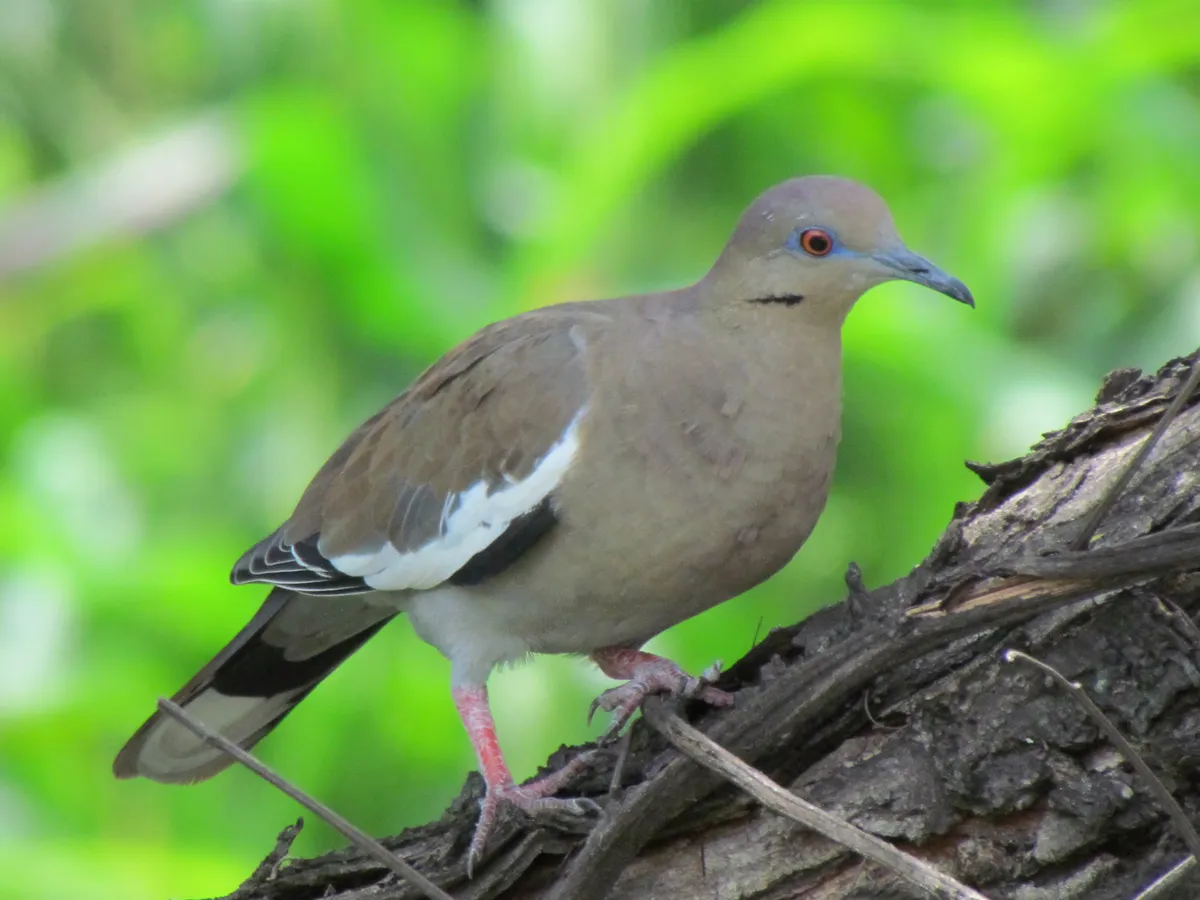
The white-winged dove (Zenaida asiatica) is a dove whose native range extends from the Southwestern United States through Mexico, Central America, and the Caribbean. They are large for doves, and can be distinguished from similar doves by the distinctive white edge on their wings. They have a blue eyering and red eyes. The plumage is brownish-gray to gray. Juveniles are duller in color and have brown eyes. The call is likened to the English phrase "who cooks for you". There are three subspecies. It was first described by George Edwards in 1743, and given its binomial name by Linnaeus in 1756. It was moved into the genus Zenaida in 1838. They inhabit a variety of environments, including desert, scrub, and urban. Their diet consists mostly of grains, but will also include pollen and nectar, especially from the saguaro cactus, which is a vital source of water. Human expansion has greatly affected the white-winged dove. Before human presence, their range closely mirrored that of their favorite food, the saguaro. The advent of agriculture in North America greatly expanded its range by providing a reliable food source. This has also led some modern populations to be migratory. Historically, they nested in enormous colonies, but most have been lost to human activities and climate change, and most nesting now occurs in isolation. Its population collapsed in the 1960s and 1970s, likely due to the loss of major nesting colonies. The International Union for Conservation of Nature considers it to be a species of least-concern.
Description
White-winged doves are a plump, medium-sized bird (large for a dove), at 29 cm (11 in) from tip to tail, and a weight of 150 g (5.3 oz). Wingspan ranges from 18.9 to 22.8 in (48–58 cm). They are brownish-gray above and gray below, with a bold white wing patch that appears as a brilliant white crescent in flight, and is also visible at rest. Adults have a ring of blue, featherless skin around each eye and a long, dark mark on the lower face. They have a blue eye ring, and their legs and feet are brighter pink/red. Their eyes are bright crimson, except for juveniles, who have brown eyes. Juveniles are duller and grayer than adults and lack iridescence. Juvenile plumage is usually found between March and October. Differentiating between sexes is difficult, and usually requires examination of the cloaca. Males do have a more iridescent purple color to the crown, neck, and nape, as well as a more distinctive ear spot, though the differences are slight. Males are usually heavier on average, but differences in daily weight due to feeding make this an inaccurate field tool. Thus, most observers cannot accurately differentiate between sexes based on external characteristics alone. The identifying hallmark is its namesake white-edged wing, which similar species lack. It appears similar to the mourning dove, with which it may be easily confused. Compared to the mourning dove, it is larger and heavier.
Text from Wikipedia — White-winged dove, revision 1370162421, CC BY-SA 4.0, retrieved 2026-09-04. Encyclopedic text reused under CC BY-SA 4.0. Sentences about hunting or regulation are removed: on this site, the rule comes from Québec.ca.
Other names
French
English
Presence in Quebec
- Origin
- Indigène
- Occurrence
- Accidentel/non régulier
- Population status
- Migrateur
- Certainty
- Confirmé
Conservation
Québec.ca
Official periods
Source: Québec.ca — tables reproduced as published (retrieved 2026-08-30).
Regulations change. Always check Québec.ca before hunting or trapping.
Where this data comes from
This species is listed in an official government dataset. The identification and status shown in the data sheet are reproduced from it.
Source: List of Quebec’s vertebrate wildlife (LFVQ) — Ministère de l’Environnement, de la Lutte contre les changements climatiques, de la Faune et des Parcs. File LFVQ_25_03_2026.csv, retrieved 2026-08-30 · CC BY 4.0.
Measurements, habitat, diet and reproduction are not shown: no official source is attached to them yet.