
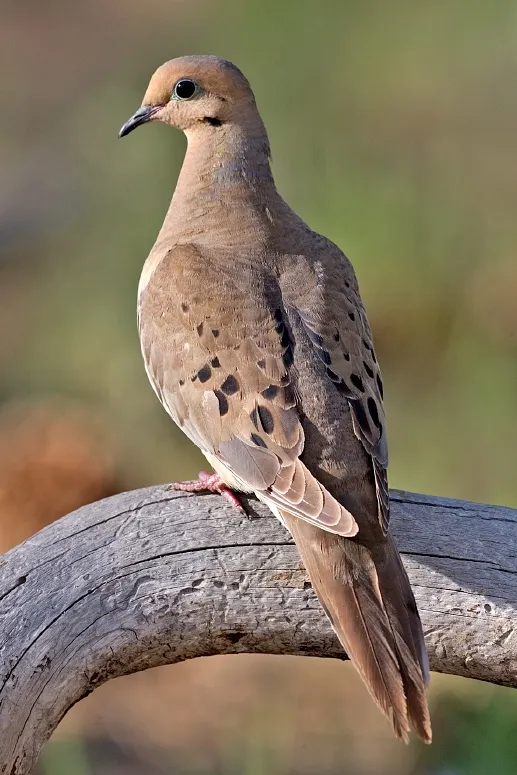
Tourterelle triste— Quebec wildlife
Zenaida macroura
ColumbidaeMigratory game bird — federal regulations
Seasons and bag limits are set by Environment and Climate Change Canada.
Wikipedia
Tourterelle triste
The mourning dove (Zenaida macroura) is a member of the dove family, Columbidae. The bird is also known as the American mourning dove, the rain dove, and colloquially as the turtle dove, and it was once known as the Carolina pigeon and Carolina turtledove. It is one of the most abundant and widespread North American birds and a popular gamebird, with more than 20 million birds (up to 70 million in some years) shot annually in the U.S., both for sport and meat. Its ability to sustain its population under such pressure is due to its prolific breeding; in warm areas, one pair may raise up to six broods of two young each in a single year. The wings make an unusual whistling sound upon take-off and landing, a form of sonation. The bird is a strong flier, capable of speeds up to 88 km/h (55 mph). Mourning doves are light gray and brown and generally muted in color. Males and females are similar in appearance. The species is generally monogamous, with two squabs (young) per brood. Both parents incubate and care for the young. Mourning doves eat almost exclusively seeds, but the young are fed crop milk by their parents.
Description
The mourning dove is a medium-sized, slender dove approximately 31 cm (12 in) in length. Mourning doves weigh 112–170 g (4.0–6.0 oz), usually closer to 128 g (4.5 oz). The mourning dove has a wingspan of 37–45 cm. The elliptical wings are broad, and the head is rounded. Its tail is long and tapered ("macroura" comes from the Greek words for "large" and "tail"). Mourning doves have perching feet, with three toes forward and one reversed. The legs are short and reddish colored. The beak is short and dark, usually a brown-black hue. The plumage is generally light gray-brown above and lighter and pinkish below. The wings have black spotting, and the outer tail feathers are white, contrasting with the black inners. Below the eye is a distinctive crescent-shaped area of dark feathers. The eyes are dark, with light blue skin surrounding them. The adult male has bright purple-pink patches on the neck sides, with light pink coloring reaching the breast. Adult males possess a distinctly bluish-gray colored crown, which females lack. Females are similar in appearance but have more brown coloring overall and are slightly smaller than males. The iridescent feather patches on the neck above the shoulders are nearly absent but can be quite vivid on males. Juvenile birds have a scaly appearance and are generally darker. Feather colors are generally believed to be relatively static, changing only by small amounts over periods of months. However, a 2011 study argued that since feathers have neither nerves or blood vessels, color changes must be caused by external stimuli. Researchers analyzed how feathers of iridescent mourning doves responded to stimulus changes of adding and evaporating water. As a result, it was discovered that iridescent feather color changed hue, became more chromatic, and increased overall reflectance by almost 50%.
Text from Wikipedia — Mourning dove, revision 1363681770, CC BY-SA 4.0, retrieved 2026-09-04. Encyclopedic text reused under CC BY-SA 4.0. Sentences about hunting or regulation are removed: on this site, the rule comes from Québec.ca.
Other names
French
English
Presence in Quebec
- Origin
- Indigène
- Occurrence
- Régulier
- Population status
- Toute l'année
- Certainty
- Confirmé
Conservation
Québec.ca
Official periods
Source: Québec.ca — tables reproduced as published (retrieved 2026-08-30).
Regulations change. Always check Québec.ca before hunting or trapping.
Where this data comes from
This species is listed in an official government dataset. The identification and status shown in the data sheet are reproduced from it.
Source: List of Quebec’s vertebrate wildlife (LFVQ) — Ministère de l’Environnement, de la Lutte contre les changements climatiques, de la Faune et des Parcs. File LFVQ_25_03_2026.csv, retrieved 2026-08-30 · CC BY 4.0.
Measurements, habitat, diet and reproduction are not shown: no official source is attached to them yet.