
No period published by Québec.ca
Québec.ca publishes no hunting or trapping period for this species. Check the official regulations.
Wikipedia
Tourterelle turque
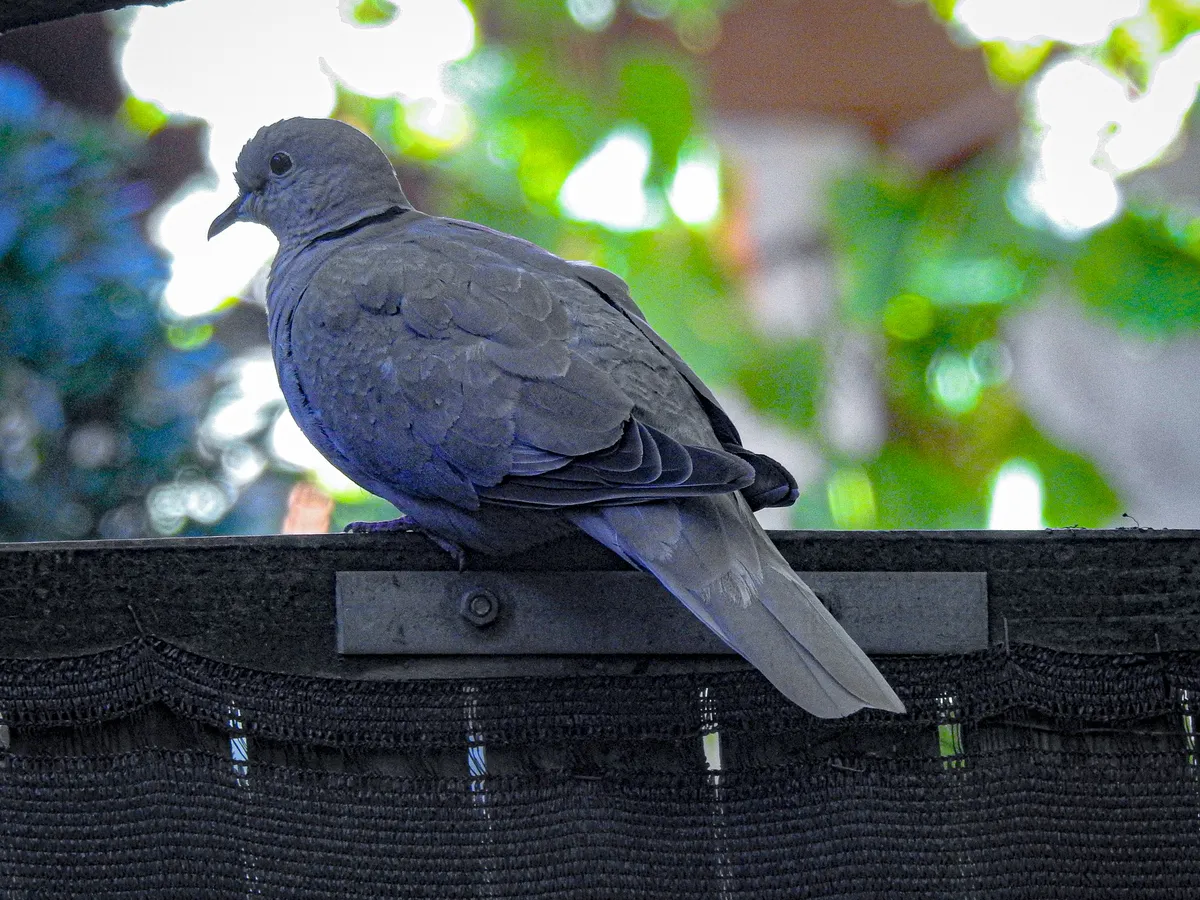
The Eurasian collared dove (Streptopelia decaocto), often called the collared dove, is a dove species from the genus Streptopelia. It is grey-buff to pinkish-grey, and has a black half-collar edged with white on its nape, alluding to the name. It is native to Europe, Asia, and North Africa. It has also been introduced to Japan, North and Central America, and select Caribbean islands.
Description
It is a medium-sized dove, with an average length of 32 cm (13 in) from tip of beak to tip of tail, a wingspan of 47–55 cm (19–22 in) and a weight of 125–240 g (4.4–8.5 oz). It is grey-buff to pinkish-grey, slightly darker above than below, and with a blue-grey underwing patch. The tail feathers are grey-buff above, and dark grey and tipped white below; the outer tail feathers are also tipped whitish above. It has a black half-collar edged with white on its nape. The short legs are red, and the bill is black. The iris is red, but from a distance the eyes appear to be black, as the pupil is relatively large; a narrow rim of reddish-brown iris surrounds the black pupil. The eye is surrounded by a small area of bare skin, either white or yellow. The two sexes are identical; juveniles only differ in having a poorly developed collar, and a brown iris. The Eurasian collared dove's call is a three-syllable goo-GOO-goo, with stress placed on the second syllable. It also makes a harsh loud screeching call chrrai-chrrai lasting about two seconds, particularly in flight just before landing. Eurasian collared doves cooing in early spring are sometimes mistakenly reported as the calls of early-arriving common cuckoos.
Text from Wikipedia — Eurasian collared dove, revision 1369873234, CC BY-SA 4.0, retrieved 2026-09-04. Encyclopedic text reused under CC BY-SA 4.0. Sentences about hunting or regulation are removed: on this site, the rule comes from Québec.ca.
Presence in Quebec
- Origin
- Exotique
- Occurrence
- Régulier
- Population status
- Toute l'année
- Certainty
- Confirmé
Conservation
Québec.ca
Official periods
Source: Québec.ca — tables reproduced as published (retrieved 2026-08-30).
Regulations change. Always check Québec.ca before hunting or trapping.
Where this data comes from
This species is listed in an official government dataset. The identification and status shown in the data sheet are reproduced from it.
Source: List of Quebec’s vertebrate wildlife (LFVQ) — Ministère de l’Environnement, de la Lutte contre les changements climatiques, de la Faune et des Parcs. File LFVQ_25_03_2026.csv, retrieved 2026-08-30 · CC BY 4.0.
Measurements, habitat, diet and reproduction are not shown: no official source is attached to them yet.