
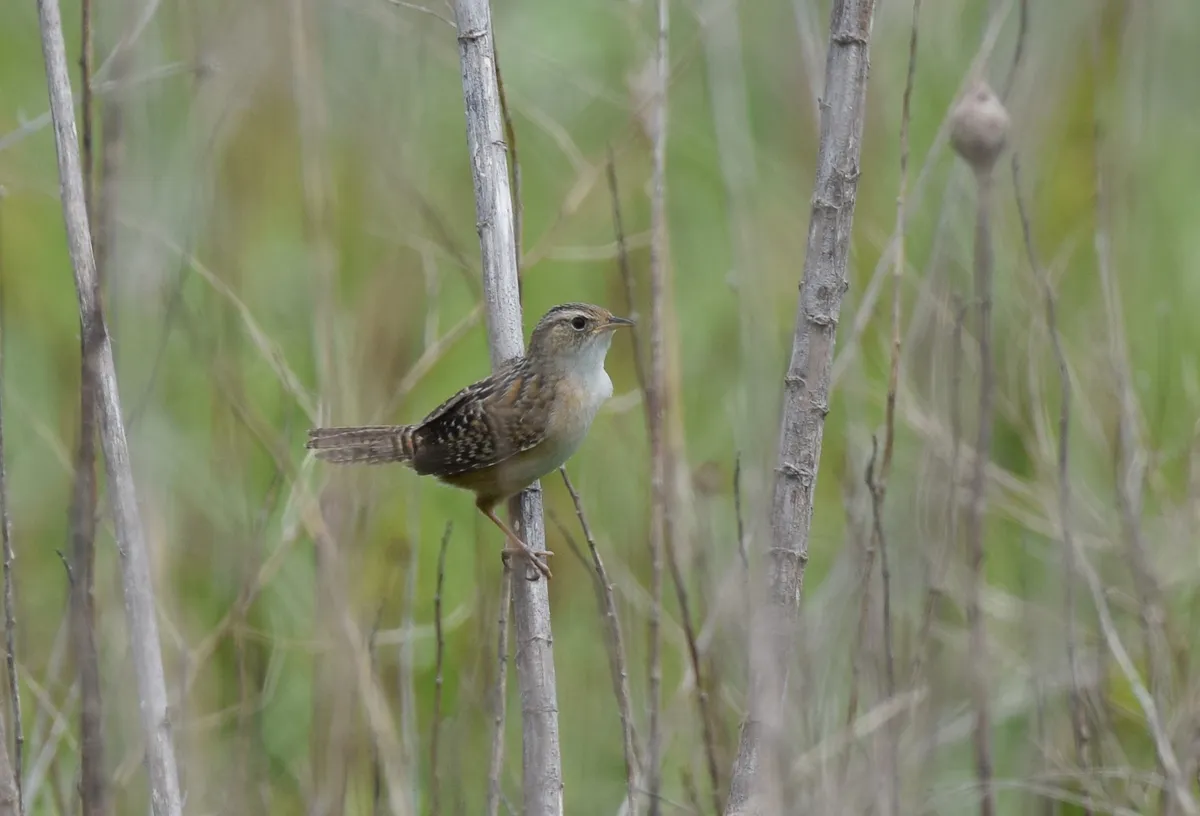
Troglodyte à bec court— Quebec wildlife
Cistothorus stellaris
TroglodytidaeNo period published by Québec.ca
Québec.ca publishes no hunting or trapping period for this species. Check the official regulations.
Wikipedia
Troglodyte à bec court
The sedge wren (Cistothorus stellaris) is a small and secretive passerine bird in the family Troglodytidae. It is widely distributed in North America. It is often found in wet grasslands and meadows where it nests in the tall grasses and sedges and feeds on insects. The sedge wren was formerly considered as conspecific with the non-migratory grass wren of central and South America.
Description
The sedge wren is a relatively small wren that measures 10 to 12 cm (3.9 to 4.7 in), weighs 7 to 10 g (0.25 to 0.35 oz) and has a wing-chord of 4.1 to 4.6 cm (1.6 to 1.8 in). Wingspan ranges from 4.7 to 5.5 in (12-14 cm). Females and males have the same plumage but males are slightly larger. Their head and back are tawny brown streaked with black and white. They have a pale buff supercilium and brown irises. Their rump is orange and tail is tawny brown bared with black. Wings are tawny brown bared with black, white and pale buff. They have a white throat and belly with pale buff on the side. Their beak is long and slender. and measures on average 6.77 to 6.95 mm The upper mandible of the beak is brown while the lower mandible is yellow. They have pink legs and feet. Juveniles are overall similar to adults but have less streaking on the head and nape and their chest is paler than adults. The sedge wren can be differentiated from the similar marsh wren (Cistothorus palustris) by its smaller size, streaked crown and different song.
Text from Wikipedia — Sedge wren, revision 1345271325, CC BY-SA 4.0, retrieved 2026-09-04. Encyclopedic text reused under CC BY-SA 4.0. Sentences about hunting or regulation are removed: on this site, the rule comes from Québec.ca.
Other names
French
English
Former scientific names
Presence in Quebec
- Origin
- Indigène
- Occurrence
- Régulier
- Population status
- Reproducteur
- Certainty
- Confirmé
Conservation
Québec.ca
Official periods
Source: Québec.ca — tables reproduced as published (retrieved 2026-08-30).
Regulations change. Always check Québec.ca before hunting or trapping.
Where this data comes from
This species is listed in an official government dataset. The identification and status shown in the data sheet are reproduced from it.
Source: List of Quebec’s vertebrate wildlife (LFVQ) — Ministère de l’Environnement, de la Lutte contre les changements climatiques, de la Faune et des Parcs. File LFVQ_25_03_2026.csv, retrieved 2026-08-30 · CC BY 4.0.
Measurements, habitat, diet and reproduction are not shown: no official source is attached to them yet.