
Troglodyte des forêts— Quebec wildlife
Troglodytes hiemalis
TroglodytidaeNo period published by Québec.ca
Québec.ca publishes no hunting or trapping period for this species. Check the official regulations.
Wikipedia
Troglodyte des forêts
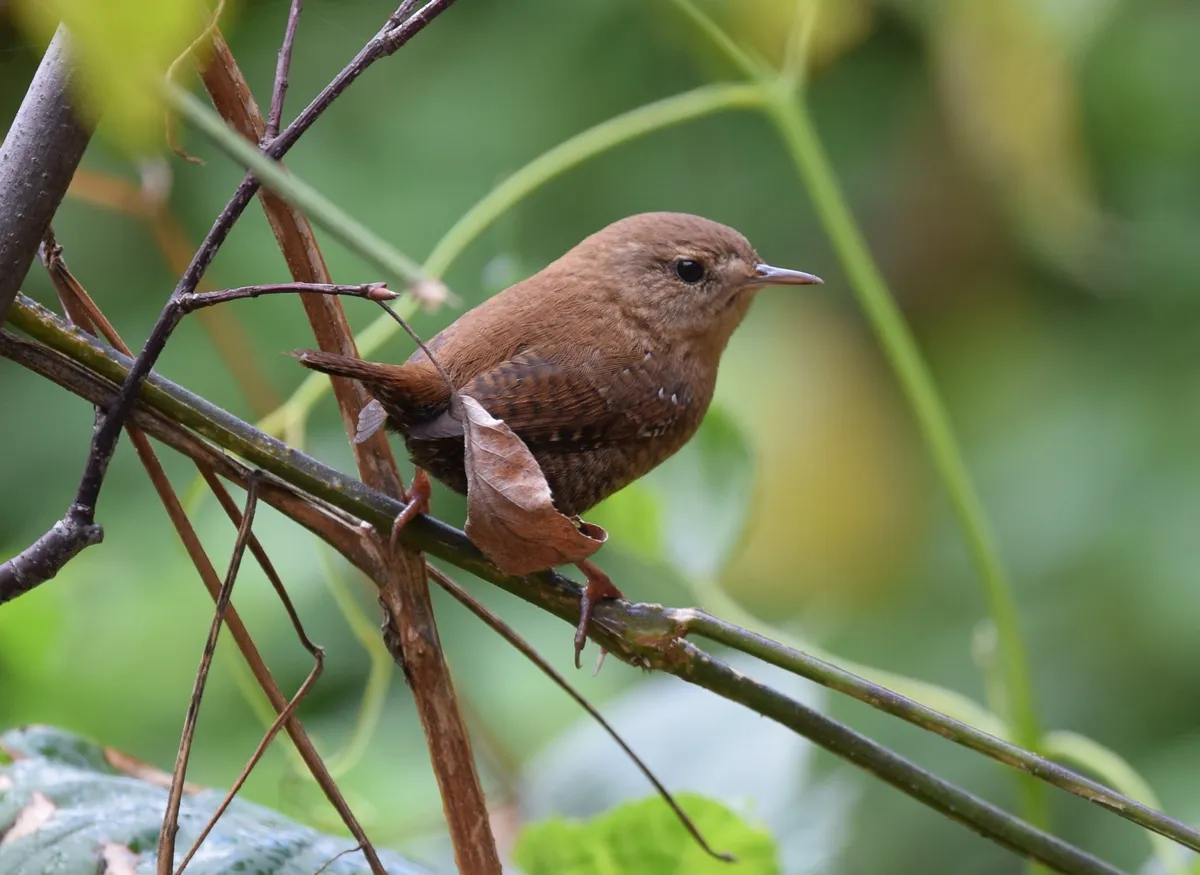
The winter wren (Troglodytes hiemalis) is a very small North American bird and a member of the mainly New World wren family Troglodytidae. The species was formerly often lumped together with Eurasian wren (Troglodytes troglodytes) of Eurasia and Pacific wren (Troglodytes pacificus) of western North America under the merged name of northern wren (with the scientific name T. troglodytes having priority), until they were split in 2010. It breeds in coniferous forests from British Columbia to the Atlantic Ocean. It migrates through and winters across southeastern Canada, the eastern half the United States and (rarely) north-eastern Mexico. Small numbers may be casual in the western United States and Canada. The scientific name for its genus is taken from the Greek word troglodytes (from "trogle" a hole, and "dyein" to creep), meaning "cave-dweller", and may refer to their tendency to nest in cavities or their foraging behavior, in which the winter wren almost exclusively ground-gleans in thick underbrush.
Description
Small tail is often cocked above its back, and short neck gives the appearance of a small brown ball. Rufous brown above, grayer below, barred with darker brown and gray, even on wings and tail. The bill is dark brown, and the legs are pale brown. Young birds are less distinctly barred. Most are identifiable by the pale "eyebrows" over their eyes. Measurements: Length: 8–12 cm (3.1–4.7 in) Weight: 8–12 g (0.28–0.42 oz) Wingspan: 12–16 cm (4.7–6.3 in)
Text from Wikipedia — Winter wren, revision 1365289801, CC BY-SA 4.0, retrieved 2026-09-04. Encyclopedic text reused under CC BY-SA 4.0. Sentences about hunting or regulation are removed: on this site, the rule comes from Québec.ca.
Other names
French
Presence in Quebec
- Origin
- Indigène
- Occurrence
- Régulier
- Population status
- Reproducteur
- Certainty
- Confirmé
Conservation
Québec.ca
Official periods
Source: Québec.ca — tables reproduced as published (retrieved 2026-08-30).
Regulations change. Always check Québec.ca before hunting or trapping.
Where this data comes from
This species is listed in an official government dataset. The identification and status shown in the data sheet are reproduced from it.
Source: List of Quebec’s vertebrate wildlife (LFVQ) — Ministère de l’Environnement, de la Lutte contre les changements climatiques, de la Faune et des Parcs. File LFVQ_25_03_2026.csv, retrieved 2026-08-30 · CC BY 4.0.
Measurements, habitat, diet and reproduction are not shown: no official source is attached to them yet.