
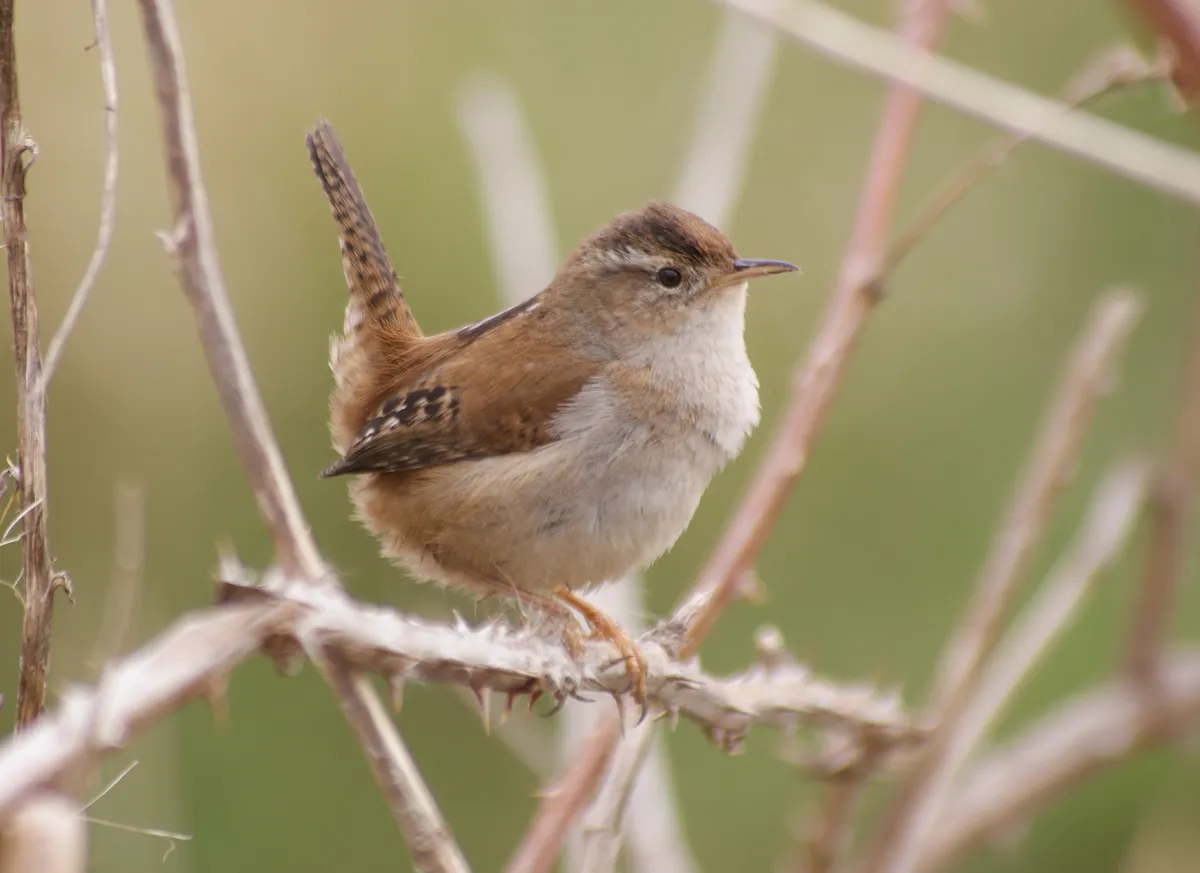
Troglodyte des marais— Quebec wildlife
Cistothorus palustris
TroglodytidaeNo period published by Québec.ca
Québec.ca publishes no hunting or trapping period for this species. Check the official regulations.
Wikipedia
Troglodyte des marais
The marsh wren (Cistothorus palustris) is a small North American songbird of the wren family. It was formerly called the long-billed marsh wren to distinguish it from the sedge wren, then known as the short-billed marsh wren.
Description
Adults have brown upperparts with a light brown belly and flanks and a white throat and breast. The back is black with white stripes. They have a dark cap with a white line over the eyes and a short thin bill. The male's song is a loud gurgle used to declare ownership of territory; western males have a more varied repertoire. This little bird is native to Canada, Mexico, and the United States. Their breeding habitat is marshes with tall vegetation such as cattails across North America. In the western United States, some birds are permanent residents. Other birds migrate to marshes and salt marshes in the southern United States and Mexico. Their non-breeding range is in the southern United States going into Mexico and their breeding range is in the northeastern United States going into Canada. Measurements: Length: 3.9–5.5 in (9.9–14.0 cm) Weight: 0.3–0.5 oz (8.5–14.2 g) Wingspan: 5.9 inches (15 cm)
Habitat and range
The marsh wren prefers areas with vegetation that tends to be uniform in composition, as well as fairly tall.
Text from Wikipedia — Marsh wren, revision 1354640523, CC BY-SA 4.0, retrieved 2026-09-04. Encyclopedic text reused under CC BY-SA 4.0. Sentences about hunting or regulation are removed: on this site, the rule comes from Québec.ca.
Other names
French
English
Presence in Quebec
- Origin
- Indigène
- Occurrence
- Régulier
- Population status
- Reproducteur
- Certainty
- Confirmé
Conservation
Québec.ca
Official periods
Source: Québec.ca — tables reproduced as published (retrieved 2026-08-30).
Regulations change. Always check Québec.ca before hunting or trapping.
Where this data comes from
This species is listed in an official government dataset. The identification and status shown in the data sheet are reproduced from it.
Source: List of Quebec’s vertebrate wildlife (LFVQ) — Ministère de l’Environnement, de la Lutte contre les changements climatiques, de la Faune et des Parcs. File LFVQ_25_03_2026.csv, retrieved 2026-08-30 · CC BY 4.0.
Measurements, habitat, diet and reproduction are not shown: no official source is attached to them yet.