
Troglodyte des rochers— Quebec wildlife
Salpinctes obsoletus
TroglodytidaeNo period published by Québec.ca
Québec.ca publishes no hunting or trapping period for this species. Check the official regulations.
Wikipedia
Troglodyte des rochers
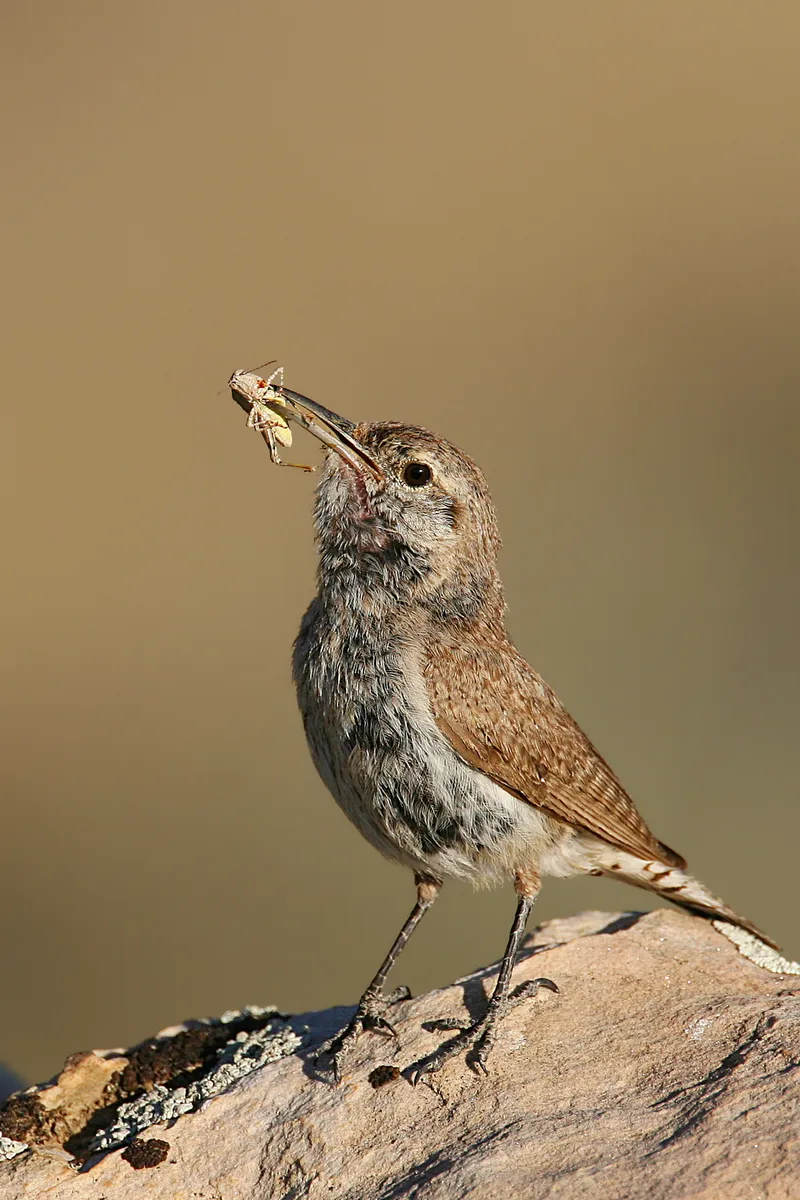
The rock wren (Salpinctes obsoletus) is a small songbird of the wren family native to the rocky areas of western North America. There are 8 subspecies of the rock wren, one of which is extinct. They are similar in size to other wrens, with a grey-brown coat, a brown rump, and a speckled white throat. They are visually similar to the canyon wren, which they share a habitat with. They are noted for their variable song and song pattern, used for territory defense, as well as their habit of building "pavements" with flat rocks around their nest to help nestlings stay dry. Rock wrens are serially monogamous, forming pairs for nesting season. Nestbuilding usually begins in March, usually in crevices, and the first brood are laid late April to June, with a possible second brood later in June. They are largely terrestrial foragers, rarely flying. Their diet consists of insects, mostly weevils, during the spring and summer, shifting to grain during autumn and winter. Though they are a least-concern species, their population size has declined by 13% from 2010 to 2020.
Description
The rock wren is between 12.5–15 cm (4.9–5.9 in) in length and has a wingspan of 22–24 cm (8.7–9.4 in). It has a bill length of 18.7 mm (0.74 in) in males and 17.8 mm (0.70 in) in females. Its wing length is 70.3 mm (2.77 in) in males, and slightly less at 67.8 mm (2.67 in) in females; similarly, its tail length is 51.9 mm (2.04 in) and 47.8 mm (1.88 in) in males and females, respectively. However, males weigh 15.7 g (0.55 oz), slightly less than females, who weigh 17.2 g (0.61 oz). Rock wrens have grey-brown upperparts with small black and white spots and pale grey underparts with a light brown rump. Additional features include a light grey line extending through the eye, a long and sharp bill, a speckled light gray throat, a long barred tail, zebra-striped undertail coverts, and dark legs. The juvenile plumage is similar to that of an adult, except for a slightly more vibrant buff, similar to a washed-out cinnamon color, fluffier body feathers, and the absence of a dark streak and spots on the underparts. Though they are very distinct in their habitat, it is possible to confuse them with the canyon wren, which have superficially similar coloring; however, the canyon wren has solid white throats and generally brighter, less muddled colors.
Text from Wikipedia — Rock wren, revision 1355972549, CC BY-SA 4.0, retrieved 2026-09-04. Encyclopedic text reused under CC BY-SA 4.0. Sentences about hunting or regulation are removed: on this site, the rule comes from Québec.ca.
Presence in Quebec
- Origin
- Indigène
- Occurrence
- Accidentel/non régulier
- Population status
- Migrateur
- Certainty
- Confirmé
Conservation
Québec.ca
Official periods
Source: Québec.ca — tables reproduced as published (retrieved 2026-08-30).
Regulations change. Always check Québec.ca before hunting or trapping.
Where this data comes from
This species is listed in an official government dataset. The identification and status shown in the data sheet are reproduced from it.
Source: List of Quebec’s vertebrate wildlife (LFVQ) — Ministère de l’Environnement, de la Lutte contre les changements climatiques, de la Faune et des Parcs. File LFVQ_25_03_2026.csv, retrieved 2026-08-30 · CC BY 4.0.
Measurements, habitat, diet and reproduction are not shown: no official source is attached to them yet.