
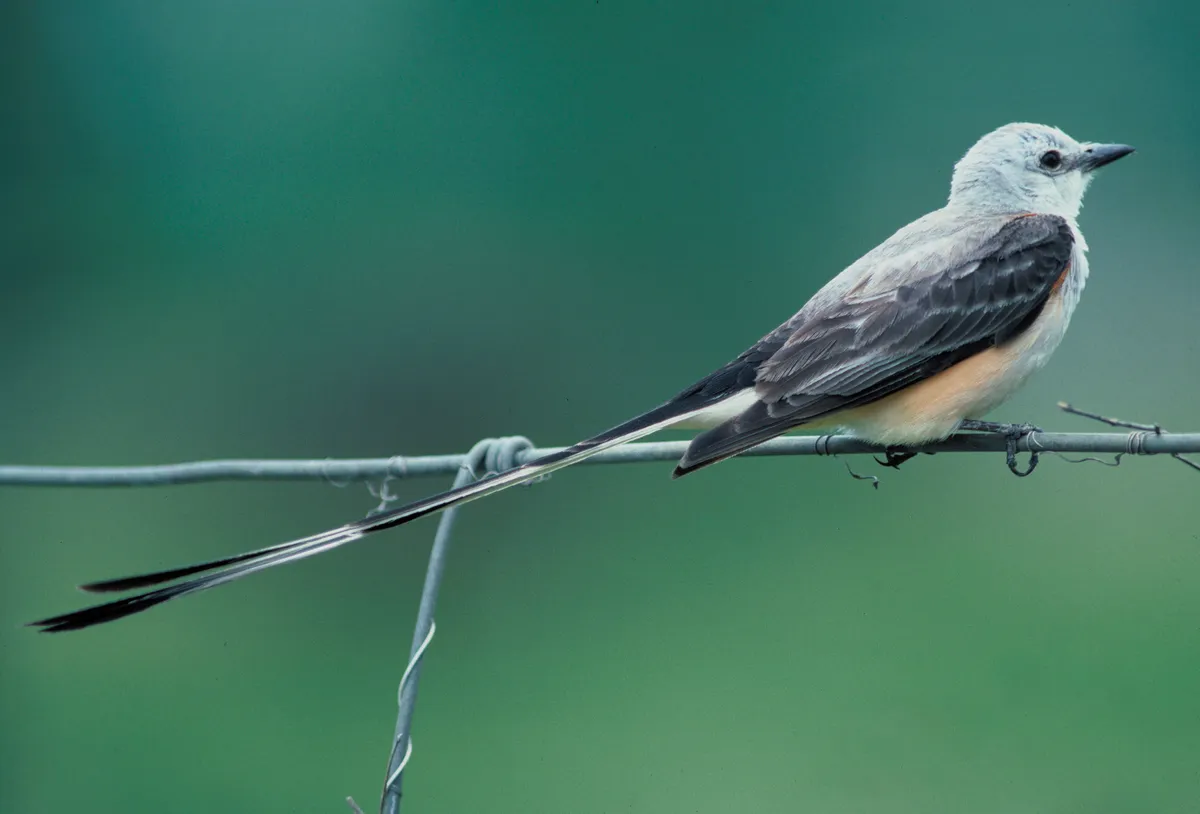
Tyran à longue queue— Quebec wildlife
Tyrannus forficatus
TyrannidaeNo period published by Québec.ca
Québec.ca publishes no hunting or trapping period for this species. Check the official regulations.
Wikipedia
Tyran à longue queue
The scissor-tailed flycatcher (Tyrannus forficatus), known as swallow-tailed flycatcher or scissorstail, is a long-tailed insectivorous bird of the genus Tyrannus, whose members are collectively referred to as kingbirds. It is found in North and Central America, and is Oklahoma's State Bird.
Description
Adult birds have pale gray heads and upper parts, light underparts, salmon-pink flanks and undertail coverts, and dark gray wings. Axillars and patch on underwing coverts are red. Their extremely long, forked tails, which are black on top and white on the underside, are characteristic and unmistakable. At maturity, the male may be up to 15 in (38 cm) in length, while the female's tail is up to 30% shorter. The wingspan is 38.1 cm (15.0 in) and the weight is up to 43 g (1.5 oz). Immature birds are duller in color and have shorter tails. A lot of these birds have been reported to be more than 40 cm (16 in).
Diet
In the summer, scissor-tailed flycatchers feed mainly on insects (grasshoppers, robber-flies, and dragonflies), which they may catch by waiting on a perch and then flying out to catch them in flight (hawking). For additional food in the winter they will also eat some berries.
Reproduction
They build a cup nest in isolated trees or shrubs, sometimes using artificial sites such as telephone poles near towns. The male performs a spectacular aerial display during courtship with his long tail forks streaming out behind him. Both parents feed the young. Like other kingbirds, they are very aggressive in defending their nest. Clutches contain three to six eggs.
Text from Wikipedia — Scissor-tailed flycatcher, revision 1372756830, CC BY-SA 4.0, retrieved 2026-09-04. Encyclopedic text reused under CC BY-SA 4.0. Sentences about hunting or regulation are removed: on this site, the rule comes from Québec.ca.
Other names
French
English
Presence in Quebec
- Origin
- Indigène
- Occurrence
- Accidentel/non régulier
- Population status
- Migrateur
- Certainty
- Confirmé
Conservation
Québec.ca
Official periods
Source: Québec.ca — tables reproduced as published (retrieved 2026-08-30).
Regulations change. Always check Québec.ca before hunting or trapping.
Where this data comes from
This species is listed in an official government dataset. The identification and status shown in the data sheet are reproduced from it.
Source: List of Quebec’s vertebrate wildlife (LFVQ) — Ministère de l’Environnement, de la Lutte contre les changements climatiques, de la Faune et des Parcs. File LFVQ_25_03_2026.csv, retrieved 2026-08-30 · CC BY 4.0.
Measurements, habitat, diet and reproduction are not shown: no official source is attached to them yet.