
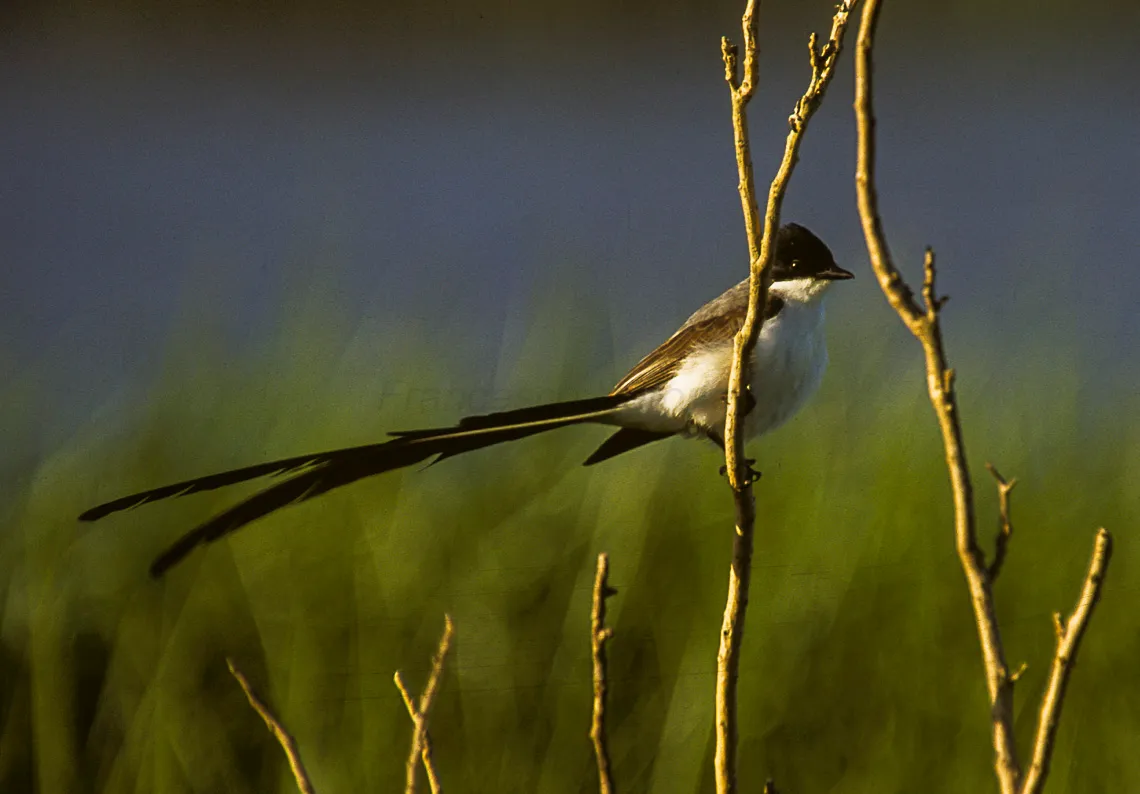
Tyran des savanes— Quebec wildlife
Tyrannus savana
TyrannidaeNo period published by Québec.ca
Québec.ca publishes no hunting or trapping period for this species. Check the official regulations.
Wikipedia
Tyran des savanes
The fork-tailed flycatcher (Tyrannus savana) is a passerine bird of the tyrant flycatcher family and is a member of a genus typically referred to as kingbirds. Named for the long, forked tail, particularly in males, fork-tailed flycatchers are seen in shrubland, savanna, lightly forested and grassland areas, from southern Mexico to Argentina. They are frequently observed on conspicuous perches whence they sally after insect prey. Northern populations near southern Mexico tend to be permanent residents, while fork-tailed flycatchers that live further south are migrants with a reputation for wandering as far north as New Brunswick, Canada.
Description
The fork-tailed flycatcher is white below, gray above, and has a black cap. Males sometimes show a yellow crown stripe. Males also have an extremely long, forked tail, of even greater length than that of the related scissor-tailed flycatcher. Females have a somewhat shorter tail, and it is significantly shorter in juveniles. Males are 37–41 cm (15–16 in) in length; females, 28–30 cm (11–12 in), including tail. They weigh only 28–32 g (0.99–1.13 oz), much less than closely related kingbirds, which are half the total length of this species. The tail in adult males is two to three times longer than the length of the bird from the bill to the base of the tail. Generally, males and females of the species look quite similar, but can be distinguished by the longer tail in males. The nominate subspecies T. s. savana has a darker grey back compared to T. s. monachus and T. s. sanctaemartae, which have notable light backs that contrast greatly with their black heads. Discrete notches on the primary feathers are also quite handy in identifying subspecies. Most fork-tailed flycatchers are migratory, but some stay year-round, especially in southern Mexico. Migratory fork-tailed flycatchers tend to have more pointed wings than nonmigratory flycatchers.
Text from Wikipedia — Fork-tailed flycatcher, revision 1325035283, CC BY-SA 4.0, retrieved 2026-09-04. Encyclopedic text reused under CC BY-SA 4.0. Sentences about hunting or regulation are removed: on this site, the rule comes from Québec.ca.
Other names
French
Presence in Quebec
- Origin
- Indigène
- Occurrence
- Accidentel/non régulier
- Population status
- Migrateur
- Certainty
- Confirmé
Conservation
Québec.ca
Official periods
Source: Québec.ca — tables reproduced as published (retrieved 2026-08-30).
Regulations change. Always check Québec.ca before hunting or trapping.
Where this data comes from
This species is listed in an official government dataset. The identification and status shown in the data sheet are reproduced from it.
Source: List of Quebec’s vertebrate wildlife (LFVQ) — Ministère de l’Environnement, de la Lutte contre les changements climatiques, de la Faune et des Parcs. File LFVQ_25_03_2026.csv, retrieved 2026-08-30 · CC BY 4.0.
Measurements, habitat, diet and reproduction are not shown: no official source is attached to them yet.