
No period published by Québec.ca
Québec.ca publishes no hunting or trapping period for this species. Check the official regulations.
Wikipedia
Tyran huppé
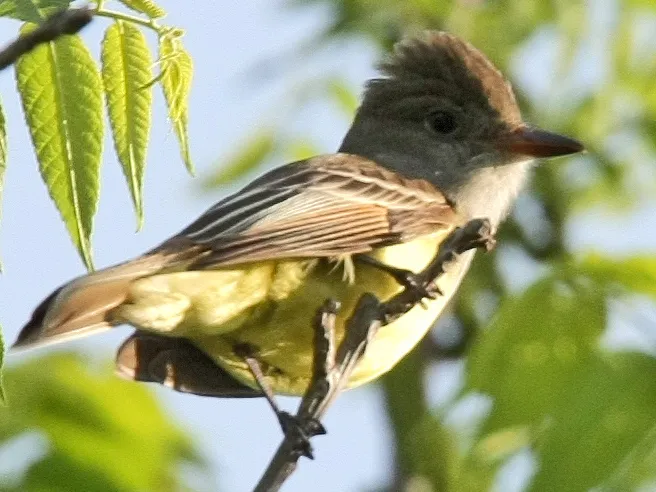
The great crested flycatcher (Myiarchus crinitus) is a large insect-eating bird of the tyrant flycatcher family. It is the most widespread member of the genus Myiarchus in North America, and is found over most of the eastern and mid-western portions of the continent. It dwells mostly in the treetops and rarely is found on the ground.
Description
Adult great crested flycatchers usually measure between 17–21 cm (6.7–8.3 in) in length with a wingspan of around 34 cm (13 in). This bird usually weighs between 27–40 g (0.95–1.41 oz). There is no sexual dimorphism. All adults are brownish on the upperparts with yellow underparts; they have a long rusty brown tail and a bushy crest. Their throat and breast are grey. Males will sing a three-part song composed of two short whistles: a wheerreep followed by a higher-pitched whee, and a soft low churr. This song is meant to be heard by a mate at short distances, indicating periods of low disturbance and stress typically intensifying just before dawn. It is appropriately named "dawn song" (or twilight song). In addition to the dawn song, great crested flycatcher also produce various calls, a series of fast ascending huit, huit, huit is given in moments of stress or excitement during interactions of between neighbours. The most characteristic sound is perhaps a single loud whee-eep, called out to communicate between mates or parents and young birds. A faster repetition of this call often signal predators in proximity to nests and young.A rapid succession of harsh-sounds rasps signals alarm or stress often heard during territorial disputes between neighbouring birds
Text from Wikipedia — Great crested flycatcher, revision 1365372338, CC BY-SA 4.0, retrieved 2026-09-04. Encyclopedic text reused under CC BY-SA 4.0. Sentences about hunting or regulation are removed: on this site, the rule comes from Québec.ca.
Other names
French
English
Presence in Quebec
- Origin
- Indigène
- Occurrence
- Régulier
- Population status
- Reproducteur
- Certainty
- Confirmé
Conservation
Québec.ca
Official periods
Source: Québec.ca — tables reproduced as published (retrieved 2026-08-30).
Regulations change. Always check Québec.ca before hunting or trapping.
Where this data comes from
This species is listed in an official government dataset. The identification and status shown in the data sheet are reproduced from it.
Source: List of Quebec’s vertebrate wildlife (LFVQ) — Ministère de l’Environnement, de la Lutte contre les changements climatiques, de la Faune et des Parcs. File LFVQ_25_03_2026.csv, retrieved 2026-08-30 · CC BY 4.0.
Measurements, habitat, diet and reproduction are not shown: no official source is attached to them yet.