
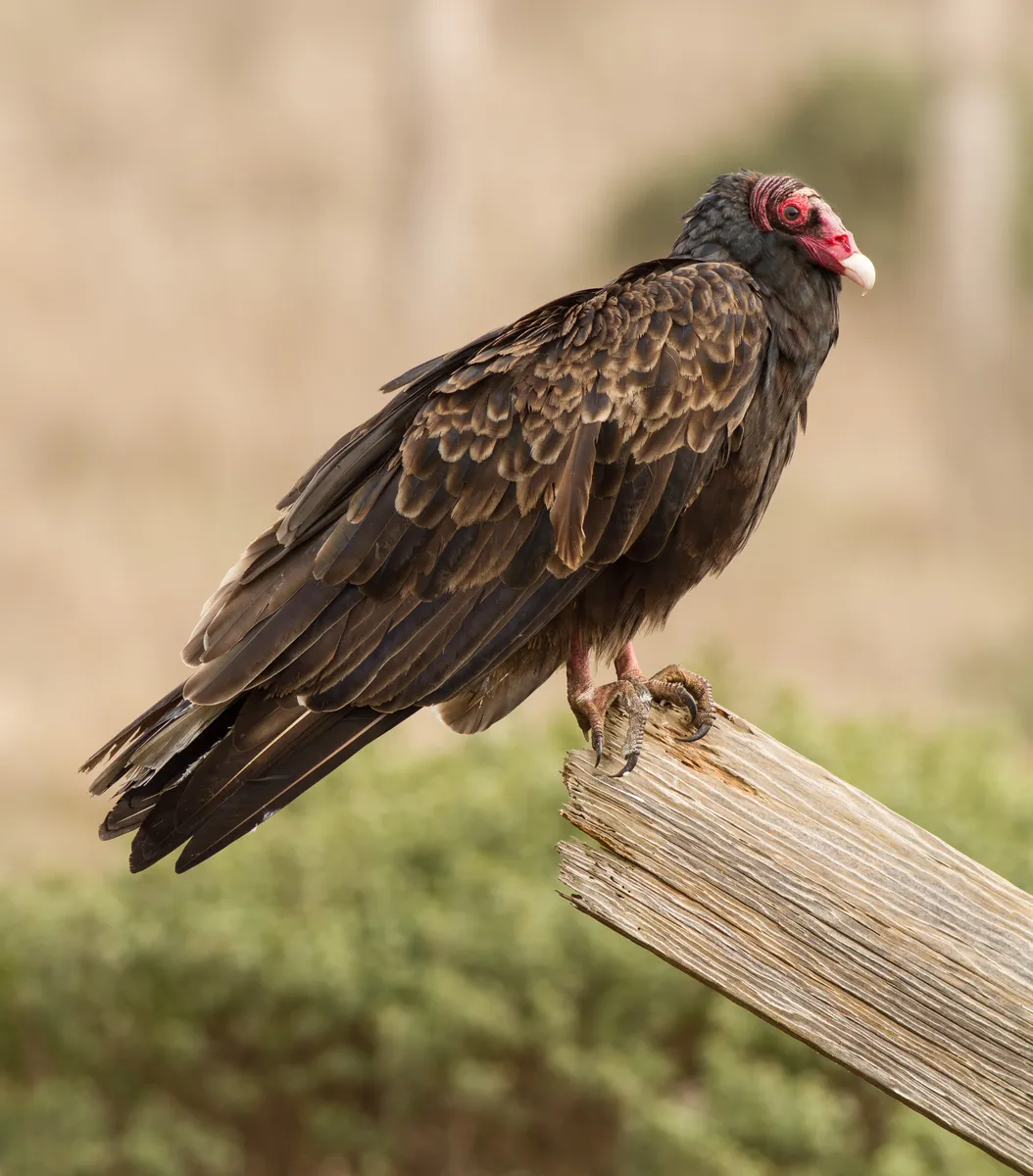
Urubu à tête rouge— Quebec wildlife
Cathartes aura
CathartidaeNo period published by Québec.ca
Québec.ca publishes no hunting or trapping period for this species. Check the official regulations.
Wikipedia
Urubu à tête rouge
The turkey vulture (Cathartes aura) is the most widespread of the New World vultures. One of three species in the genus Cathartes of the family Cathartidae, the turkey vulture ranges from southern Canada to the southernmost tip of South America. It inhabits a variety of open and semi-open areas, including subtropical forests, shrublands, pastures, and deserts. Like all New World vultures, it is not closely related to the Old World vultures of Europe, Africa, and Asia. However, the two groups strongly resemble each other due to convergent evolution. The turkey vulture is a scavenger and feeds almost exclusively on carrion. It finds its food using its keen eyes and sense of smell, flying low enough to detect the gasses produced by the early stages of decay in dead animals. In flight, it uses thermals to move through the air, flapping its wings infrequently. It roosts in large community groups. Lacking a syrinx—the vocal organ of birds—its only vocalizations are grunts or low hisses. It nests in caves, hollow trees, or thickets. Each year it generally raises two chicks, which it feeds by regurgitation. It has very few natural predators. In the United States, the vulture receives legal protection under the Migratory Bird Treaty Act of 1918.
Description
A large bird, it has a wingspan of 1.5–2 m (4.9–6.6 ft) a length of 62–81 cm (24–32 in), and weight of 0.8 to 2.41 kg (1.8 to 5.3 lb). Birds in the northern limit of the species' range average larger in size than the vulture from the neotropics. 124 birds from Florida averaged 2 kg (4.4 lb) while 65 and 130 birds from Venezuela were found to average 1.22 and 1.45 kg (2.7 and 3.2 lb), respectively. It displays minimal sexual dimorphism; sexes are identical in plumage and in coloration, and are similar in size. The body feathers are mostly brownish-black, but the flight feathers on the wings appear to be silvery-gray beneath, contrasting with the darker wing linings. The adult's head is small in proportion to its body and is red in color with few to no feathers. It also has a relatively short, hooked, ivory-colored beak. The irises of the eyes are gray-brown; legs and feet are pink-skinned, although typically stained white. The eye has a single incomplete row of eyelashes on the upper lid and two rows on the lower lid. The two front toes of the foot are long and have small webs at their bases. Tracks are large, between 9.5 and 14 cm (3.7 and 5.5 in) in length and 8.2 and 10.2 cm (3.2 and 4.0 in) in width, both measurements including claw marks. Toes are arranged in the classic, anisodactyl pattern. The feet are flat, relatively weak, and poorly adapted to grasping; the talons are also not designed for grasping, as they are relatively blunt. In flight, the tail is long and slim. The black vulture is relatively shorter-tailed and shorter-winged, which makes it appear rather smaller in flight than the turkey vulture, although the body masses of the two species are roughly the same.
Text from Wikipedia — Turkey vulture, revision 1370748557, CC BY-SA 4.0, retrieved 2026-09-04. Encyclopedic text reused under CC BY-SA 4.0. Sentences about hunting or regulation are removed: on this site, the rule comes from Québec.ca.
Other names
French
English
Presence in Quebec
- Origin
- Indigène
- Occurrence
- Régulier
- Population status
- Reproducteur
- Certainty
- Confirmé
Conservation
Québec.ca
Official periods
Source: Québec.ca — tables reproduced as published (retrieved 2026-08-30).
Regulations change. Always check Québec.ca before hunting or trapping.
Where this data comes from
This species is listed in an official government dataset. The identification and status shown in the data sheet are reproduced from it.
Source: List of Quebec’s vertebrate wildlife (LFVQ) — Ministère de l’Environnement, de la Lutte contre les changements climatiques, de la Faune et des Parcs. File LFVQ_25_03_2026.csv, retrieved 2026-08-30 · CC BY 4.0.
Measurements, habitat, diet and reproduction are not shown: no official source is attached to them yet.