
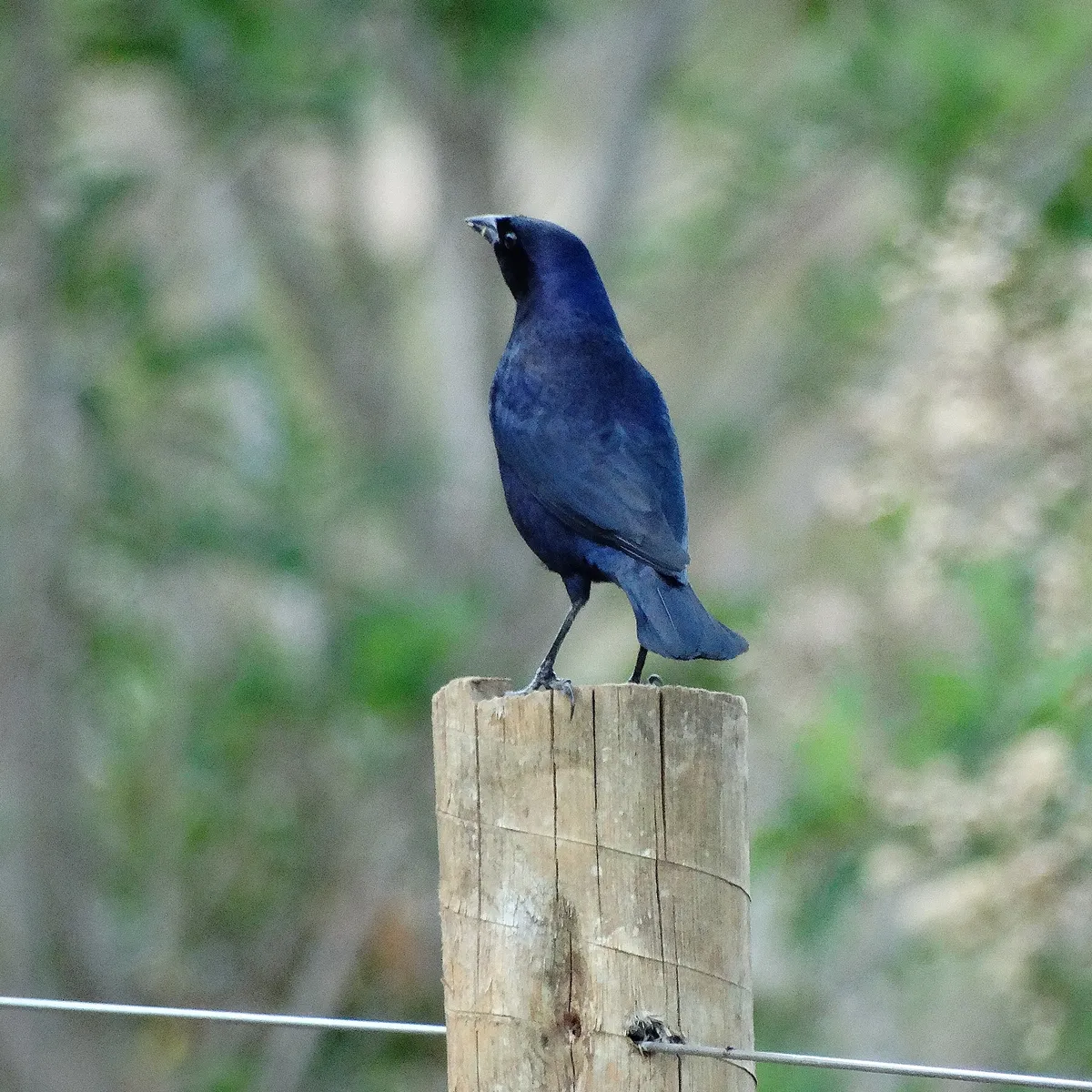
Vacher luisant— Quebec wildlife
Molothrus bonariensis
IcteridaeNo period published by Québec.ca
Québec.ca publishes no hunting or trapping period for this species. Check the official regulations.
Wikipedia
Vacher luisant
The shiny cowbird (Molothrus bonariensis) is a passerine bird in the New World family Icteridae. It breeds in most of South America except for dense forests and areas of high altitude such as mountains. Since 1900 the shiny cowbird's range has shifted northward, and it was recorded in the Caribbean islands as well as the United States, where it is found breeding in southern Florida. It is a bird associated with open habitats, including disturbed land from agriculture and deforestation. Adults are sexually dimorphic. Males are all black with a purple-blue iridescence. The female is smaller, with dull brown plumage that is sometimes paler on the underparts. Females of the species can be distinguished from the female brown-headed cowbird by their longer, finer bills and flatter heads. The shiny cowbird's diet consists mainly of insects, other arthropods and seeds, and they have been recorded foraging for grains in cattle troughs. Like most other cowbirds, it is an obligate brood parasite, laying its eggs in the nests of many other bird species such as the rufous-collared sparrow. Different host species show different responses to their nests being parasitised, with behaviours ranging from accepting and caring for the cowbird eggs, to rejecting the eggs from the nest. As the shiny cowbird is an effective generalist brood parasite, it can be considered the South American counterpart to the brown-headed cowbird.
Description
The physical appearance of the shiny cowbird adult depends on the subspecies. Sizes range from 31–40 grams (1.1–1.4 oz) in mass and 18 cm (7.1 in) in length (M. b. minimus), to 55–65 grams (1.9–2.3 oz) in mass and 22 cm (8.7 in) in length (M. b. cabanisii). Basic adult plumage for M. b. bonariensis is black with purple-blue iridescence for males, and dusty gray-brown for females. M. b. cabanisii males have plumage similar to M. b. bonariensis, while females are paler in colouration. M. b. aequatorialis males have violet iridescence and females are dark in colour. M. b. occidentalis males have rich purple iridescence, and females are distinct compared to the other subspecies as they have a pale upper body and very pale, streaked underparts. M. b. venezuelensis males look similar to M. b. occidentalis, and females dark in colour. M. b. minimus males look similar to M. b. bonariensis, and females have a darker head than M. b. bonariensis and have streaked scapulars and inter-scapulars. M. b. riparius males are similar to M. b. bonariensis, and the females have darker upper bodies and paler underparts than M. b. bonariensis. Upon hatching, shiny cowbirds are altricial and are confined to their nests. Hatchlings are covered in a gray down. Juvenile males are dark on their upper body, with dull dray underparts streaked with dark brown or black, and a buff abdomen. Females are a buff brown colour on top, with light buff, brown, or gray underparts that may or may not be streaked with brown.
Text from Wikipedia — Shiny cowbird, revision 1341025623, CC BY-SA 4.0, retrieved 2026-09-04. Encyclopedic text reused under CC BY-SA 4.0. Sentences about hunting or regulation are removed: on this site, the rule comes from Québec.ca.
Presence in Quebec
- Origin
- Indigène
- Occurrence
- Accidentel/non régulier
- Population status
- Migrateur
- Certainty
- Confirmé
Conservation
Québec.ca
Official periods
Source: Québec.ca — tables reproduced as published (retrieved 2026-08-30).
Regulations change. Always check Québec.ca before hunting or trapping.
Where this data comes from
This species is listed in an official government dataset. The identification and status shown in the data sheet are reproduced from it.
Source: List of Quebec’s vertebrate wildlife (LFVQ) — Ministère de l’Environnement, de la Lutte contre les changements climatiques, de la Faune et des Parcs. File LFVQ_25_03_2026.csv, retrieved 2026-08-30 · CC BY 4.0.
Measurements, habitat, diet and reproduction are not shown: no official source is attached to them yet.