
No period published by Québec.ca
Québec.ca publishes no hunting or trapping period for this species. Check the official regulations.
Wikipedia
Viréo à tête bleue
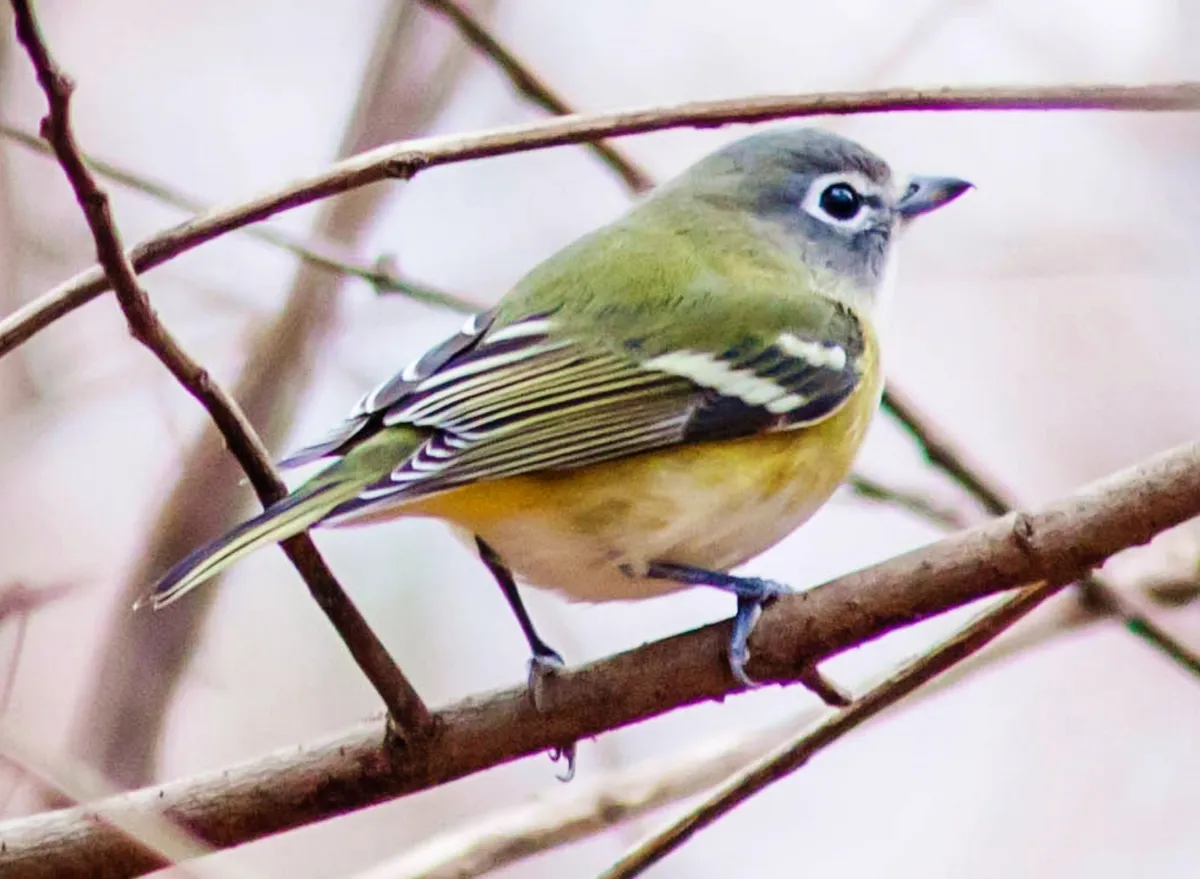
The blue-headed vireo (Vireo solitarius) is a migratory songbird found in North and Central America. There are currently two recognized subspecies that belong to the blue-headed vireo. It has a range that extends across Canada and the eastern coast of the United States, Mexico, and some of Central America. It prefers large temperate forests with a mix of evergreen trees and deciduous under growth. As the name suggests, the blue-headed vireo is characterized by its blue-grey head and bold yellow wing bars. Both sexes are very similar in plumage and size. Juveniles also have a similar plumage. Populations of the blue-headed vireo have been steadily increasing since the 1970s. Therefore, in 2004, the species was classified as a "Least Concern" species.
Description
The blue-headed vireo has similar plumage year round and does not drastically change its appearance during the breeding season. It can be characterized by its olive green upper body, two bold yellow wing bars down the edge of its wing, and a deep blue-grey crown from which it gets its name. The juvenile plumage of immature blue-headed vireos is not distinct but very similar to the adult plumage. While this bird's appearance is similar to the closely related Cassin's vireo (Vireo cassinii), the Cassin's vireo can be differentiated by its lighter yellow patches, a smaller, thinner bill, and a brownish-grey crown. There is little to no sexual dimorphism between males and females as both are similar in plumage colouration and size. Like most Vireos, the blue-headed vireo is a relatively small bird with a length of 126–148 mm (5.0–5.8 in). The wingspan is usually found to be around 200–240 mm (7.9–9.4 in) and their weight is typically 13–19 g (0.46–0.67 oz). There are some subtle differences between the V.s. solitarius and V.s. alticola subspecies. V.s. alticola, the larger of the two subspecies, has a darker back with a larger wing length of 76–83.5 mm (2.99–3.29 in) and a bill length of 11–12 mm (0.43–0.47 in). Conversely, V.s. solitarius is slightly smaller with a wing length of 69.2–77.8 mm (2.72–3.06 in), and a bill length of 8.9–11 mm (0.35–0.43 in). The average lifespan of the blue-headed vireo in the wild has been measured to be approximately 7 years and 5 months.
Text from Wikipedia — Blue-headed vireo, revision 1371443522, CC BY-SA 4.0, retrieved 2026-09-04. Encyclopedic text reused under CC BY-SA 4.0. Sentences about hunting or regulation are removed: on this site, the rule comes from Québec.ca.
Other names
French
English
Presence in Quebec
- Origin
- Indigène
- Occurrence
- Régulier
- Population status
- Reproducteur
- Certainty
- Confirmé
Conservation
Québec.ca
Official periods
Source: Québec.ca — tables reproduced as published (retrieved 2026-08-30).
Regulations change. Always check Québec.ca before hunting or trapping.
Where this data comes from
This species is listed in an official government dataset. The identification and status shown in the data sheet are reproduced from it.
Source: List of Quebec’s vertebrate wildlife (LFVQ) — Ministère de l’Environnement, de la Lutte contre les changements climatiques, de la Faune et des Parcs. File LFVQ_25_03_2026.csv, retrieved 2026-08-30 · CC BY 4.0.
Measurements, habitat, diet and reproduction are not shown: no official source is attached to them yet.