
No period published by Québec.ca
Québec.ca publishes no hunting or trapping period for this species. Check the official regulations.
Wikipedia
Viréo aux yeux blancs
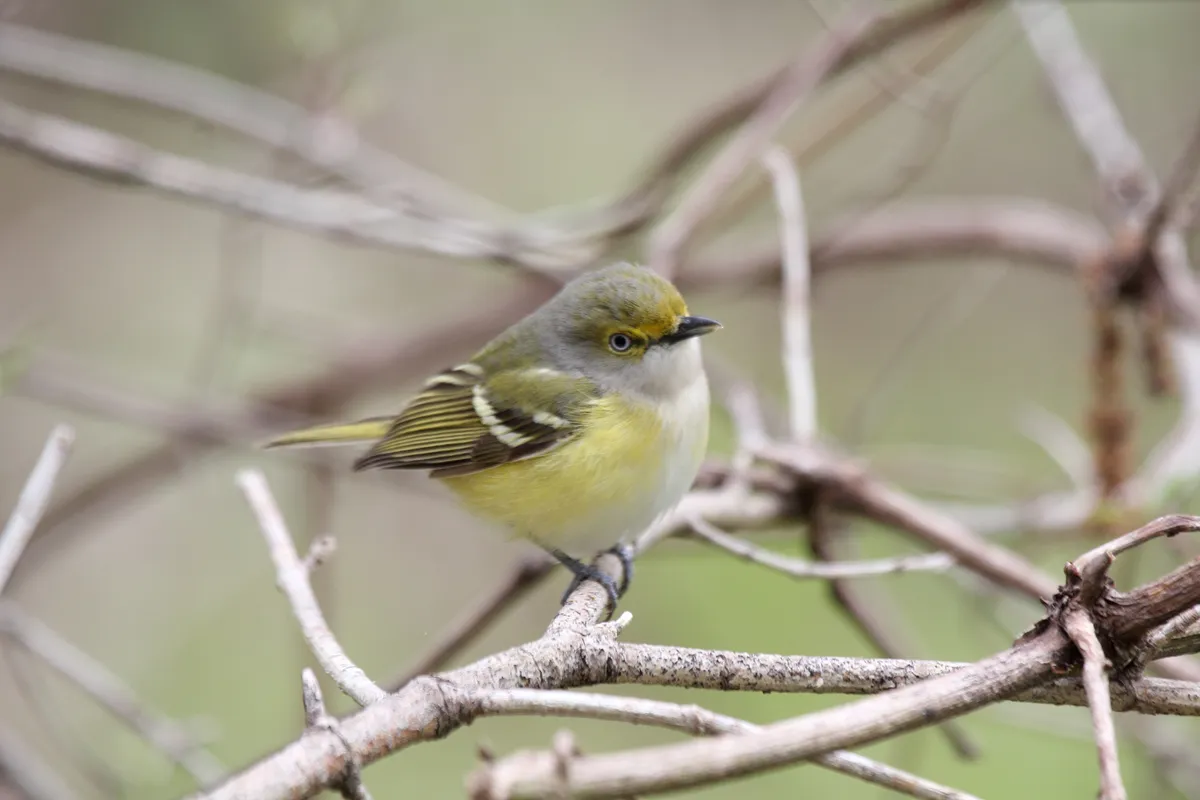
The white-eyed vireo (Vireo griseus) is a small songbird of the family Vireonidae.
Description
Measurements: Length: 4.3–5.1 in (11–13 cm) Weight: 0.3–0.5 oz (10–14 g) Wingspan: 6.7 in (17 cm) Its head and back are a greyish olive, and the underparts are white with yellow flanks. The wings and tail are dark, and there are two white wing bars on each wing. The eyes have white irises, and are surrounded by yellow spectacles. Sexes are similar.
Diet
During the breeding season, the diet of this species consists almost exclusively of insects, primarily caterpillars and stink bugs (Pentatomidae); beetles, flies, wasps, snails, and very rarely small vertebrates are also consumed. In the autumn and winter it supplements its diet of insects with berries.
Reproduction
They nest near the ground in tangled thickets. Nests are made of weeds, leaves, grass, bark or bits of trash. The grass-lined nest is a neat cup shape, attached to a fork in a tree branch by spider webs. It lays 3–5 dark-spotted white eggs. Both the male and female incubate the eggs for 12–16 days. The young leave the nest 9–11 days after hatching.
Text from Wikipedia — White-eyed vireo, revision 1362784499, CC BY-SA 4.0, retrieved 2026-09-04. Encyclopedic text reused under CC BY-SA 4.0. Sentences about hunting or regulation are removed: on this site, the rule comes from Québec.ca.
Other names
French
English
Presence in Quebec
- Origin
- Indigène
- Occurrence
- Accidentel/non régulier
- Population status
- Migrateur
- Certainty
- Confirmé
Conservation
Québec.ca
Official periods
Source: Québec.ca — tables reproduced as published (retrieved 2026-08-30).
Regulations change. Always check Québec.ca before hunting or trapping.
Where this data comes from
This species is listed in an official government dataset. The identification and status shown in the data sheet are reproduced from it.
Source: List of Quebec’s vertebrate wildlife (LFVQ) — Ministère de l’Environnement, de la Lutte contre les changements climatiques, de la Faune et des Parcs. File LFVQ_25_03_2026.csv, retrieved 2026-08-30 · CC BY 4.0.
Measurements, habitat, diet and reproduction are not shown: no official source is attached to them yet.