
No period published by Québec.ca
Québec.ca publishes no hunting or trapping period for this species. Check the official regulations.
Wikipedia
Viréo mélodieux
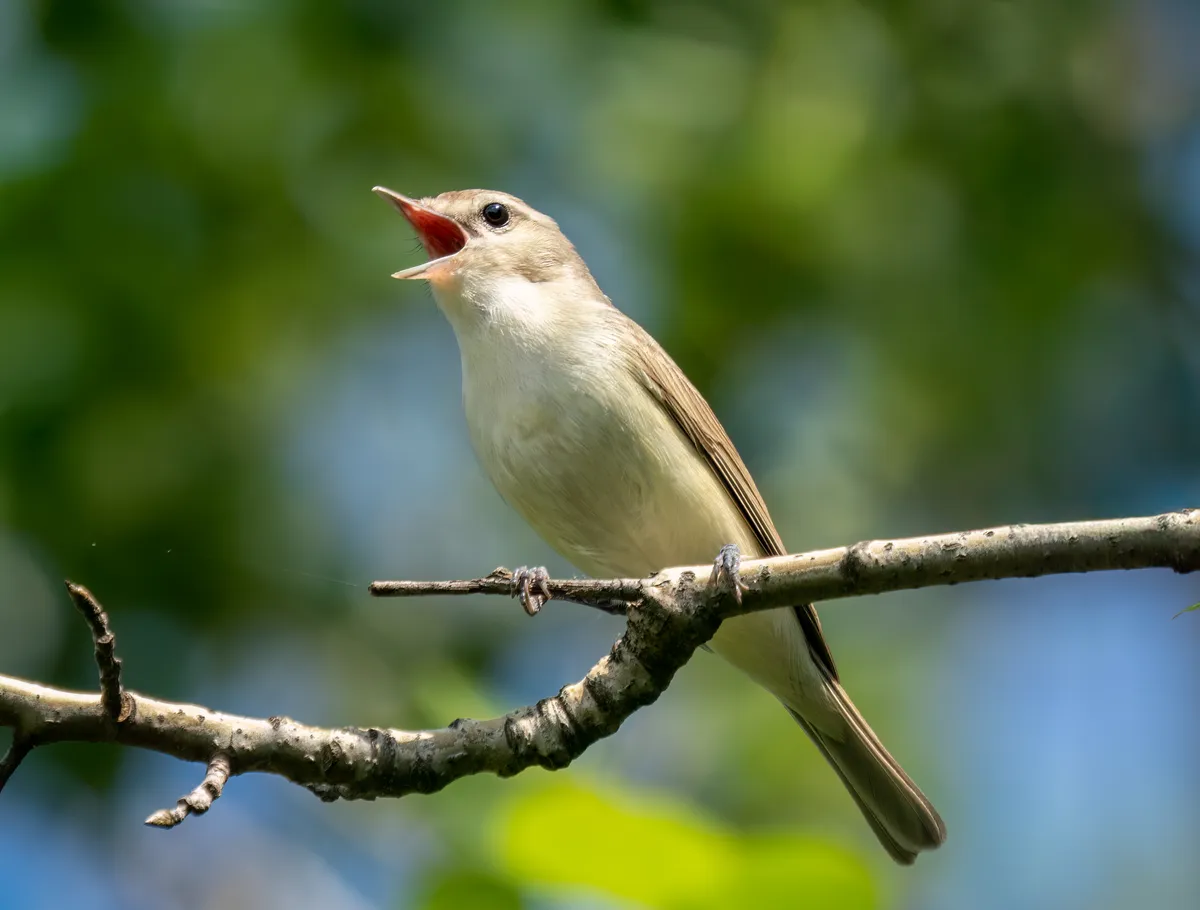
The warbling vireo (Vireo gilvus) is a small North American songbird. Its breeding habitat is open deciduous and mixed woods from Alaska to Mexico. It often nests in widely spaced trees, often cottonwood or aspen, along streams or rivers. It migrates to Mexico and Central America. Measurements: Length: 12–13 cm (4.7–5.1 in) Wingspan: 22 cm (8.7 in) Weight: 10–16 g (0.35–0.56 oz) They are mainly olive-grey on the head and upperparts with white underparts; they have brown eyes and the front of the face is light. There is a white supercilium. They have thick blue-grey legs and a stout bill. Western birds are generally smaller and have darker grey crowns. Warbling vireos forage for insects in trees, hopping along branches and sometimes hovering. They also eat berries, especially before migration and in winter quarters, where they are, like other vireos, apparently quite fond of gumbo-limbo seeds, though they will not venture into human-modified habitat to get them. They make a deep cup nest suspended from a tree branch or shrub, placed relatively high in the east and lower in the west. The male helps with incubation and may sing from the nest. The song is a cheerful warble, similar to that of the painted bunting and the purple finch. There are subtle differences in song between eastern and western birds, at least where the ranges meet in Alberta. Some authors recommend splitting the eastern and western subspecies of this species into separate species, and as of 2025, the eBird/Clements taxonomy split the two into separate species. The eastern warbling vireo, V. g. gilvus, breeds from central Alberta and northern Montana east and south through most of the United States and parts of southern Canada, outside the range of the previous group. It winters south of the Isthmus of Tehuantepec from south-central Chiapas to Nicaragua. It completes its autumn moult on the breeding grounds, while the swainsonii group completes it after leaving. The western warbling vireo, V. swainsoni, includes V. g. swainsoni, which breeds from southeastern Alaska and southwestern Northwest Territories to the Sierra San Pedro Mártir, Baja California, and V. g. brewsteri, which breeds from southern Idaho, Wyoming, and Montana to south-central Oaxaca. These two subspecies winter in Mexico. The swainsoni group also includes V. g. victoriae, an isolated population breeding in the Sierra de la Laguna, Baja California Sur, and migrating to unknown wintering grounds. The brown-capped vireo (Vireo leucophrys), resident in Central America and northern South America, is sometimes considered conspecific with the warbling vireo.
Text from Wikipedia — Warbling vireo, revision 1350380506, CC BY-SA 4.0, retrieved 2026-09-04. Encyclopedic text reused under CC BY-SA 4.0. Sentences about hunting or regulation are removed: on this site, the rule comes from Québec.ca.
Other names
French
English
Presence in Quebec
- Origin
- Indigène
- Occurrence
- Régulier
- Population status
- Reproducteur
- Certainty
- Confirmé
Conservation
Québec.ca
Official periods
Source: Québec.ca — tables reproduced as published (retrieved 2026-08-30).
Regulations change. Always check Québec.ca before hunting or trapping.
Where this data comes from
This species is listed in an official government dataset. The identification and status shown in the data sheet are reproduced from it.
Source: List of Quebec’s vertebrate wildlife (LFVQ) — Ministère de l’Environnement, de la Lutte contre les changements climatiques, de la Faune et des Parcs. File LFVQ_25_03_2026.csv, retrieved 2026-08-30 · CC BY 4.0.
Measurements, habitat, diet and reproduction are not shown: no official source is attached to them yet.