
Aucune période publiée par Québec.ca
Québec.ca ne publie aucune période de chasse ou de piégeage pour cette espèce. Consultez la réglementation officielle.
Wikipédia
Viréo à tête noire
The black-capped vireo (Vireo atricapilla) is a small bird native to the United States and Mexico. It was listed as an endangered species in the United States in 1987. It is the only Vireo that is sexually dichromatic. Recovery of the species' population contributed to its delisting in 2018. The IUCN lists the species as "near threatened."
Description
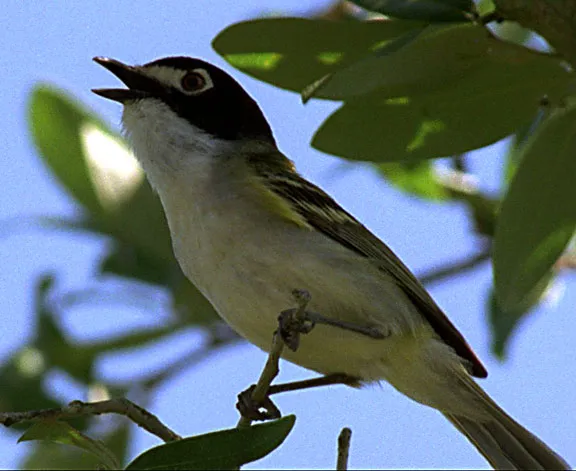
The black-capped vireo is a songbird about 12 cm (4.5 inches ) in length. Sexually mature males are olive green above and white below with faint yellow flanks. The crown and upper half of the head is black with a partial white eye ring and lores. The iris is brownish-red and the bill is black. Females are duller in color than males and have a slate-gray crown and underparts washed with greenish yellow. First-year males often have more extensive gray in the cap, similar to adult females.
Habitat and range
The historic breeding distribution of the black-capped vireo extended south from south-central Kansas through central Oklahoma and Texas to central Coahuila, Mexico. At present, the range extends from Oklahoma south through the Edwards Plateau and Big Bend National Park, Texas, to at least the Sierra Madera in central Coahuila, and south to southwestern Tamaulipas. In Oklahoma, the black-capped vireo is found only in Blaine, Cleveland, Cotton and Comanche Counties. It winters along the west coast of Mexico from southern Sonora to Guerrero.
Texte tiré de Wikipédia — Black-capped vireo, révision 1357073487, CC BY-SA 4.0, relevé le 2026-09-04. Texte encyclopédique repris sous licence CC BY-SA 4.0. Les phrases touchant la chasse ou la réglementation sont retirées : sur ce site, la règle vient de Québec.ca.
Présence au Québec
- Origine
- Indigène
- Régularité
- Accidentel/non régulier
- Statut des populations
- Migrateur
- Degré de certitude
- Confirmé
Conservation
Québec.ca
Périodes officielles
Source : Québec.ca — tableaux reproduits tels que publiés (relevé du 2026-08-30).
La réglementation change. Vérifiez toujours Québec.ca avant de chasser ou de piéger.
Provenance des données
Cette espèce figure dans un jeu de données gouvernemental officiel. L’identification et le statut de la fiche technique en sont repris.
Source : Liste de la faune vertébrée du Québec (LFVQ) — ministère de l’Environnement, de la Lutte contre les changements climatiques, de la Faune et des Parcs. Fichier LFVQ_25_03_2026.csv, relevé le 2026-08-30 · CC BY 4.0.
Les mesures, l’habitat, l’alimentation et la reproduction ne sont pas affichés : aucune source officielle n’y est encore rattachée.