
Hunting periods published by Québec.ca
Official tables below — zones, gear and dates.
Wikipedia
Loup gris
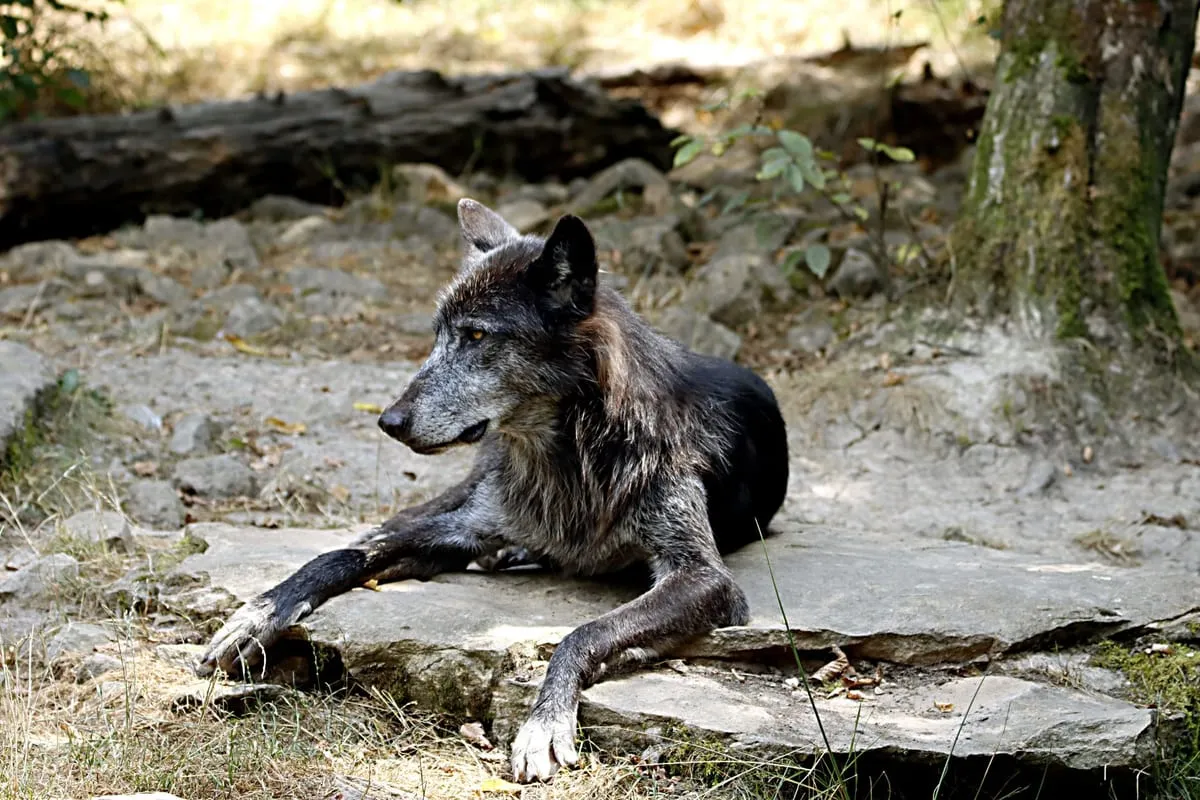
The wolf (Canis lupus; pl.: wolves), also known as the grey wolf or gray wolf, is a canine native to Eurasia and North America. More than thirty subspecies of Canis lupus have been recognized, including the dog and dingo, though grey wolves, as popularly understood, include only naturally occurring wild subspecies. The wolf is the largest wild extant member of the family Canidae, and is further distinguished from other Canis species by its less pointed ears and muzzle, as well as a shorter torso and a longer tail. The wolf is nonetheless related closely enough to smaller Canis species, such as the coyote and the golden jackal, to produce fertile hybrids with them. The wolf's fur is usually mottled white, brown, grey, and black, although subspecies in the arctic region may be nearly all white. It travels in nuclear families, consisting of a mated pair accompanied by their offspring. Offspring may leave to form their own packs on the onset of sexual maturity and in response to competition for food within the pack. Wolves are also territorial, and fights over territory are among the principal causes of mortality. A carnivore, the wolf is an apex predator that feeds on large wild hooved mammals as well as smaller animals, livestock, carrion, and garbage. Pathogens and parasites, notably the rabies virus, may infect wolves. The global wild grey wolf population is estimated to be between 200,000 and 250,000 individuals as of 2026 and has been assessed as Least Concern by the International Union for Conservation of Nature (IUCN). Although the fear of wolves exists in many human societies, the majority of recorded attacks on people have been attributed to animals suffering from rabies.
Description
The wolf is the largest extant member of the family Canidae, and is further distinguished from coyotes and jackals by a broader snout, shorter ears, a shorter torso and a longer tail. It is slender and powerfully built, with a large, deeply descending rib cage, a sloping back, and a heavily muscled neck. The wolf's legs are moderately longer than those of other canids, which enables the animal to move swiftly, and to overcome the deep snow that covers most of its geographical range in winter, though more short-legged ecomorphs are found in some wolf populations. The ears are relatively small and triangular. The wolf's head is large and heavy, with a wide forehead, strong jaws and a long, blunt muzzle. The skull is 230–280 mm (9.1–11.0 in) in length and 130–150 mm (5.1–5.9 in) in width. The teeth are heavy and large, making them better suited to crushing bone than those of other canids, though they are not as specialized as those found in hyenas. Its molars have a flat chewing surface, but not to the same extent as the coyote, whose diet contains more vegetable matter.
Text from Wikipedia — Wolf, revision 1368893596, CC BY-SA 4.0, retrieved 2026-09-04. Encyclopedic text reused under CC BY-SA 4.0. Sentences about hunting or regulation are removed: on this site, the rule comes from Québec.ca.
Other names
French
English
Presence in Quebec
- Origin
- Indigène
- Occurrence
- Régulier
- Population status
- Toute l'année
- Certainty
- Confirmé
Conservation
Québec.ca
Official periods
Source: Québec.ca — tables reproduced as published (retrieved 2026-08-30).
Hunting
Coyote and wolf
| Zone where hunting is permitted | Gear | 2026-2027 hunting season | 2027-2028 hunting season |
|---|---|---|---|
| 1, 2, 3, 4, 5, 6, 7, 8, 9, 10, 11, 15, 26, 27 | Firearms, crossbow and bow | From October 25, 2026 to March 31, 2027 | From October 25, 2027 to March 31, 2028 |
| 12, 13, 14, 16, 18, 21, 28 | Firearms, crossbow and bow | From October 18, 2026 to March 31, 2027 | From October 18, 2027 to March 31, 2028 |
| 19 South, 29 | Firearms, crossbow and bow | From October 18, 2026 to April 15, 2027 | From October 18, 2027 to April 15, 2028 |
Trapping
Coyote, wolf, Arctic fox and red fox
| UGAF | Periods |
|---|---|
| 1, 2, 3, 4, 5, 6, 7, 11, 13, 17, 20, 21, 29, 30, 31, 32, 33, 34, 35, 38, 39, 41, 42, 43, 44, 45, 46, 47, 48, 49, 50, 51, 52, 53 | From October 18 to March 1 |
| 8, 9, 10, 12, 14, 15, 16, 18, 19, 22, 23, 24, 25, 26, 27, 28, 36, 37, 40, 70, 71, 72, 73, 74, 75, 76, 77, 78, 79, 80, 81, 82, 83, 84, 85, 86 | From October 25 to March 1 |
| 54, 55, 56, 57, 58, 59, 60, 61, 62, 63, 64, 65, 66 | From October 18 to March 15 |
| 68 | From October 18 to March 15 |
| 69 | From December 15 to December 31 |
Zones where hunting is permitted
Zone numbers listed in the tables above. Each links to the official zone map (PDF).
Regulations change. Always check Québec.ca before hunting or trapping.
Where this data comes from
This species is listed in an official government dataset. The identification and status shown in the data sheet are reproduced from it.
Source: List of Quebec’s vertebrate wildlife (LFVQ) — Ministère de l’Environnement, de la Lutte contre les changements climatiques, de la Faune et des Parcs. File LFVQ_25_03_2026.csv, retrieved 2026-08-30 · CC BY 4.0.
Measurements, habitat, diet and reproduction are not shown: no official source is attached to them yet.