
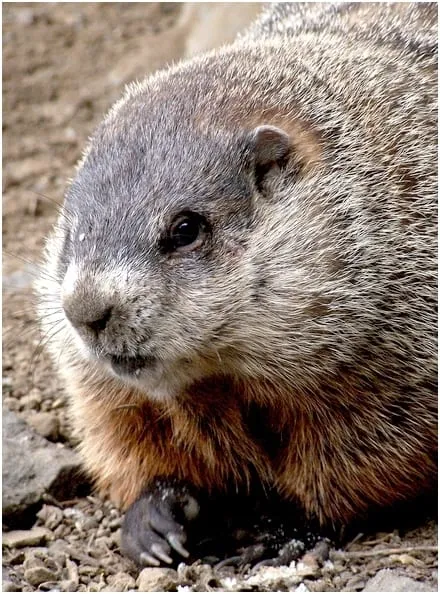
Marmotte commune— species and hunting in Quebec
Marmota monax
SciuridaeHunting periods published by Québec.ca
Official tables below — zones, gear and dates.
Wikipedia
Marmotte commune
The groundhog (Marmota monax), also known as the woodchuck, is a rodent of the family Sciuridae, belonging to the group of large ground squirrels known as marmots. A lowland creature of North America, it is found through much of the Eastern United States, across Canada and into Alaska. It was given its scientific name as Mus monax by Carl Linnaeus in 1758, based on a description of the animal by George Edwards, published in 1743. The groundhog, being a lowland animal, is exceptional among marmots. Other marmots, such as the yellow-bellied and hoary marmots, live in rocky and mountainous areas. Groundhogs are considered one of the most solitary of marmot species. They live in aggregations, and their social organization and long-term pair bonds varies across populations. The groundhog's male and female interactions are usually limited to the mating season and copulation. However, certain populations of groundhogs have been observed to form long-term adult male-female association throughout the year, and often from year to year. The groundhog is an important contributor to the maintenance of healthy soil in woodlands and plains; as such, the species is considered a crucial habitat engineer. The groundhog is an extremely intelligent animal, forming complex social networks and kinship with its young; it is capable of understanding social behavior, communicating threats through whistling, and working cooperatively to accomplish tasks such as burrowing.
Description
The groundhog is the largest sciurid in its geographical range, excluding its presence in British Columbia where its range may be comparable to that of its somewhat larger cousin, the hoary marmot. Adults may measure from 41.8 to 68.5 cm (16+7⁄16 to 26+15⁄16 in) in total length, including a tail of 9.5 to 18.7 cm (3+3⁄4 to 7+3⁄8 in). Weights of adult groundhogs typically fall between 2 and 6.3 kg (4 lb 7 oz and 13 lb 14 oz). Male groundhogs are slightly larger than females on average and, like all marmots, they are considerably heavier during autumn (when engaged in autumn hyperphagia) than when they emerge from hibernation in spring. Adult males average year-around weight 3.83 kg (8 lb 7 oz), with spring to fall average weights of 3.1 to 5.07 kg (6 lb 13 oz to 11 lb 3 oz) while females average 3.53 kg (7 lb 13 oz), with spring to fall averages of 3.08 to 4.8 kg (6 lb 13 oz to 10 lb 9 oz). Seasonal weight changes reflect circannual deposition and use of fat. Groundhogs attain progressively higher weights each year for the first two or three years, after which weight plateaus. Groundhogs have four incisors, which grow 1.5 millimetres (1⁄16 in) per week. Constant usage wears them down by about that much each week. Unlike the incisors of many other rodents, the incisors of groundhogs are white to ivory-white. Groundhogs are well-adapted for digging, with powerful, short legs and broad, long claws. The groundhog's tail is shorter than that of other Sciuridae—only about one-fourth of body length.
Text from Wikipedia — Groundhog, revision 1373046209, CC BY-SA 4.0, retrieved 2026-09-04. Encyclopedic text reused under CC BY-SA 4.0. Sentences about hunting or regulation are removed: on this site, the rule comes from Québec.ca.
Other names
French
English
Presence in Quebec
- Origin
- Indigène
- Occurrence
- Régulier
- Population status
- Toute l'année
- Certainty
- Confirmé
Conservation
Québec.ca
Official periods
Source: Québec.ca — tables reproduced as published (retrieved 2026-08-30).
Hunting
Woodchuck
| Zone where hunting is permitted | Gear | 2026-2027 hunting season | 2027-2028 hunting season |
|---|---|---|---|
| 1, 2, 3, 4, 5, 6, 7, 8, 9, 10, 11, 12, 13, 14, 15, 16, 18, 19 south, 21, 26, 27, 28, 29 | Firearms, crossbow and bow | All year | All year |
Zones where hunting is permitted
Zone numbers listed in the tables above. Each links to the official zone map (PDF).
Regulations change. Always check Québec.ca before hunting or trapping.
Where this data comes from
This species is listed in an official government dataset. The identification and status shown in the data sheet are reproduced from it.
Source: List of Quebec’s vertebrate wildlife (LFVQ) — Ministère de l’Environnement, de la Lutte contre les changements climatiques, de la Faune et des Parcs. File LFVQ_25_03_2026.csv, retrieved 2026-08-30 · CC BY 4.0.
Measurements, habitat, diet and reproduction are not shown: no official source is attached to them yet.