
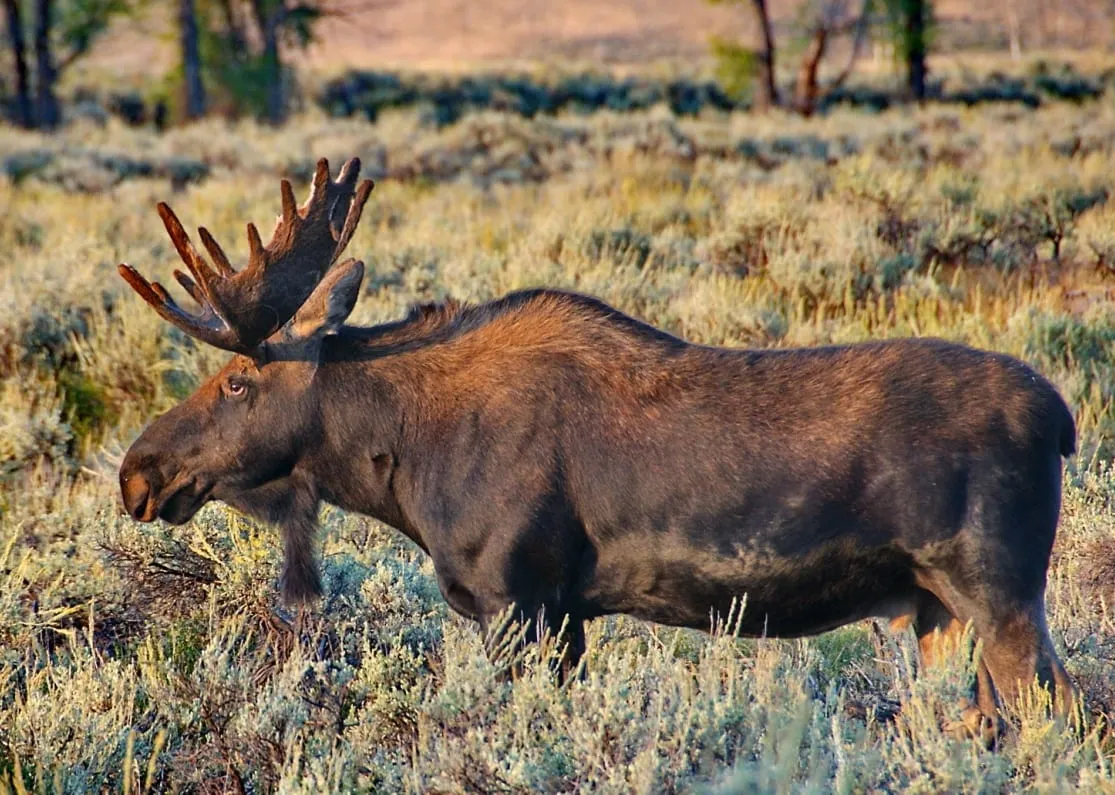
Orignal— species and hunting in Quebec
Alces alces
CervidaeHunting periods published by Québec.ca
Official tables below — zones, gear and dates.
Wikipedia
Orignal
The moose (pl.: moose; used in North America) or elk (pl.: elk or elks; used in Eurasia) (Alces alces) is the world's tallest, largest and heaviest extant species of deer and the only extant species in the genus Alces. It is also the tallest, and the second-largest, land animal in North America, falling short only to the American bison in body mass. Most adult male moose have broad, palmate ("open-hand shaped") antlers; other members of the deer family have pointed antlers with a dendritic ("twig-like") configuration. Moose inhabit the circumpolar boreal forests or temperate broadleaf and mixed forests of the Northern Hemisphere, thriving in cooler, temperate areas as well as subarctic climates. Prior to the early modern period (around 1600–1700), moose were one of many valuable sources of sustenance for certain North American Indians. The moose has been reintroduced to some of its former habitats. Currently, the greatest populations occur in Canada. Additionally, substantial numbers are found in Alaska, the northern states of the contiguous United States, Fennoscandia, the Baltic states, the Caucasus region, Poland, Eastern Europe, Mongolia, Kazakhstan, and Russia. Predominantly a browser, the moose's diet consists of both terrestrial and aquatic vegetation, depending on the season, with branches, twigs and dead wood making up a large portion of their winter diet. Predators of moose include wolves, bears, humans, wolverines (rarely, though may take calves), and (rarely, if swimming in the ocean) orcas. Unlike most other deer species, moose do not form herds and are solitary animals, aside from calves who remain with their mother until the cow begins estrus again (typically 18 months after the birth of a calf). At this point, the cow chases her calf away. Although generally slow-moving and sedentary, moose can become defensively aggressive, and move very quickly if angered or startled. Their mating season in the autumn features energetic fights between males competing for a female. Moose have played a prominent role in the culture of people in the Northern Hemisphere.
Description
On average, an adult moose stands 1.4–2.1 m (4.6–6.9 ft) high at the shoulder, which is more than 30 cm (1 ft) higher than the next-largest deer on average, the wapiti. The tail is short (6–8 cm (2.4–3.1 in) in length) and vestigial in appearance; unlike other ungulates the moose tail is too short to swish away insects. Males (or "bulls") normally weigh from 380 to 700 kg (838 to 1,543 lb) and females (or "cows") typically weigh 200 to 490 kg (441 to 1,080 lb), depending on racial or clinal as well as individual age or nutritional variations. The head-and-body length is 2.4–3.1 m (7 ft 10 in – 10 ft 2 in), with the vestigial tail adding only a further 5–12 cm (2–4+1⁄2 in). The largest of all the races is the Alaskan subspecies (A. a.
Text from Wikipedia — Moose, revision 1373196807, CC BY-SA 4.0, retrieved 2026-09-04. Encyclopedic text reused under CC BY-SA 4.0. Sentences about hunting or regulation are removed: on this site, the rule comes from Québec.ca.
Other names
French
Former scientific names
Presence in Quebec
- Origin
- Indigène
- Occurrence
- Régulier
- Population status
- Toute l'année
- Certainty
- Confirmé
Conservation
Québec.ca
Official periods
Source: Québec.ca — tables reproduced as published (retrieved 2026-08-30).
Hunting
Crossbow and bow hunting seasons
| Zone where hunting is permitted | Segment | 2026 hunting season | 2027 hunting season |
|---|---|---|---|
| 1, 2, 10 West, 11 West, 15 | Moose with antlers | From September 26 to October 4, 2026 | From September 25 to October 3, 2027 |
| 13 | Moose | From September 26 to October 4, 2026 | From September 25 to October 3, 2027 |
| 3, 4, 5, 6, 8, 9 | Moose with antlers | From October 3 to October 9, 2026 | From October 2 to October 8, 2027 |
| 7 | Moose with antlers | From October 3 to October 16, 2026 | From October 2 to October 15, 2027 |
| 10 East, 11 East | Moose with antlers | From September 26 to October 12, 2026 | From September 25 to October 11, 2027 |
| 12, 14, 26, 27 | Moose with antlers | From September 19 to October 4, 2026 | From September 18 to October 3, 2027 |
| 16 | Moose with antlers | From September 12 to September 20, 2026 | From September 11 to September 19, 2027 |
| 18, 28 | 2026 Moose with antlers 2027 Moose | From September 12 to September 20, 2026 | From September 11 to September 19, 2027 |
| Northwest part of 19 South | Moose | From August 29 to September 6, 2026 | From August 28 to September 5, 2027 |
| East partand west part of 19 South (except the northwest part), 29 | Moose | From September 5 to September 13, 2026 | From September 4 to September 12, 2027 |
Hunting
Bow hunting seasons
| Zone where hunting is permitted | Segment | 2026 hunting season | 2027 hunting season |
|---|---|---|---|
| 22 | Moose with antlers | From September 5 to September 13, 2026 | From September 4 to September 12, 2027 |
Hunting
Firearms, crossbow and bow hunting seasons
| Zone where hunting is permitted | Segment | 2026 hunting season | 2027 hunting season |
|---|---|---|---|
| 1, 2 (except the Macpès and Duquesne townships), 3, 4 | Moose with antlers | From October 17 to October 25, 2026 | From October 16 to October 24, 2027 |
| 10 West, 11 West, 15 | Moose with antlers | From October 10 to October 18, 2026 | From October 9 to October 17, 2027 |
| 12, 14, 26, 27 | Moose with antlers | From October 10 to October 25, 2026 | From October 9 to October 24, 2027 |
| 13 | 2026 Moose with antlers 2027 Moose | From October 10 to October 25, 2026 | From October 9 to October 24, 2027 |
| 16 | Moose with antlers | From September 26 to October 16, 2026 | From September 25 to October 15, 2027 |
| 28 | 2026 Moose with antlers 2027 Moose | From September 26 to October 16, 2026 | From September 25 to October 15, 2027 |
| 18 | 2026 Moose with antlers 2027 Moose | From September 26 to October 12, 2026 | From September 25 to October 11, 2027 |
| East part of 19 South | Moose | From September 19 to November 1, 2026 | From September 18 to October 31, 2027 |
| West part of 19 South (except the northwest part), 29 | Moose | From September 19 to October 18, 2026 | From September 18 to October 17, 2027 |
| Northwest part of 19 South | Moose | From September 12 to October 12, 2026 | From September 11 to October 11, 2027 |
| 22 | Moose with antlers | From September 19 to October 12, 2026 | From September 18 to October 11, 2027 |
Hunting
Crossbow and bow hunting seasons
| Zec | Segment | 2026 hunting season | 2027 hunting season |
|---|---|---|---|
| Batiscan-Neilson | Moose with antlers | From September 19 to September 27, 2026 | From September 18 to September 26, 2027 |
| Des Martres | Moose with antlers | From September 19 to September 27, 2026 | From September 18 to September 26, 2027 |
| Dumoine | Moose with antlers | From September 26 to October 4, 2026 | From September 25 to October 3, 2027 |
| Jeanotte | Moose with antlers | From Septembre 19 to Octobre 4, 2026 | From September 18 to October 3, 2027 |
| Kipawa | Moose | From September 26 to October 4, 2026 | From September 25 to October 3, 2027 |
| Maganasipi | Moose with antlers | From September 26 to October 4, 2026 | From September 25 to October 3, 2027 |
| Restigo | Moose with antlers | From September 26 to October 4, 2026 | From September 25 to October 3, 2027 |
| Rivière-Blanche | Moose with antlers | From September 19 to September 27, 2026 | From September 18 to September 26, 2027 |
Hunting
Firearms, crossbow and bow hunting seasons
| Zec | Segment | 2026 hunting season | 2027 hunting season |
|---|---|---|---|
| Batiscan-Neilson | Moose with antlers | From October 10 to October 18, 2026 | From October 9 to October 17, 2027 |
| Des Martres | Moose with antlers | From October 10 to October 22, 2026 | From October 9 to October 21, 2027 |
| Dumoine | Moose with antlers | From October 10 to October 18, 2026 | From October 9 to October 17, 2027 |
| Jeanotte | Moose with antlers | From October 10 to October 18, 2026 | From October 9 to October 17, 2027 |
| Kipawa | 2026 Moose with antlers 2027 Moose | From October 10 to October 18, 2026 | From October 9 to October 17, 2027 |
| Maganasipi | Moose with antlers | From October 10 to October 18, 2026 | From October 9 to October 17, 2027 |
| Restigo | Moose with antlers | From October 10 to October 18, 2026 | From October 9 to October 17, 2027 |
| Rivière-Blanche | Moose with antlers | From October 10 to October 15, 2026 | From October 9 to October 14, 2027 |
Zones where hunting is permitted
Zone numbers listed in the tables above. Each links to the official zone map (PDF).
Regulations change. Always check Québec.ca before hunting or trapping.
SIT Québec register
Outfitters hunting this species
457 outfitters list this species among the game they hunt.
On this site
Related articles
Explore everything you need to know about Quebec moose hunting, including hunting zones, seasons, techniques, and calling methods.
Learn about the draw process for female moose hunting in Quebec, including regulations, zones, and practical tips.
Where this data comes from
This species is listed in an official government dataset. The identification and status shown in the data sheet are reproduced from it.
Source: List of Quebec’s vertebrate wildlife (LFVQ) — Ministère de l’Environnement, de la Lutte contre les changements climatiques, de la Faune et des Parcs. File LFVQ_25_03_2026.csv, retrieved 2026-08-30 · CC BY 4.0.
Measurements, habitat, diet and reproduction are not shown: no official source is attached to them yet.